 United States
“Hickey & Boggs is the only theatrical film Culp directed, but it is a film of value, long neglected to the point of being forgotten.”
Cineaste
Cineaste
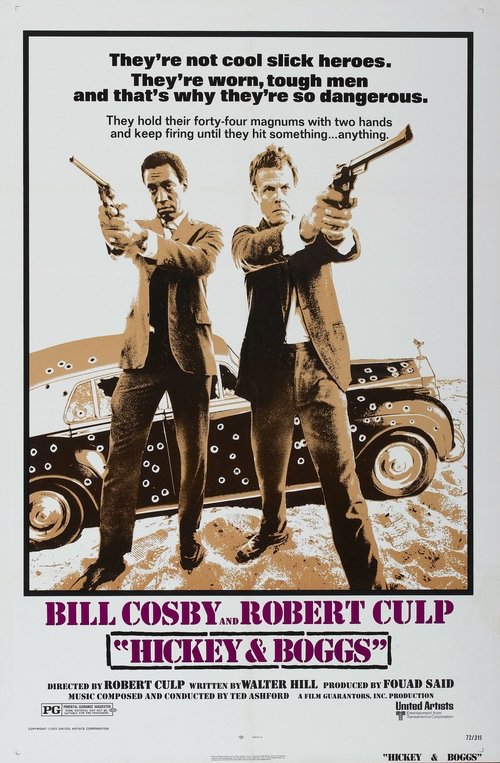
In 1972, Robert Culp stepped behind the camera for the first and only time to direct a gritty neo-noir that paired him with his I Spy co-star Bill Cosby. The film, Hickey & Boggs, casts them as two weary private detectives in Los Angeles who take on a seemingly routine missing person case. That case quickly unravels into a violent tangle of murder, double-crosses, and a suitcase full of stolen money, pulling the partners into a criminal web that threatens to consume them.
Culp and Cosby share the screen with a supporting cast that includes Rosalind Cash as Nyona, a woman with secrets of her own, and Ta-Ronce Allen as her young daughter. The script comes from Walter Hill, who would go on to write and direct such tough-minded action films as The Warriors and 48 Hrs. Hill's fingerprints are all over this story, which trades in betrayal and hard-boiled dialogue. Shot on a modest budget of about $1 million, the film was released by United Artists on October 4, 1972, and has since become a cult favorite among fans of 1970s crime cinema.
Buy
Availability and pricing can change. Confirm on the provider's site before purchasing.
Los Angeles in the early 1970s feels sunbaked and morally exhausted. Al Hickey (Bill Cosby) and Frank Boggs (Robert Culp) are two jaded private investigators who once worked together but have drifted apart. A lawyer (Lou Frizzell) pulls them back into partnership with a simple assignment: find a missing woman named Mary Jane. The case seems routine, but nothing about it stays simple for long.
Hickey carries visible weariness, haunted by failures both professional and private. Boggs is similarly worn down, his marriage to Edith (Sheila Sullivan) crumbling under his cynicism. The two are not friends in any warm sense. They are colleagues bound by habit and shared history, with few other options.
As they begin digging, the case spirals outward. Mary Jane's disappearance connects to a suitcase full of money stolen from a Pittsburgh bank robbery. The money has passed through many hands, and everyone who touches it ends up dead. Hickey and Boggs find themselves pursued by mob hitmen, harassed by police, and caught in a web of double-crosses where trust is a luxury neither can afford.
The investigation leads them through a series of increasingly dangerous encounters across the city. They meet Nyona (Rosalind Cash), a woman with her own secrets, and her young daughter (Ta-Ronce Allen). Nyona's mother (Isabel Sanford) adds another layer of complication. The detectives also cross paths with a used car salesman (Bernard Nedell), a florist named Quemando (Ron Henriquez), and a host of minor players who each seem to know more than they say.
Walter Hill's script, his first produced screenplay, is laced with hard-boiled dialogue that exposes the men's shared history and resentments. Boggs at one point cruelly taunts Hickey about a woman from his past, cutting to the heart of Hickey's private torment. The partnership is not a buddy-comedy pairing; it is a marriage of convenience between two broken men with nothing left but the job.
The central conflict emerges as Hickey and Boggs realize Mary Jane is not merely a victim but a participant in a larger criminal scheme. The suitcase of money has made everyone paranoid and violent. The detectives navigate a landscape where the police are either corrupt or indifferent, and every lead seems to end in another body.
The film's tone is relentlessly bleak. Unlike the buddy-cop films that would follow, Hickey & Boggs offers no comic relief. The violence is sudden, brutal, often off-screen, leaving the aftermath to speak for itself. The detectives are not heroes; they are survivors, and even that status feels provisional. As the case unfolds, they are drawn deeper into a conspiracy that threatens not just their lives but whatever fragile sense of purpose they have left.
The story builds toward a confrontation that forces Hickey and Boggs to make impossible choices. Every thread, the missing woman, the stolen money, the dead bodies, the broken marriages, the ghosts of Vietnam, converges in a final act that offers no easy resolution.
Hickey & Boggs 1972 Trailer | Bill Cosby | Robert Culp
Critical Consensus
Hickey & Boggs is a downbeat, uncompromising neo-noir that pairs Bill Cosby and Robert Culp in a grimly realistic portrait of private detection. Walter Hill's hard-boiled script and Culp's restrained direction create a film that refuses the comforts of the buddy-cop formula, favoring instead a bleak vision of moral decay. Long neglected, it has been rediscovered as a significant precursor to the crime cinema of the 1970s.
“Hickey & Boggs is the only theatrical film Culp directed, but it is a film of value, long neglected to the point of being forgotten.”
Cineaste
Cineaste
“What distinguishes it from its followers, however, is its intensely bleak perspective; where most buddy cop movies are marked by their levity...”
PopMatters
PopMatters
“Boggs tries everything, even saying to Hickey, 'Just because you can't get this dumb, stupid, pitiful bitch out of your guts.' It's horrendous...”
Los Angeles Review of Books
Los Angeles Review of Books
“Though it's as bare as barebones can be, this disc offers a surprisingly...”
Slant Magazine
Slant Magazine
Bill Cosby
Al Hickey
Robert Culp
Frank Boggs
Ta-Ronce Allen
Nyona's Daughter
Rosalind Cash
Nyona
Lou Frizzell
Lawyer
Nancy Howard
Apartment Manager's Wife
Bernard Nedell
Used Car Salesman
Isabel Sanford
Nyona's Mother
Sheila Sullivan
Edith Boggs
Carmencristina Moreno
Mary Jane
Jason Culp
Mary Jane's Son
Ron Henriquez
Quemando: Florist
Director
Robert Culp
Writer
Walter Hill
Composer
Ted Ashford
Cinematographer
Bill Butler
Producer
Fouad Said
Join the community
fans discussing