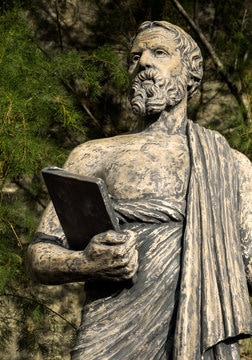
Herodotus
Birthday
-0484-01-01
Birth Sign
Capricorn
Birthplace
Halicarnassus
Age
Died at 59
About
Herodotus of Halicarnassus was the ancient Greek historian and geographer known as the Father of History, a title he earned through his groundbreaking work, The Histories. This single text, completed around 430 BC, recounts the Greco-Persian Wars while weaving in a vast tapestry of ethnographic, geographic, and cultural observations about the peoples of the known world, from Egypt to Scythia. His method of systematic inquiry, which he called historia, set the foundation for Western historical writing. Though some contemporaries and later critics questioned his inclusion of myth and hearsay, modern scholarship has confirmed many of his reports. His work remains an indispensable source for understanding the ancient Mediterranean and Near East. As of 2026, he continues to be studied and debated in universities worldwide, and his influence pervades modern historiography.
Early Life & Background
Herodotus was born around 484 BC into a prominent family in Halicarnassus, a Greek city on the coast of Asia Minor. His father Lyxes and mother Dryo provided him with a privileged upbringing, and his relative Panyassis, an epic poet, likely nurtured his early interest in storytelling. The turning point came around 457 BC when he was exiled after a failed uprising against the local tyrant Lygdamis. This exile freed him from political obligations and set him on a path of extensive travel across the Persian Empire, Egypt, and the Black Sea region. He spent years interviewing locals, observing customs, and collecting stories that would later form the backbone of his Histories.
Career Growth
Herodotus began publicly reciting portions of his work in Athens around 445 BC, where he was celebrated as a brilliant storyteller. The Athenian assembly reportedly awarded him a substantial sum, a rare honor for a non-citizen. He then participated in founding the Athenian colony of Thurii in southern Italy around 443 BC, where he spent his final years. The complete Histories appeared around 430 BC, a sprawling narrative that opens with the abduction of Io and culminates in the Greek victories at Salamis and Plataea. The work was organized into nine books by later Alexandrian scholars, each named after a Muse. It became the definitive account of the Persian Wars and established Herodotus as the founder of historical inquiry.
Career Timeline
Public Image & Style
Herodotus is remembered as the archetypal curious traveler and the first journalist, blending rigorous inquiry with captivating storytelling. His narrative style includes ethnographic digressions, invented speeches, and mythical elements, earning him both admiration and skepticism. Enthusiasts, sometimes called Herodoteans, gather at academic conferences and online forums like the Herodotus Helpline on Twitter, which has over 50,000 followers. The account is known for its witty and accessible tone, answering questions about ancient history for a broad audience.
Fame & Fandom
Herodotus currently holds no placement in the iFANN Global Top 1,000 or any Top-100 scope list, a status that reflects his ancient origins rather than a lack of enduring influence. While modern celebrity culture relies on real-time metrics and chart positions, the Father of History exists outside these contemporary rankings, having been evaluated by the iFANN system as unranked due to the absence of current global fame signals typical of living personalities. His legacy operates on a different timescale entirely, sustained not by viral moments but by millennia of scholarly reverence.
The concept of a formal fandom for Herodotus does not exist in the modern sense. There is no documented fanbase with an official name, organized campaigns, or grassroots rituals like birthday billboards or subway ads. Instead, his audience consists of scholars, classicists, historians, and students who engage with his work through academic study and translation. This institutional appreciation functions as his enduring legacy, preserved by universities and museums rather than fan clubs. The closest equivalent to a fan nickname is the title 'Father of History,' bestowed by Cicero, which remains universally referenced across biographical sources. Modern engagement takes the form of reading his foundational text, The Histories, and participating in intellectual traditions that span two thousand years. Unlike contemporary stars, Herodotus interacts with his followers solely through his written words, offering a one-way dialogue where readers explore his inquiries into the Greco-Persian Wars and the cultures of the known world. His 'fans' are those who continue to debate his reliability, analyze his ethnographic digressions, and appreciate his narrative style, proving that true historical impact transcends the need for a named community.
Interesting Facts and Legends
Herodotus never mentions his own name within the text of The Histories, a deliberate choice that has puzzled readers for centuries. Ancient critics sometimes dismissed him as the Father of Lies for including outlandish tales, such as giant gold-digging ants in India, though some of these reports have found partial corroboration in modern scholarship. The division of his work into nine books named after the Muses was a later invention by scholars in Alexandria, occurring long after his death. He mastered the art of suspense, frequently ending sections with cliffhangers that kept audiences engaged, and he coined the word historia itself as a book title to signify systematic inquiry.
A central legend surrounding his life is the dual reputation he carries as both the Father of History and the Father of Lies, a tension that fuels ongoing debates about his accuracy. One particularly famous story from his work involves the gold-digging ants, which has become iconic precisely because it seems so unbelievable, often cited as evidence of his credulity. Another enduring maxim attributed to him is the observation that human happiness never remains long in the same place, a quote that has evolved into a foundational principle of political thought. His name also appears in unexpected modern contexts, such as a 2025 Android banking malware dubbed 'Herodotus' for its ability to mimic human behavior, a darkly ironic tribute chosen by security researchers. Finally, the ambiguity of his death date, cited variously as c. 425 BC or as late as 413 BC, adds to the mystique of this ancient figure whose legacy continues to shape how we understand history.
Notable Quotes
“These are the researches of Herodotus of Halicarnassus, which he publishes, in the hope of thereby preserving from decay the remembrance of what men have done.”
“In peace, sons bury their fathers. In war, fathers bury their sons.”
“Of all men's miseries the bitterest is this: to know so much and to have control over nothing.”
“It is better by noble boldness to run the risk of being subject to half of the evils we anticipate than to remain in cowardly listlessness for fear of what might happen.”
Family & Personal Life
Herodotus was born to Lyxes and Dryo in Halicarnassus. He had a brother named Theodorus and was related to the epic poet Panyassis. He never married and had no known children. No ancient source records any romantic partner or descendants, and the standard biographical assumption is that he remained single and childless throughout his life.
Notable Connections
Herodotus was related to the epic poet Panyassis, who influenced his early interest in storytelling. He was followed by the Athenian historian Thucydides, who implicitly criticized Herodotus's inclusion of myth and set a more rigorous standard. The Roman orator Cicero gave him the enduring title Father of History. Aristotle referenced and critiqued his work.
Relationships & Dating History
Herodotus had no known romantic relationships. No ancient source records a wife, partner, or children. The standard biographical assumption, based on the silence of all ancient authors, is that he remained single and childless. As of 2026, he is deceased and never married.
Death & Aftermath
Died
-0425-01-01 (aged 59)
Death Place
Thurii
Cause of Death
Unknown
Herodotus of Halicarnassus died around 425 BC, likely in the Athenian colony of Thurii where he spent his final years. The precise date remains unknown to history, with no record specifying a day or month for his passing. His estate was handled according to the customs of ancient Greece, though no specific details on inheritance or wills are recorded. Ancient biographical sources do not record the location of his burial, whether it was cremation or interment, or who presided over his rites.
Immediate public tributes or vigils did not occur at the time of his death, as these concepts belong to later eras. Contemporaries like Thucydides debated the accuracy of his work while he lived, but Cicero and Dionysius of Halicarnassus later revered him as the Father of History. Tradition suggests he may have been buried in Thurii, yet the specifics of his funeral rites remain unconfirmed. Posthumously, his magnum opus The Histories became the definitive account of the Greco-Persian Wars, establishing the foundation for Western historiography.
Modern scholarship continues to analyze his ethnographic observations from Egypt to Scythia, while the crater Herodotus on the Moon bears his name. Numerous scholarships and foundations dedicated to history and archaeology now carry his name. His work remains a primary source that is published, analyzed, and taught globally, ensuring his legacy endures through ongoing academic debate rather than immediate commemoration at the time of his passing.
Net Worth (Estate Value)
Herodotus lived in the 5th century BC, and no credible financial records survive. His wealth derived from his family's land holdings in Halicarnassus. The concept of net worth in the modern sense does not apply, and no contemporary source provides an estimate. He was not wealthy by modern standards but was comfortably supported by his family's aristocratic status.
Awards & Accolades
View 5 records, honours and achievementsKnown For
The Histories
c. 430 BC · Author
Keywords
Quick Facts
- Profession
- historian, writer, geographer
- Born
- -0484-01-01
- Birthplace
- Halicarnassus
- Died
- -0425-01-01
- Death Place
- Thurii
- Gender
- Male
- Birth Sign
- Capricorn
Personal Details
- Full Name
- Herodotus
- Education
- Privately educated in Greek classics, poetry, and rhetoric
Frequently Asked Questions
Is Herodotus the Father of History or the Father of Lies?
Did Herodotus actually travel to all the places he wrote about?
What is the main subject of Herodotus's Histories?
How many books are in Herodotus's Histories?
When did Herodotus die and where?
Similar People
Join the community
fans discussing