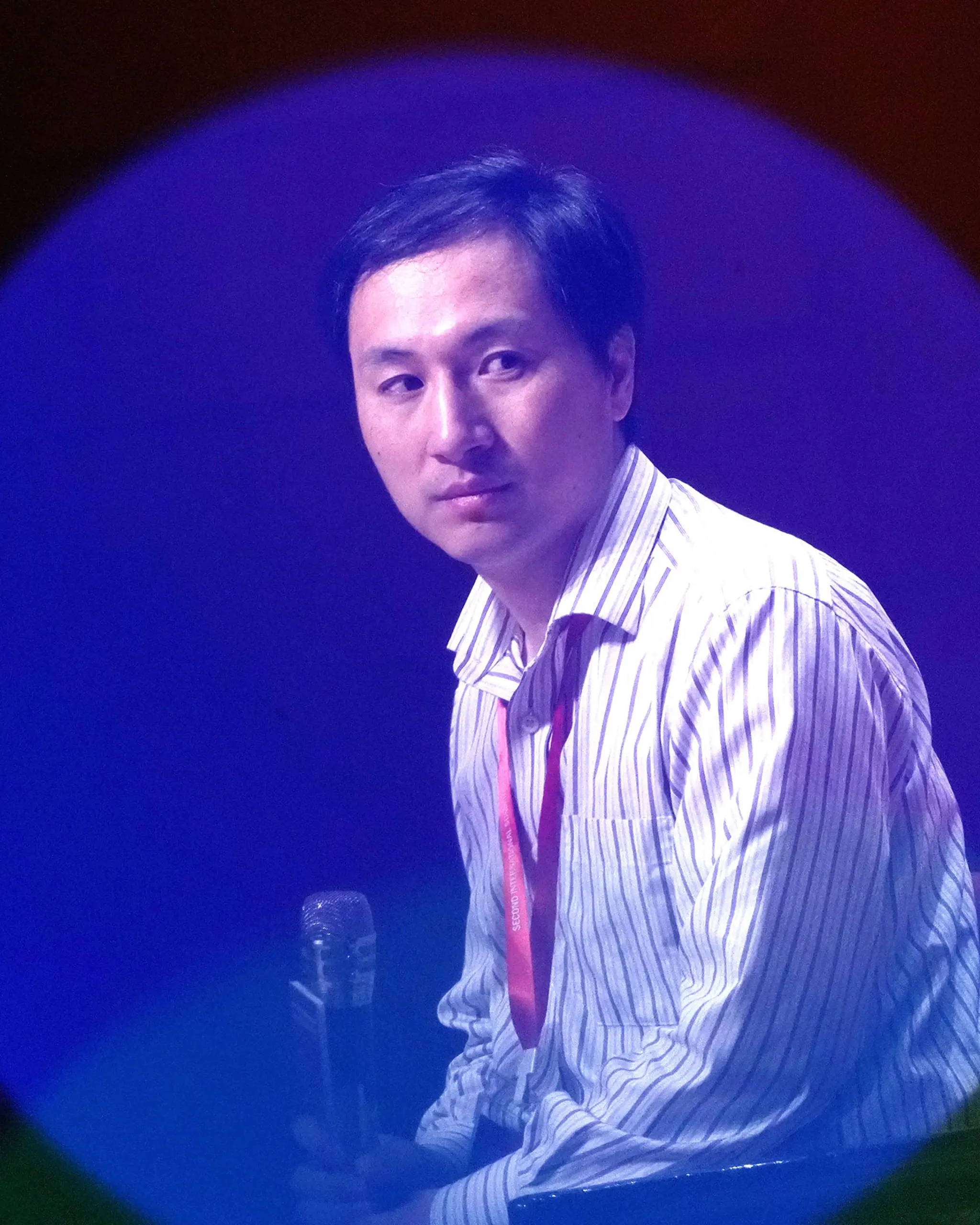
He Jiankui
 China
Chinabiophysicist•geneticist•biomedical engineer
Also known as: He Jiankui (贺建奎), He Jiankui
Birthday
1984
Birth Sign
Capricorn
Birthplace
Xinhua County, Hunan, China
Age
42 years old
About
He Jiankui is a Chinese biophysicist and geneticist who became a global flashpoint in bioethics. Born in 1984 in Xinhua County, Hunan, he trained in physics and biomedical engineering, earning a PhD from Rice University before returning to China to work at the Southern University of Science and Technology (SUSTech) in Shenzhen. As an associate professor of biology, he led a lab focused on gene editing, but his name became inseparable from a scandal that shook the scientific world.
In November 2018, He announced that he had used CRISPR to edit the genomes of twin girls, known by pseudonyms Lulu and Nana, to make them resistant to HIV. The babies were born in October 2018, making them the first genetically edited humans. The news initially drew praise as a potential breakthrough, but scrutiny quickly revealed a darker side. An investigation found that He had bypassed ethical review, misled his university, and raised private funds to conduct the experiment, prompting widespread condemnation from scientists and the public alike. Time magazine named him one of the 100 most influential people of 2019, but the recognition came alongside a global outcry that branded him a "mad scientist."
He was suspended from his research in November 2018 and fired by SUSTech in January 2019. In December 2019, a Chinese court found him guilty of illegal medical practice and sentenced him to three years in prison, along with a fine of 3 million yuan. He was released in April 2022. His attempts to rebuild his career have been rocky: in February 2023, he briefly obtained a Hong Kong work visa, but it was revoked after an investigation into false statements. By September 2023, he landed a new position as the founding director of the Genetic Medicine Institute at Wuchang University of Technology, a private college in Wuhan. His story remains a cautionary tale about the limits of scientific ambition.
Early Life & Background
He Jiankui grew up in a modest rural household in Xinhua County, a mountainous region in Hunan Province known for its farming communities. His parents were not scientists; they worked the land, and young Jiankui's path to academia was anything but assured. He showed an early aptitude for math and physics, excelling in school despite limited resources. His hunger for knowledge led him to pursue undergraduate studies in physics, a field far removed from the biology that would later define his career.
The pivot came during his graduate studies. He moved to the United States and enrolled at Rice University in Houston, Texas, where he studied under physicist Michael Deem. His doctoral research focused on biophysics and evolutionary dynamics, blending physics with biological systems. It was here that he first encountered the tools of genetic engineering, and the potential of CRISPR technology captured his imagination. After earning his PhD, He returned to China, joining SUSTech in Shenzhen as an associate professor of biology in 2012.
At SUSTech, He founded his own laboratory dedicated to gene editing. He also launched GeneMind, a company in Shenzhen focused on gene-sequencing and gene-editing technologies. His early work was ambitious, aiming to make gene therapy affordable and accessible. He published research on CRISPR and began to see himself as a pioneer. But his ambition outpaced his caution, setting the stage for the events of 2018.
Career Growth
He Jiankui's breakthrough was also his downfall. In October 2018, twin girls Lulu and Nana were born after He edited their CCR5 gene using CRISPR-Cas9, aiming to confer HIV resistance. He announced the feat on 25 November 2018, two days before the Second International Summit on Human Genome Editing opened in Hong Kong. The announcement sent shockwaves through the scientific community, which had long debated the ethics of germline editing. Initial reactions ranged from awe to horror, but an investigation soon revealed that He had bypassed ethical review, misled his university, and funded the experiment privately. The scientific consensus was that the work was premature and medically unjustified.
Within months, He's world collapsed. SUSTech suspended his research in November 2018 and fired him in January 2019. In December 2019, a Chinese court convicted him of illegal medical practice, sentencing him to three years in prison and a fine of 3 million yuan. He served his sentence and was released in April 2022.
Since his release, He has attempted to rebuild his career. In February 2023, he briefly obtained a Hong Kong work visa, but it was revoked after an investigation into false statements. By September 2023, he became the founding director of the Genetic Medicine Institute at Wuchang University of Technology in Wuhan. In January 2026, The New York Times reported that he is planning further gene-editing experiments targeting Alzheimer's disease. By May 2026, reports indicate he has expanded into brain-computer interfaces. His story remains a cautionary tale about the limits of scientific ambition.
Career Timeline
Public Image & Style
He Jiankui's public image is defined by the controversy that surrounds him. Media outlets have variously described him as a "mad scientist," "China's Dr. Frankenstein," and a cautionary tale about scientific ambition. His 2018 announcement at a Hong Kong conference was met with global condemnation, and he appeared "nervous-looking" during the presentation. The scientific community has largely distanced itself from him, with organizations like the World Health Organization and numerous national academies condemning his work. His case has become a reference point in discussions about the ethics and regulation of CRISPR technology worldwide. Despite this, He maintains a social media presence where he continues to advocate for gene therapy, and he has found a new platform at Wuchang University of Technology, where he directs the Genetic Medicine Institute.
Fame & Fandom
He Jiankui commands a unique place in modern history, not through the adoration of a fanbase but as a singular figure of global infamy. Unlike pop stars or athletes who cultivate loyal followings, his audience consists of bioethicists, scientists, and the general public united by a shared sense of caution and controversy. There is no formal fandom name for his supporters; the community that engages with his story is defined by its critical distance rather than devotion. His legacy is built on the 2018 announcement of the first gene-edited babies, a moment that turned him into a global symbol of scientific overreach. While he has returned to research following his release from prison, the public narrative remains fixed on the ethical shockwaves of that initial experiment. Despite the lack of traditional celebrity worship, his influence persists through ongoing debates about genetic engineering and the boundaries of human intervention. This enduring relevance places him firmly within the global consciousness, recognized across media coverage, search trends, and consumption signals worldwide. He Jiankui is currently the 71st most famous person from China, a position holding steady from the previous cycle according to the iFANN Global Fame Rankings.
Interesting Facts and Legends
He Jiankui maintains an active presence on social media platforms including Twitter/X (@Jiankui_He), Facebook, and YouTube, where he discusses affordable gene therapy and his continued work. In February 2023, he admitted to The Guardian that he acted too quickly during his 2018 experiment, though he stopped short of issuing a full apology. His ex-wife, Cathy Tie, was famously dubbed Biotech Barbie in various reports. The twin girls known as Lulu and Nana were never his children; they were born to unidentified parents who participated in his research, and their current status remains unknown. A defining legend of his career is the November 2018 announcement at a Hong Kong conference, where he revealed the birth of the world's first CRISPR-edited humans, sparking immediate global condemnation and earning him the moniker China's Dr. Frankenstein. Following this event, he was sentenced to three years in prison for illegal medical practice in December 2019 before being released in April 2022. Recent reports from 2026 suggest he has pivoted toward brain-computer interfaces while continuing to face scrutiny over the long-term implications of his earlier work.
Notable Quotes
“I acted too quickly.”
“I am not a mad scientist.”
“Gene editing can cure diseases.”
“The future of medicine is in our genes.”
Family & Personal Life
He Jiankui was married to Cathy Tie, a Chinese-American geneticist who worked alongside him at SUSTech and GeneMind. The couple married in the early 2010s while both were building their careers in gene editing. They collaborated professionally, with Tie involved in the research that led to the CRISPR babies. The marriage ended in divorce, with reports in May 2026 referring to Tie as He's ex-wife. Tie has since launched an embryo gene-editing startup in the United States. He Jiankui and Tie had no publicly documented children. The twin girls Lulu and Nana were not his children but the subjects of his experiment.
Notable Connections
He Jiankui is associated with several key figures. His ex-wife, Cathy Tie, was a close collaborator and later launched her own gene-editing startup in the US. His PhD supervisor at Rice University was physicist Michael Deem. The twin girls Lulu and Nana, whose genomes he edited, are central to his story, though their parents were the actual research participants. His work has also drawn attention from global bodies like the World Health Organization, which condemned his experiment.
Relationships & Dating History
He Jiankui's personal life came under scrutiny during the CRISPR babies scandal. He was married to Cathy Tie, a Chinese-American geneticist who worked with him at SUSTech and GeneMind. The couple married in the early 2010s. They had no publicly documented children. Their marriage ended in divorce, with reports in May 2026 referring to Tie as his ex-wife. Tie has since launched an embryo gene-editing startup in the US. As of 2026, He Jiankui is reportedly single and focused on his research.
- MarriedCathy Tie2012 - 2024Married in the early 2010s; divorced by 2026.
Salary, Net Worth In 2026
$7 Million
iFANN Editorial Team estimate
He Jiankui's financial situation is difficult to pinpoint, as public net worth figures are not readily available. What is known: he founded GeneMind in 2012, a gene-sequencing and gene-editing technology company, which may still generate some income. He also holds an academic position at Wuchang University of Technology, though his salary is not public. His 2019 court case imposed a fine of 3 million yuan (about $430,000). Per iFANN's editorial analysis, his net worth is estimated at around $7 Million as of 2026, based on his past business ventures and current academic work. The exact breakdown is unclear, but his income likely comes from his university role and any residual value from GeneMind.
Awards Won (1)
He Jiankui's awards are limited and controversial. He was named one of Time magazine's 100 most influential people in 2019, a recognition that came alongside widespread condemnation of his work. He has not received scientific honors from mainstream bodies, which have largely distanced themselves from him.
2019 · Influence
Known For
CRISPR-edited babies (Lulu and Nana)
2018 · Lead scientist
Keywords
Sources
Quick Facts
- Profession
- biophysicist, geneticist, biomedical engineer
- Born
- 1984
- Birthplace
- Xinhua County, Hunan, China
- Gender
- Male
- Spouse
- Cathy Tie (divorced)
Personal Details
- Full Name
- He Jiankui (贺建奎)
- Spouse
- Cathy Tie (divorced)
- Education
- PhD in biophysics from Rice University
Frequently Asked Questions
Is He Jiankui still in prison?
What happened to the CRISPR babies Lulu and Nana?
Did He Jiankui go to jail?
Is He Jiankui married?
What is He Jiankui doing now?
Similar People
Join the community
fans discussing