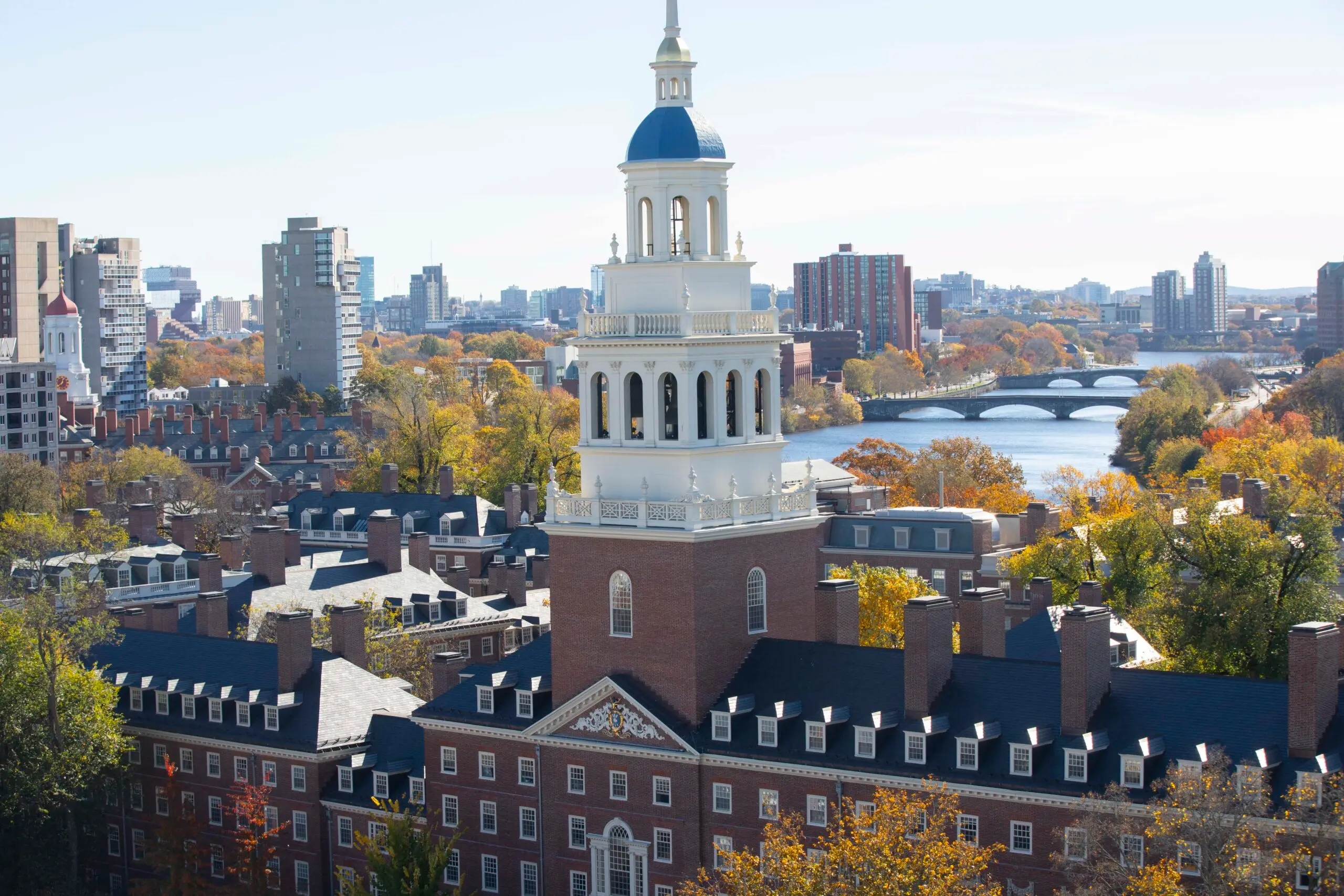
Harvard University
 United States
"Veritas — Truth"
About
Harvard University, the oldest institution of higher education in the United States, was founded on October 28, 1636, by a vote of the Great and General Court of the Massachusetts Bay Colony. Initially called "New College," it was established in Newtowne, later renamed Cambridge, Massachusetts. The original purpose was to train Puritan clergy. In 1638, the school received its first major benefaction from John Harvard, a Puritan minister who bequeathed half of his estate and his library of over 400 books. The college was renamed Harvard College in 1639 in his honor. The governing charter, the Harvard Corporation, was granted in 1650. The Massachusetts Constitution officially recognized Harvard as a university in 1780, and its medical school, the third oldest in the U.S., was founded in 1782.
Under President Charles William Eliot (1869–1909), Harvard transformed into a modern research university, adding professional schools and co-founding the Association of American Universities in 1900. Today, Harvard comprises 14 schools, including Harvard College for undergraduates and 13 graduate and professional schools. Its main 209-acre campus is in Cambridge, centered on Harvard Yard, with additional campuses in Boston's Allston neighborhood and the Longwood Medical Area. The Harvard Library is the world's largest academic library, with over 20 million volumes.
Harvard's endowment, valued at $55.7 billion, is the largest of any academic institution globally. The university consistently ranks among the top universities worldwide. Its alumni include eight U.S. presidents, 188 living billionaires, and numerous Nobel laureates and Olympic medalists. In fiscal year 2024, Harvard reported operating revenue of $6.5 billion and expenses of $6.1 billion, generating an operating surplus. Philanthropic revenue, including endowment distributions and gifts, accounted for 45% of total operating revenues.
Mission
Harvard's mission is to pursue truth, knowledge, and a better world through teaching, learning, and research. The original charter pledges the university to "the education of English and Indian youth." Harvard aims to educate the citizens and citizen-leaders for our society, expanding the boundaries of human knowledge and applying that knowledge to solve the world's most pressing problems.
History
The Great and General Court of the Massachusetts Bay Colony voted £400 to establish a school or college on October 28, 1636. The court selected Newtowne, a small settlement on the Charles River, as the site. In 1638, the town was renamed Cambridge after the English university city. That same year, John Harvard, a Puritan minister who had emigrated from England, died of tuberculosis. His will left half of his estate, about £780, and his library of over 400 books to the fledgling college. In 1639, the institution was named Harvard College in his honor.
The first class of nine students graduated in 1642. The Harvard Corporation, the governing board, was established by charter in 1650. During the American Revolution, Harvard housed Continental soldiers and educated key Founding Fathers. In 1780, the Massachusetts Constitution recognized Harvard as a university, and the medical school opened in 1782. The 19th century saw Harvard become a center of elite education, but it was President Charles William Eliot (1869–1909) who transformed it into a modern research university. Eliot introduced elective courses, raised academic standards, and expanded professional schools. Under his leadership, Harvard co-founded the Association of American Universities in 1900.
President James B. Conant (1933–1953) navigated the Great Depression and World War II, reforming admissions to be more meritocratic and expanding financial aid. In the post-war era, Harvard became a global research powerhouse. In 2022, the university released a report detailing its historical ties to slavery and committed $100 million to address the legacy. The 2023–2024 academic year saw campus unrest and the resignation of President Claudine Gay, with Alan M. Garber assuming the presidency. Despite challenges, Harvard's finances remain robust, with a $55.7 billion endowment and $6.5 billion in operating revenue in fiscal 2024.
Subdivisions
Harvard College
Undergraduate liberal arts college
Graduate School of Arts and Sciences
Graduate programs in arts and sciences, founded 1872
Harvard Medical School
Graduate medical school, founded 1782
Harvard Law School
Graduate law school, founded 1817
Harvard Business School
Graduate business school, founded 1908
Harvard Kennedy School
Graduate school of government, founded 1936
Harvard School of Engineering and Applied Sciences
Engineering and applied sciences, founded 2007
Harvard Divinity School
Graduate theological school, founded 1816
Harvard Graduate School of Education
Graduate education school, founded 1920
Harvard T.H. Chan School of Public Health
Graduate public health school, founded 1922
Harvard Graduate School of Design
Graduate design school, founded 1914
Harvard Dental School
Graduate dental school, founded 1867
Harvard Extension School
Continuing education, founded 1910
Notable People
John Adams
Alumnus · 1755
Second President of the United States
John Quincy Adams
Alumnus · 1787
Sixth President of the United States
Rutherford B. Hayes
Alumnus · 1842
19th President of the United States
Theodore Roosevelt
Alumnus · 1880
26th President of the United States
Franklin D. Roosevelt
Alumnus · 1904
32nd President of the United States
John F. Kennedy
Alumnus · 1940
35th President of the United States
George W. Bush
Alumnus · 1968
43rd President of the United States
Bill Gates
Alumnus (dropped out) · 1973-1975
Co-founder of Microsoft
Mark Zuckerberg
Alumnus (dropped out) · 2002-2004
Co-founder of Facebook
John Hancock
Alumnus · 1754
American revolutionary leader, signer of Declaration of Independence
Samuel Adams
Alumnus · 1740
American revolutionary leader, signer of Declaration of Independence
Henry David Thoreau
Alumnus · 1837
Author and philosopher
T.S. Eliot
Alumnus · 1909
Poet, Nobel Prize in Literature 1948
Helen Keller
Alumnus · 1904
Author and activist
Al Gore
Alumnus · 1969
45th Vice President of the United States, Nobel Peace Prize 2007
Milestones
1636
Founded by the Massachusetts General Court
1638
John Harvard bequeaths his library and half his estate
1639
Renamed Harvard College
1642
First graduating class of nine students
1650
Harvard Corporation charter granted
1780
Recognized as a university by Massachusetts Constitution
1782
Harvard Medical School founded
1869
Charles William Eliot begins 40-year presidency
1900
Co-founded the Association of American Universities
1908
Harvard Business School founded
1936
Harvard Kennedy School founded
2022
University commits $100 million to address historical ties to slavery
2024
Fiscal year revenue reaches $6.5 billion
Teams
Sources
Organization Info
- Founded
- October 28, 1636
- Headquarters
- Cambridge, Massachusetts
- Country
- United States
- President
- Alan M. Garber
- Type
- University
- Founder
- Massachusetts General Court
- Endowment
- $55.7 billion
- Library Size
- Over 20 million volumes
- Number of Schools
- 14
- U.S. Presidents Educated
- 8
- Nobel Laureates (affiliated)
- Over 160
Financials
- Revenue
- 6500000000
- Endowment
- 55700000000
Official Website
www.harvard.edu
Join the community
fans discussing