 United States
“Harlots is a raucous, feminist period drama that refuses to look away from the grim realities of its world while still finding room for wit, warmth, and genuine suspense.”
Caroline Framke
Variety
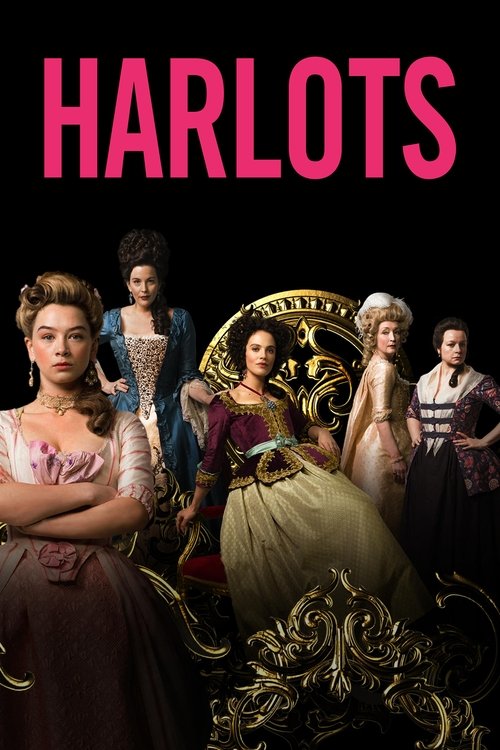
Set in the 1760s, Harlots is a period drama that pulls no punches in its depiction of London's Georgian sex trade. Created by Alison Newman and Moira Buffini, the series was inspired by historian Hallie Rubenhold's book The Covent Garden Ladies, which documented the real lives of sex workers through the infamous Harris's List. The show's guiding principle, according to producer Alison Owen, was to tell everything from the whore's eye view, meaning nudity and sex acts were framed from the women's perspective rather than for male titillation.
The central figure is Margaret Wells (Samantha Morton), a fiercely ambitious brothel owner determined to move her establishment from a rundown house to a prestigious property in Greek Street, Soho. Margaret's driving philosophy is blunt: money is a woman's only power. She has two daughters: Charlotte (Jessica Brown Findlay), a celebrated courtesan who has already been sold to an aristocrat, and Lucy (Eloise Smyth), a sheltered girl whose virginity is about to be auctioned. Margaret's childhood friend Nancy Birch (Kate Fleetwood) runs a flagellation brothel nearby, while the primary antagonist is Lydia Quigley (Lesley Manville), a wealthy and utterly ruthless rival madam who exploits vulnerable women and views Margaret's ambitions as a threat.
The show balances soapy melodrama with sharp social commentary, exploring themes of female agency, economic survival, and class hierarchy. It features significant lesbian storylines, characters of color in substantial roles, women with disabilities, and diverse body types without tokenism. Over three seasons, Harlots subverts the traditional costume drama by centering the experiences of sex workers in a world that sees them as disposable.
Stream
Availability and pricing can change. Confirm on the provider's site before purchasing.
The series begins in 1763 London, where Margaret Wells runs a modest brothel in a seedy district. She has long dreamed of acquiring a lease on a house in Greek Street, a more upscale area in Soho that promises financial security and social mobility. To secure the property, Margaret goes into debt with a moneylender, a gamble that puts her entire operation at risk. Her childhood friend Nancy Birch, who runs a brothel specializing in flagellation, warns her against overreaching, but Margaret is determined.
Margaret's elder daughter Charlotte is a celebrated courtesan kept by Sir George Howard, a wealthy aristocrat. Charlotte enjoys a degree of independence and influence, but she resents the fact that her mother sold her virginity years earlier. Lucy, the younger daughter, has been raised in relative innocence, but Margaret's financial troubles force her to consider auctioning Lucy's maidenhead to the highest bidder, a decision that will have devastating consequences for the entire family.
Lydia Quigley, the city's most powerful madam, runs an exclusive brothel patronized by the highest echelons of society. She was the woman who exploited Margaret and Nancy as children when they were first brought into the sex trade. Lydia views Margaret's ambitions as a direct threat to her empire and uses every tool at her disposal, bribery, blackmail, and violence, to destroy her. Lydia's son Charles is a spoiled, incompetent pawn who occasionally proves useful.
Season 1 centers on the escalating war between Margaret and Lydia for control of London's most profitable sexual commerce. Margaret's attempt to buy the Greek Street property puts her in debt, and when Lydia enlists constables to raid her house, Margaret is forced to pay a crippling fine. To raise the money, she auctions Lucy's virginity, an act that sets off a chain of events that fractures the Wells family and draws in new allies and enemies.
Season 2 expands the world significantly. Margaret's choices in Season 1 have lasting repercussions, and the power dynamics shift as Charlotte begins to assert her own independence and ambitions. The show introduces new characters and deepens existing ones, exploring the legal and social systems that constrain these women. Lydia's machinations grow more elaborate, and the rivalry between the bawds takes on new dimensions as both women face threats from unexpected quarters, including a reform-minded magistrate and a group of religious activists.
Season 3, the final season, sees Charlotte stepping into the role of bawd at the Greek Street brothel after Margaret's departure from London. The season introduces new antagonists, particularly a ruthless new pimp named Isaac Pincher and his violent associate Hal, who threaten the established order of London's sex trade. The season also prominently features a molly house, a brothel catering to homosexual men, run by Ned and Fredo, which becomes a target for persecution. Isabella, a wealthy woman searching for her kidnapped daughter, arrives and intersects with Nancy's storyline. Lydia Quigley, having been committed to Bedlam psychiatric hospital at the end of Season 2, finds a way to re-emerge and reassert her influence. The season builds toward a climactic confrontation between the women of Greek Street and the new pimps, with Charlotte leading the fight to protect her territory and her family.
Critical Consensus
A bold, feminist period drama that subverts the traditional costume drama by centering the experiences of sex workers in 18th-century London. With powerhouse performances from Samantha Morton and Lesley Manville, the show balances soapy melodrama with sharp social commentary, offering a refreshingly unvarnished look at female survival in a brutal world.
“Harlots is a raucous, feminist period drama that refuses to look away from the grim realities of its world while still finding room for wit, warmth, and genuine suspense.”
Caroline Framke
Variety
“The performances are uniformly excellent, with Morton and Manville creating a rivalry that crackles with history, resentment, and grudging respect.”
Daniel Fienberg
The Hollywood Reporter
“Harlots offers a rare and welcome perspective: the whore's eye view of Georgian London, where sex work is neither glamorized nor moralized, simply presented as a brutal economic reality.”
Judy Berman
The Guardian
“In its first season, Harlots focused primarily on the antagonistic relationship between ambitious bawd Margaret Wells and more established madam Lydia Quigley. But as the series continued, its story expanded into something much more complex.”
Allison Keene
Paste Magazine
“Season two of Hulu's period drama Harlots seemed to trace the arcs of its female protagonists to their logical conclusions. These developments presented the writers with an opportunity to expand the show's world.”
Slant Magazine
Slant Magazine
Samantha Morton
Margaret Wells
Jessica Brown Findlay
Charlotte Wells
Eloise Smyth
Lucy Wells
Lesley Manville
Lydia Quigley
Kate Fleetwood
Nancy Birch
Danny Sapani
Will North
Hugh Skinner
Sir George Howard
Joshua McGuire
Charles Quigley
Bronwyn James
Fanny
Pippa Bennett-Warner
Harriet
Liv Tyler
Isabella
Henry Goodman
Isaac Pincher
Ben Lambert
Hal
Ellie Heydon
Anne
Jack Greenlees
Justice Knox
Directors
Coky Giedroyc, China Moo-Young, Jonathan Teplitzky
Writers
Moira Buffini, Alison Newman, Jessica Ruston
Composer
Rael Jones
Cinematographers
David Luther, Tim Palmer
Producers
Alison Owen, Debra Hayward, Alison Carpenter
BAFTA TV Craft Award (2018)
Best Costume Design: Nominated
Gracie Award (2018)
Outstanding Female Actor in a Leading Role in a Drama Series: Won
Women's Image Network Award (2018)
Best Actress in a Drama Series: Nominated
Royal Television Society Award (2018)
Best Costume Design: Nominated
British Screenwriters' Award (2018)
Best Writing in a Television Drama: Nominated
Join the community
fans discussing