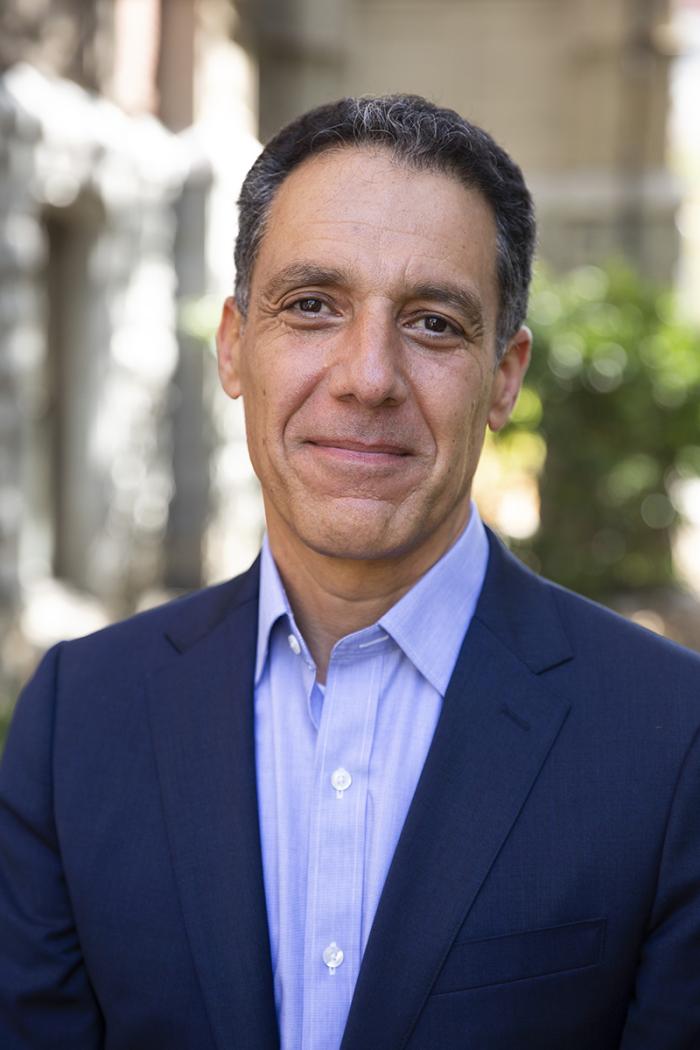
Hany Farid
 United States
Birthday
February 10, 1966
Birth Sign
Aquarius
Birthplace
United States
Age
60 years old
Height
5 ft 10 in (178 cm)
About
Hany Farid is an American computer scientist and university professor who has become one of the world's leading experts in digital image forensics and deepfake detection. Born February 10, 1966, he is widely recognized as a co-designer of the PhotoDNA algorithm, a technology used globally to detect child sexual abuse material online. Farid served as Dean and Head of School for the UC Berkeley School of Information and continues to hold a faculty position there. He is the author of the book Photo Forensics (2016), a standard reference in the field. Farid's work has shaped how governments, law enforcement, and technology companies approach the authentication of digital media. He regularly testifies before Congress on the risks of synthetic media and advises on policy related to AI-generated content. As of 2026, he serves as the first Chief Technology Officer of the Coalition for Content Provenance and Authenticity (C2PA), an organization he helped found alongside Adobe, Microsoft, and the BBC. Farid also became a Senior Advisor to the Content Authenticity Initiative (CAI) in 2024. He has been named to the TIME 100 Next list and the Politico 50 list for his influence on technology and policy. His work continues to be cited in legislation and court rulings worldwide.
Early Life & Background
Hany Farid grew up in the United States with a passion for mathematics and computing. He pursued undergraduate studies at the University of Rochester, earning a Bachelor of Science in computer science and mathematics. He went on to the University of Pennsylvania, where he earned a Master of Science and Ph.D. in computer science, focusing on computer vision and image analysis. In the late 1990s, Farid joined Dartmouth College as a faculty member in the Department of Computer Science. During this period, he began applying his computer vision expertise to the problem of detecting image manipulation, a field that was still in its infancy. His early work on detecting digital forgeries through statistical analysis of image pixels established him as a pioneer in digital forensics. He developed foundational algorithms for detecting manipulation based on lighting inconsistencies, JPEG compression artifacts, and camera sensor noise patterns. His early research laid the groundwork for his later breakthroughs.
Career Growth
Farid's breakthrough came in 2009 when he co-designed the PhotoDNA algorithm with Microsoft. This technology creates a unique hash or digital fingerprint of images, enabling platforms to detect and block known child sexual abuse material without human review. PhotoDNA was later adopted by Facebook, Twitter, Google, and the National Center for Missing and Exploited Children. In 2016, he published his seminal book Photo Forensics with MIT Press. In 2019, he joined UC Berkeley as a professor in the School of Information and the Department of Electrical Engineering and Computer Sciences. In 2021, he was appointed Dean and Head of School for the UC Berkeley School of Information, serving until 2024. In 2024, he was named the first Chief Technology Officer of C2PA. In 2025, he launched Farid Forensics, a consulting firm providing digital forensic analysis to legal firms, media organizations, and governments. Farid has provided expert analysis for the FBI, U.S. Department of Defense, and major media outlets. He has received the ACM SIGMM Technical Achievement Award and the IEEE Signal Processing Society Best Paper Award.
Career Timeline
Public Image & Style
Hany Farid is widely regarded as the world's leading expert on digital forensics and deepfakes. Media portrayals consistently describe him as a go-to authority on synthetic media. His communication style is measured, precise, and accessible, avoiding academic jargon when explaining complex technical concepts. He typically appears in business casual attire or a suit jacket for television appearances, projecting a calm and authoritative presence. Farid does not have a traditional fandom; his audience consists primarily of policymakers, journalists, legal professionals, and technology industry leaders. He is active on X (Twitter) with approximately 25,000 followers, where he shares research findings and commentary on AI and deepfakes. He has been featured on the cover of WIRED and contributed to TIME and The New York Times Magazine. His notable quotes include warnings about the era where seeing is no longer believing and calls for technical standards and media literacy.
Fame & Fandom (iFAMOUS Rankings)
Hany Farid commands a global audience defined by professional necessity rather than celebrity adoration, serving as the definitive authority on digital media authentication for governments, newsrooms, and legal systems worldwide. His influence is measured in the frequency with which editors and judges consult his expertise to verify the authenticity of evidence in an era of synthetic media. According to the iFANN Global Fame Engine evaluation conducted in August 2026, Hany Farid is currently evaluated but does not hold a placement in the published rankings for the Global Top 1,000 or any Top-100 scope list. This status reflects his position as a specialized academic and technical expert whose fame is concentrated within scientific, legal, and journalistic sectors rather than the general entertainment public. While his name appears frequently in high-profile reporting regarding deepfakes and misinformation, he has not accumulated a formalized fanbase or a specific fandom designation documented in the iFANN data. The absence of a named fandom aligns with his career trajectory as a computer scientist and university professor who engages with the public through lectures, media interviews, and consulting rather than through the mechanisms of pop culture stardom. Consequently, there are no organized fan campaigns, rituals, or dedicated communities operating under a specific banner to support his work, distinguishing him from figures whose public profiles rely on mass-market popularity.
Interesting Facts and Legends
Hany Farid has testified as an expert witness in over 50 legal cases involving disputed digital evidence, utilizing his ability to analyze image metadata, lighting, shadows, and reflections to determine manipulation often within minutes. His seminal work on the PhotoDNA algorithm was inspired by a 2008 meeting with Microsoft executives tasked with the challenge of manually reviewing millions of images for child exploitation content. A prolific researcher, he has published over 150 peer-reviewed academic papers and book chapters, including the standard reference text Photo Forensics (2016). He was an early advocate for content credentials and digital watermarks to track the origin and editing history of media, though he notes that newer generative AI systems present increasing difficulties for forensic detection. In March 2026, he received the McGuire Prize, a significant milestone recognizing his contributions to digital forensics. A widely retold narrative emerged in June 2026 when Farid publicly admitted that despite decades of expertise, he can no longer trust his own eyes due to the advanced capabilities of generative AI to deceive human perception. This story, highlighted by major outlets like the New York Times, describes his state of being "flummoxed and scared" by the erosion of shared reality. Furthermore, he serves as a primary go-to authority for news editors asking whether content is AI-generated, a role that has become central to his current public profile in the fight against misinformation.
Notable Quotes
“We are entering an era where seeing is no longer believing. The technology to create convincing fake audio and video is advancing faster than our ability to detect it.”
“The solution to deepfakes is not just better detection technology. We need technical standards for content provenance, legal frameworks for accountability, and media literacy education for the public.”
“PhotoDNA was designed to solve a specific problem: finding copies of known child sexual abuse material without anyone having to look at it. It's been remarkably effective, but it's only one piece of a much larger puzzle.”
“I am optimistic about technology's potential to solve problems, but I am not naive about the challenges. Every detection method we develop, someone will try to circumvent. It's an arms race.”
Family & Personal Life
Hany Farid is married and has children, though he keeps details about his family private. He does not publicly share his spouse's name or his children's names and ages. He maintains a strict boundary between his professional and personal life, and no information about his parents or siblings is available in public sources. He holds dual U.S. and Canadian citizenship.
Notable Connections
Hany Farid collaborates with Microsoft Research on PhotoDNA, with Adobe on the Content Authenticity Initiative, and with the founding members of C2PA including Adobe, Microsoft, BBC, Intel, Sony, and Truepic. He works closely with colleagues at UC Berkeley and formerly at Dartmouth College. He has a long-term partnership with the National Center for Missing and Exploited Children (NCMEC) in deploying PhotoDNA.
Relationships & Dating History
Hany Farid is married, but he does not publicly discuss his spouse or the details of their relationship. There are no records of previous marriages, divorces, or high-profile relationships. He has children, but their names and ages are kept private. As of 2026, Farid remains married, with no public information suggesting any change in his marital status.
- MarriedCurrentFarid is married, but his spouse's name and relationship details are not publicly documented.
Salary, Net Worth In 2026
$4 Million
iFANN Editorial Team estimate
Per iFANN's editorial analysis, Hany Farid's estimated net worth is $4 Million. His primary income sources include his academic salary as a tenured professor at UC Berkeley, estimated at $200,000-350,000 annually. He charges $500-1,000+ per hour for forensic analysis consulting, with annual consulting revenue estimated at $200,000-500,000. Speaking engagements at technology conferences and universities command fees of $10,000-25,000 per appearance. His book Photo Forensics generates modest royalty income. In 2025, he launched Farid Forensics, a consulting firm that handles cases involving AI-generated evidence in legal proceedings, adding to his revenue. Patent royalties from PhotoDNA, which is owned by Microsoft, are not publicly documented.
Awards Won (3)
Hany Farid has received several academic and professional awards for his contributions to digital forensics. He won the ACM SIGMM Technical Achievement Award for multimedia forensics and security, and the IEEE Signal Processing Society Best Paper Award for his research on digital image forensics. He also received the National Science Foundation CAREER Award and multiple Dartmouth College Faculty Research Awards. He has not won entertainment industry awards such as Oscars or Grammys.
Technical Achievement
multimedia forensics and security
Best Paper
digital image forensics
Known For
PhotoDNA
2009 · Co-designer
Photo Forensics
2016 · Author
Deepfake Detection
2020 · Leading expert
C2PA
2024 · Chief Technology Officer
Keywords
Quick Facts
- Profession
- computer scientist
- Birthplace
- United States
- Gender
- Male
Personal Details
- Height
- 5 ft 10 in (178 cm)
- Education
- B.S. in Computer Science and Mathematics from University of Rochester; M.S. and Ph.D. in Computer Science from University of Pennsylvania
Frequently Asked Questions
Is Hany Farid married?
What is Hany Farid's net worth in 2026?
How old is Hany Farid?
What did Hany Farid invent?
Does Hany Farid have children?
Social Media
Join the community
fans discussing