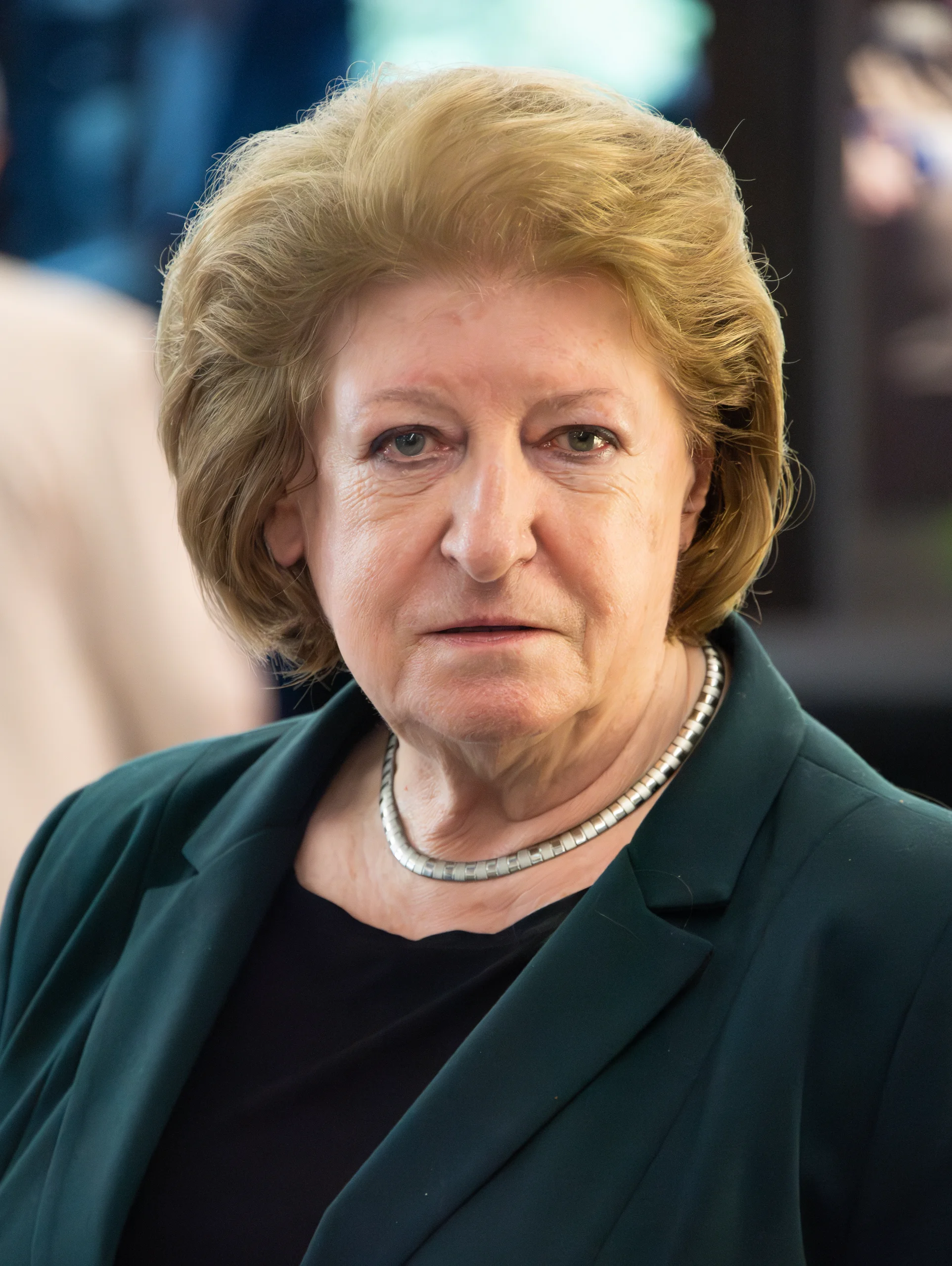
Hanna Suchocka
 Poland
Also known as: Hanna Stanisława Suchocka
Birthday
April 3, 1946
Birth Sign
Aries
Birthplace
Pleszew, Poland
Age
80 years old
About
Hanna Stanisława Suchocka is a Polish politician, diplomat, and jurist who made history as the first woman to serve as Prime Minister of Poland. Born on April 3, 1946, she led an eight-party coalition government from July 1992 to October 1993 during a turbulent transition from communism to democracy. A professor at Adam Mickiewicz University in Poznań, she currently chairs the Constitutional Law Department and serves as President of the Venice Commission.
Her career stands out for its unwavering commitment to constitutional integrity and human rights. She navigated complex political storms, including a controversial abortion vote that led to her government's fall, yet she maintained her reputation as a principled legal scholar. Today, she remains a prominent voice in international law, advising nations across Europe on judicial reforms and democratic standards.
Early Life & Background
Hanna Suchocka entered the world in Pleszew, a town in western Poland, just months after the end of World War II. Her childhood unfolded under the shadow of a newly established communist regime that would define her early years. Despite the strictures of the People's Republic of Poland, she pursued education with fierce determination. She enrolled at Adam Mickiewicz University in Poznań, where she earned her degree in law.
After graduating, Suchocka stayed at the university, building a reputation as a respected academic rather than seeking immediate political power. She specialized in constitutional law and began publishing extensively on state organization and human rights. During the 1980s, as the communist grip loosened, she became a key figure in the democratic opposition. She aligned herself with the Solidarity trade union movement, using her legal expertise to support the struggle for freedom while maintaining her position as a scholar.
Her rise was not sudden. It was built on decades of study, writing, and quiet resistance. By the time the Round Table Talks of 1989 opened the door to free elections, she had already established herself as a leading voice for the rule of law in Poland. This foundation allowed her to step into high office when the moment arrived, bringing a lifetime of preparation to the helm of government.
Career Growth
Political life accelerated for Suchocka following the historic Round Table Talks of 1989. She served as a member of the Sejm, the Polish parliament, and held various roles within the democratic opposition. In July 1992, President Lech Wałęsa appointed her as the 14th woman globally to serve as Prime Minister. Leading an eight-party coalition, she faced immense challenges including economic instability and social unrest.
A defining moment occurred shortly after she took office when her government passed a restrictive abortion bill in July 1992. The move sparked massive protests and led to a no-confidence vote. On November 16, 1992, Suchocka famously broke with her own party coalition over the issue, stating she could not remain silent on matters of conscience and law. This principled stand contributed to her government's fall, and she resigned on October 26, 1993, marking the first such defeat in post-communist Poland.
She returned to the spotlight in 1997 as Minister of Justice and Prosecutor General under Prime Minister Jerzy Buzek. Later, she joined the Venice Commission in 2002, serving as First Vice-President before being elected President. In this role, she has advised numerous European nations on constitutional reforms and judicial independence. In 2018, Pope Francis appointed her to the Pontifical Commission for the Protection of Minors. As of 2026, she continues to serve as a respected elder stateswoman in international constitutional law.
Career Timeline
Public Image & Style
She is portrayed as a principled, tough, and intellectual leader. Media coverage often highlights her firm stands and her willingness to prioritize legal integrity over political expediency. Known for her professional demeanor, sharp legal mind, and quiet authority, she commands respect in both academic and diplomatic circles.
Her signature style involves a no-nonsense approach to governance and law. She does not rely on charisma alone but on the strength of her arguments and her deep knowledge of constitutional principles. Social media presence is minimal, with no active personal accounts used for public engagement. Her digital footprint consists of institutional profiles and news archives.
Fame & Fandom (iFAMOUS Rankings)
Hanna Suchocka's admirers don't gather under a banner. There is no official fandom name, no coordinated campaigns, and no viral moments. Her following lives in university halls, constitutional courtrooms, and the quiet corridors of European institutions. Political scientists, legal scholars, and advocates for women in leadership cite her as a reference point, but they do so through awards and symposia, not fan art or hashtags.
As of September 2026, iFANN's Global Fame Engine has evaluated Suchocka but she does not currently hold a placement in the published rankings. That means no spot in the Global Top 1,000 or any Top-100 scope list. The engine's assessment is plain: she is EVALUATED_UNRANKED. No number, no rank, no movement to report. For a figure whose fame is institutional rather than popular, the absence is telling.
Her renown, such as it is, is built on milestones that resonate in history books rather than trending feeds. The Jan Nowak-Jeziorański Award in 2020, her inclusion in the Council of Europe's '75 women in 75 years' series in 2024, these are the markers of her standing. When the Council of Women World Leaders features her, it is a professional recognition, not a fan club shout-out.
What her audience lacks in numbers, it makes up for in depth. They are the people who study Poland's democratic transition, who debate constitutional law, who track the Venice Commission's rulings. They do not need a fandom name; they have her legacy.
Interesting Facts and Legends
Hanna Suchocka holds the distinction of being the first woman to be Prime Minister of Poland and the 14th woman in the world to hold the office of prime minister. Her government's attempt to pass a restrictive abortion law in 1992 was a rare instance where a Polish PM openly clashed with her own coalition and the public, leading to the law's eventual annulment by the Constitutional Tribunal.
Despite her political prominence, her primary identity remains that of a constitutional law professor. She authored numerous scientific articles on the organization of the state and human rights. Even in her late 70s and early 80s, she remains active in high-level international diplomacy, serving as President of the Venice Commission well into the 2020s.
In 2018, she sat on the Pontifical Commission for the Protection of Minors and publicly stated the commission needed 'working time' with Pope Francis to address abuse issues effectively. This candid remark highlighted her direct approach to institutional reform. Her 2020 Jan Nowak-Jeziorański Award and 2024 Council of Europe recognition are recent institutional nods to a life spent on democracy's front lines.
Notable Quotes
“I can remain silent in many things, but not in matters of conscience and law.”
“We must ensure that the Constitution is not just a piece of paper but a living document that protects the dignity of every citizen.”
“The Vatican commission needs working time to do its job properly.”
Family & Personal Life
Hanna Suchocka has maintained a fiercely private personal life throughout her public career. Unlike many politicians of her stature, she has never publicly disclosed details regarding romantic relationships, dating history, or marriage. There are no credible records, biographies, or news reports indicating that she was ever married, engaged, or had children.
Sources consistently describe her as having dedicated her life entirely to her profession, academia, and public service. She resides in Poland, likely maintaining her connection to Adam Mickiewicz University in Poznań. Her family background includes parents who raised her in Pleszew, but she has kept their specific identities and stories out of the public eye. As of 2026, there is no public information suggesting she is currently in a relationship; she is widely regarded as having lived a single life focused on her work.
Notable Connections
Relationships & Dating History
Hanna Suchocka has maintained a fiercely private personal life throughout her public career. Unlike many politicians of her stature, she has never publicly disclosed details regarding romantic relationships, dating history, or marriage. There are no credible records, biographies, or news reports indicating that she was ever married, engaged, or had children. Sources consistently describe her as having dedicated her life entirely to her profession, academia, and public service.
As of 2026, there is no public information suggesting she is currently in a relationship. She is widely regarded as having lived a single life focused on her work. Consequently, there are no documented partners, breakups, or family members related to a spouse or children. Her privacy regarding her personal life has been a consistent feature of her public persona.
Salary, Net Worth In 2026
$1 Million
iFANN Editorial Team estimate
iFANN Editorial Team research indicates Hanna Suchocka's net worth is estimated at approximately $1 million. This figure reflects her status as a public servant, academic, and diplomat rather than a commercial celebrity or business mogul. Her income derived from salaries as a university professor, her tenure as Prime Minister, and her role as a high-ranking diplomat.
These positions typically offer standard civil service compensation, which is modest compared to the wealth of corporate leaders or entertainers. No sources provide specific figures, real estate holdings, or investment portfolios. It is safe to conclude that her financial status is that of a middle-to-upper-middle-class academic and public official, with no significant commercial ventures or endorsement deals. The estimate represents her accumulated earnings from decades of public service and academic work.
Awards Won (4)
Hanna Suchocka has received significant national and international recognitions for her contributions to democracy and law. She was awarded the Jan Nowak-Jeziorański Award in 2020 for her outstanding contribution to the promotion of freedom and democracy. In 2024, she was selected as one of the 75 most influential women in the history of the Council of Europe. She also received honorary doctorates from several universities, including Nicolaus Copernicus University in Toruń.
Her election to lead the Venice Commission is a distinction of the highest order in the field of constitutional law. Additionally, she has received various Polish state orders, including the Order of the White Eagle and the Order of Polonia Restituta, recognizing her long-standing service to the nation.
2020 · Freedom and Democracy
Lifetime Achievement
2024 · Influence
Historic Recognition
Known For
Prime Minister of Poland
1992 · First female Prime Minister
President of the Venice Commission
2002 · Diplomat and Legal Scholar
Minister of Justice
1997 · Prosecutor General
Keywords
Sources
Quick Facts
- Profession
- politician, diplomat, jurist
- Born
- April 3, 1946
- Birthplace
- Pleszew, Poland
- Gender
- Female
- Birth Sign
- Aries
- Education
- Adam Mickiewicz University
Personal Details
- Full Name
- Hanna Stanisława Suchocka
- Children
- Education
- Adam Mickiewicz University in Poznań (Law degree)
Frequently Asked Questions
Who was Hanna Suchocka?
Is Hanna Suchocka married or does she have children?
What was Hanna Suchocka's major achievement as Prime Minister?
What is Hanna Suchocka doing now in 2026?
Did Hanna Suchocka receive any major awards recently?
Similar People
Join the community
fans discussing