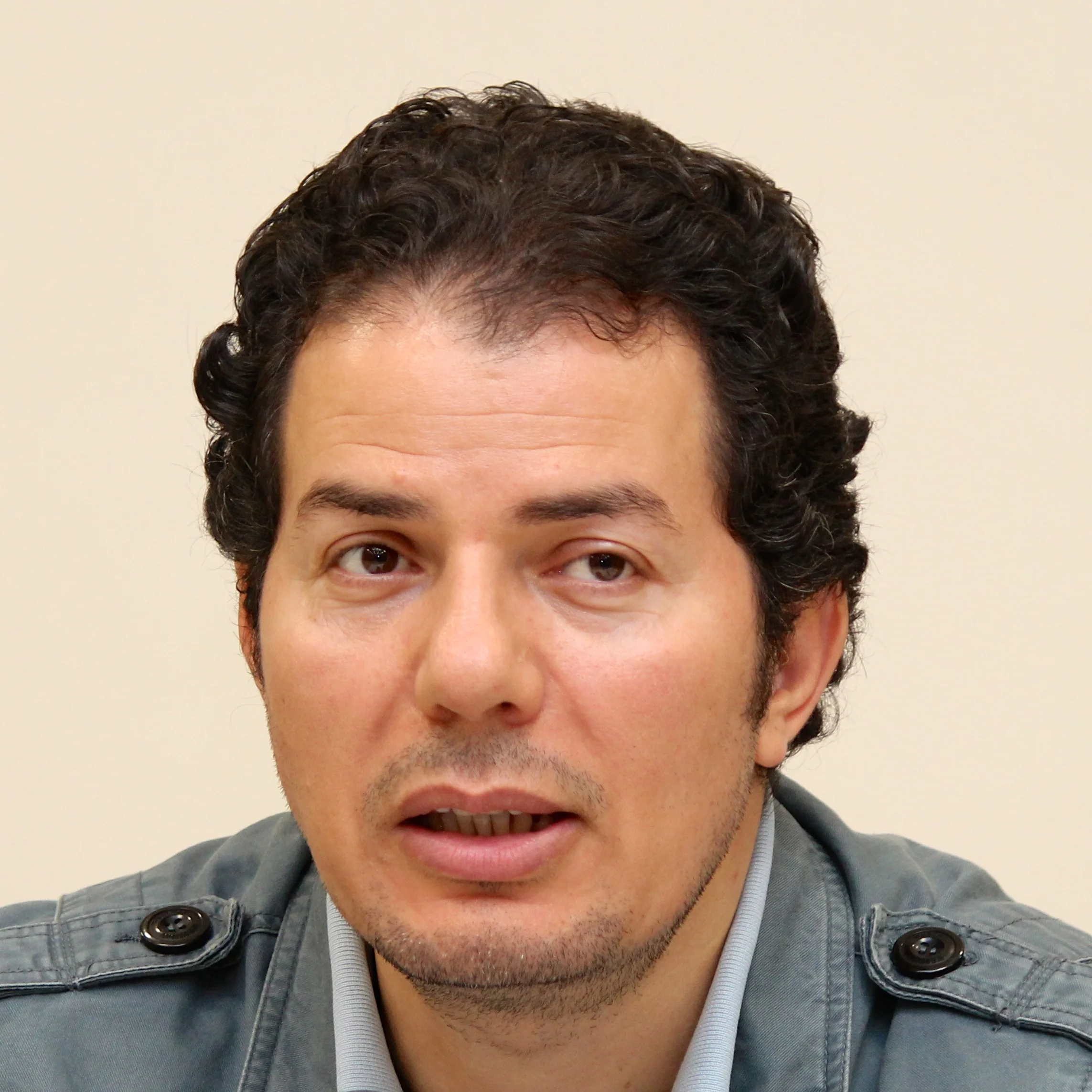
Hamed Abdel-Samad
 Egypt
Egyptwriter•autobiographer•historian•political scientist
Birthday
February 1, 1972
Birth Sign
Aquarius
Birthplace
Giza, Egypt
Age
54 years old
About
Hamed Abdel-Samad is a German-Egyptian author, political scientist, and historian, known for his sharp critiques of Islam, political Islam, and the integration of Muslims in Europe. Born in Giza, Egypt, he now lives in Germany, where he has become one of the most provocative public intellectuals on these topics. His books, essays, and interviews reach a wide audience across Europe and the Middle East, sparking both admiration and fierce controversy.
Abdel-Samad’s work is defined by a personal trajectory from religious radicalism to secularism, which he documents in his acclaimed memoir. He writes in German and English, and his commentary appears in major outlets like Spiegel, NZZ, and The Globalist. As of 2026, he remains an active voice, publishing essays and giving interviews that challenge conventional thinking on faith, freedom, and identity.
Early Life & Background
Born in Giza, Egypt, on February 1, 1972, Hamed Abdel-Samad grew up as the third of five children in a deeply religious household. His father was a Sunni Muslim imam, and the family’s life revolved around the mosque and Islamic teachings. From a young age, Abdel-Samad was steeped in religious education, attending Quranic schools and memorizing scripture. The expectations of his father’s role weighed heavily on him, and he later described his childhood as one of constant religious pressure.
As a teenager, Abdel-Samad became involved with the Muslim Brotherhood, drawn to its promise of a pure Islamic society. He attended meetings, read their literature, and absorbed their ideology. But the more he learned, the more doubts crept in. He began to question the teachings and the organization’s methods, a process he would later describe as a slow awakening.
In the 1990s, Abdel-Samad moved to Germany, a decision that changed his life. He enrolled at university, studying political science and Islamic studies. To support himself, he took on various jobs, and after graduating, he worked for UNESCO in Geneva and later in the Department of Islamic Studies. These experiences exposed him to a wider world and gave him the intellectual tools to analyze the religion he had once embraced. His memoir, Mein Abschied vom Himmel, published in 2009, recounts this journey from radicalism to secularism, a story that resonated with many in Germany and beyond.
Career Growth
Abdel-Samad’s breakthrough came in 2009 with the publication of his memoir, Mein Abschied vom Himmel (Farewell to Heaven). The book, which detailed his break with the Muslim Brotherhood and his path to secularism, made him a household name in Germany. Spiegel covered it extensively, and he became a sought-after commentator on Islam and integration.
In 2010, he published an essay for The Globalist titled “The Muslim World and the Titanic,” and gave a controversial Spiegel interview where he compared Islam to a drug. The metaphor, “Islam is like a drug, like alcohol. A small amount can have a healing and inspiring effect, but when the believer…,” drew international attention and set the tone for his later work.
His 2014 book, Der islamische Faschismus (Islamic Fascism), was his most contentious. Critics called it “a scrappily pasted-together book,” but it solidified his reputation as a fearless critic. In 2015, he published Mohamed: Eine Abrechnung (Mohamed: A Reckoning), a critical examination of the Prophet Muhammad’s life, which Qantara.de discussed as part of his shift “from critique of Islam to post-Salafism.”
Over the years, Abdel-Samad has appeared on MEMRI TV, been profiled in The Point magazine, and written for NZZ on topics ranging from Ramadan’s history to the contradictions between Islam and freedom. In 2023, he told NZZ that “Islam and freedom contradict each other,” a statement that continues to fuel debate. He has also appeared in documentaries and on Ayaan Hirsi Ali’s podcast. As of 2025, he remains an active writer, with a Times of Israel blog post titled “From Ally to Accuser” examining his evolving public standing.
Career Timeline
Public Image & Style
Hamed Abdel-Samad is known for his provocative and analytical style, often challenging religious orthodoxy head-on. He is described as “one of Germany’s best-known Muslim media pundits” and “a solitary voice of courage amidst the storm.” His public persona is that of a former insider who uses his personal history to critique Islam from within. He writes in a direct, confrontational tone, and his social media presence, particularly on X, reflects his engagement with current debates. There is no formal fandom, but he has a loyal following among secularists and free-speech advocates, as well as critics who see him as divisive.
Fame & Fandom (iFAMOUS Rankings)
Hamed Abdel-Samad occupies a distinct position in the landscape of contemporary political commentary, recognized for his unyielding critiques of political Islam and his unique trajectory from religious radicalism to secular advocacy. While he commands a dedicated readership among critics of fundamentalism and secularists across Europe and the Middle East, iFANN's Global Fame Engine has evaluated this person but they do not currently hold a placement in the published rankings, including the Global Top 1,000 or any Top-100 scope list. Consequently, no ordinal rank or numerical score is assigned at this time. His influence is derived not from celebrity metrics but from the circulation of his books and essays in major outlets like Spiegel and NZZ, where his arguments regarding the incompatibility of Islam and freedom spark intense debate rather than mass adoration. The audience surrounding Abdel-Samad functions as an ideological following rather than a traditional fanbase; there is no formal name documented for this group, nor are there organized fan clubs, rituals, or campaigns associated with him. Unlike entertainers who inspire crowds to disrupt streets or fund birthday billboards, support for Abdel-Samad manifests through engagement with his written works and social media interactions on platforms like X, where he maintains approximately 7.9K followers. His presence is characterized by controversy and intellectual confrontation, reflecting a status built on shared convictions rather than the worship typical of pop culture icons. This distinction ensures that while his voice is heard loudly in specific circles, it does not register within the broad statistical frameworks used to measure global fame.
Interesting Facts and Legends
Hamed Abdel-Samad was once a member of the Muslim Brotherhood, a fact he has openly discussed in his public life. He has claimed that the organization's founder, Hassan Al-Banna, admired Adolf Hitler and modeled the group on the Nazi Party. Additionally, he has argued that "Islam and freedom contradict each other," a phrase that has become a recurring talking point in debates about integration. His professional background includes work for UNESCO in Geneva, providing institutional credentials beyond his writing career. His book Der islamische Faschismus faced criticism from some reviewers yet remains a significant component of his public profile. He has also compared Islam to a drug, suggesting that small amounts can be healing while larger quantities prove harmful. Beyond these documented facts, a central narrative surrounds his transition from a devout Muslim to a prominent critic after being beaten by extremists in Germany, leading to his conversion to Christianity. This biographical journey is widely retold as the defining moment of his identity. Another key event often referenced is the publication of Der islamische Faschismus, which sparked intense international debate regarding his theories on political Islam. These stories form the core of his public mythology, distinguishing him as a figure who risked personal safety to challenge radical ideologies.
Notable Quotes
“Islam is like a drug, like alcohol. A small amount can have a healing and inspiring effect, but when the believer...”
“Islam and freedom contradict each other.”
“With immigration and radical Islam, Europe will be heading back to the Middle Ages.”
Family & Personal Life
Abdel-Samad was born in Giza, Egypt, the third of five children. His father was a Sunni Muslim imam, and the family’s life was deeply rooted in religious practice. He has spoken about the pressure of growing up in a religious household, but he has not publicly shared details about his siblings or their current lives. After moving to Germany, he built a new life, but he has kept his personal family life largely private. There is no public information about a spouse or children.
Notable Connections
Hamed Abdel-Samad has appeared on Ayaan Hirsi Ali’s podcast to discuss cultural identities, and he has been featured in Iraqi filmmaker Hashim Almadani’s documentary Secular – The Invisible Middle-Easterner. He has also been the subject of a 2025 Times of Israel blog post by Michael Kuenne, titled “From Ally to Accuser.”
Relationships & Dating History
Salary, Net Worth In 2026
$1 Million
iFANN Editorial Team estimate
iFANN currently estimates Hamed Abdel-Samad's net worth at $1 Million as of 2026. This valuation reflects his sustained career as a writer, autobiographer, historian, and political scientist. His primary revenue streams include sales of his German-language bestsellers, such as Mein Abschied vom Himmel and Der islamische Faschismus, which have achieved significant circulation throughout Europe. Income is further generated through regular speaking engagements and appearances in major media outlets like NZZ and Spiegel, where he contributes columns and interviews. Although he operates outside the sphere of traditional celebrity, his niche as a controversial public intellectual has enabled him to build a financially sustainable profession. The combination of his published works and his active role in public discourse continues to support his economic standing in the current market.
Awards & Accolades
Known For
Mein Abschied vom Himmel
2009 · Author
Der islamische Faschismus
2014 · Author
Mohamed: Eine Abrechnung
2015 · Author
Keywords
Sources
Quick Facts
- Profession
- writer, autobiographer, historian, political scientist
- Born
- February 1, 1972
- Birthplace
- Giza, Egypt
- Gender
- Male
- Birth Sign
- Aquarius
- Nationality
- German-Egyptian
Personal Details
- Full Name
- Hamed Abdel-Samad
- Education
- University studies in Germany; worked for UNESCO in Geneva and the Department of Islamic Studies
Frequently Asked Questions
Is Hamed Abdel-Samad an atheist?
What is Hamed Abdel-Samad's most controversial book?
Why did Hamed Abdel-Samad leave Egypt?
What is Hamed Abdel-Samad's stance on the Muslim Brotherhood?
Is Hamed Abdel-Samad still active as a writer in 2026?
Social Media
Similar People
Join the community
fans discussing