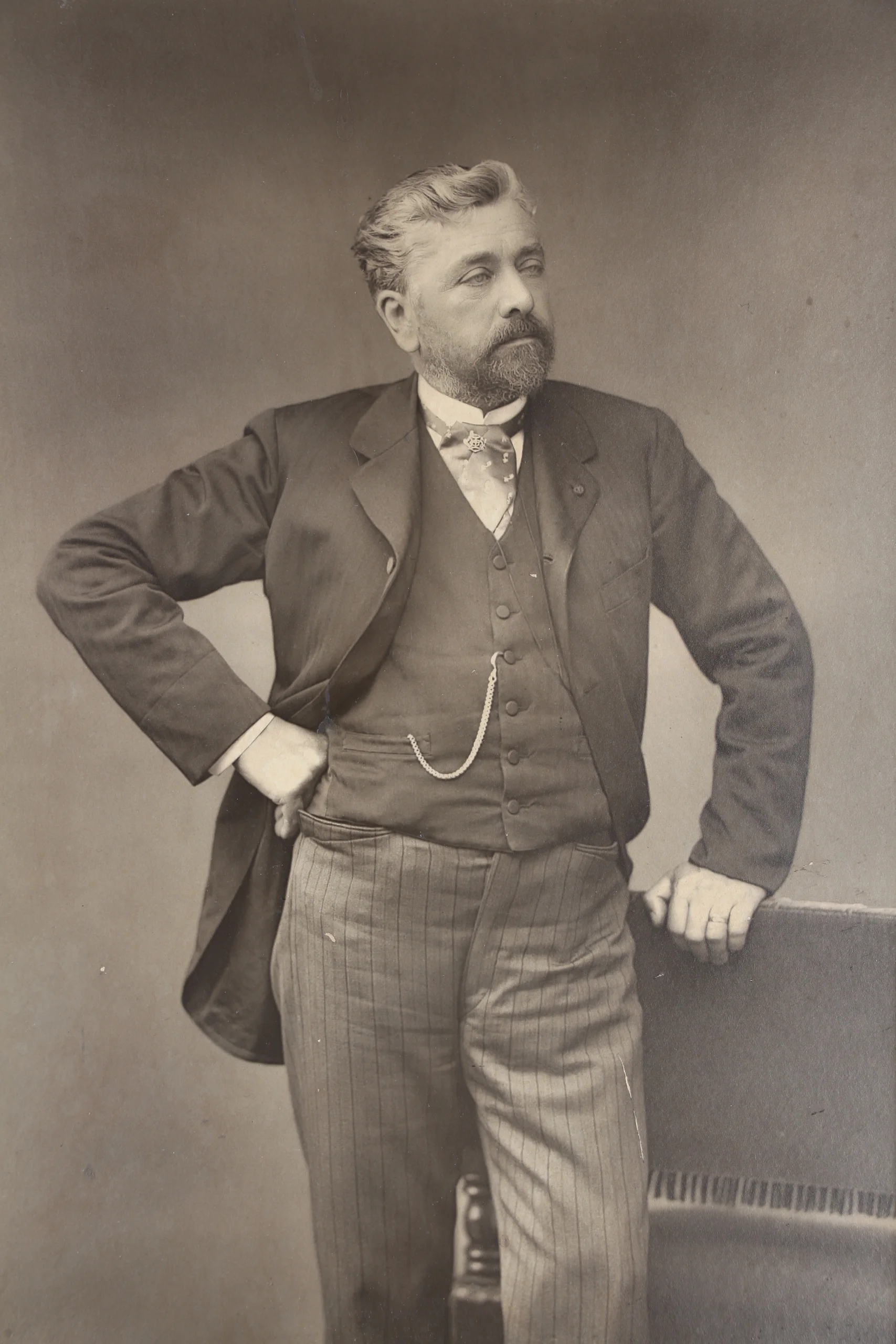
Gustave Eiffel
 France
civil engineer•architect•entrepreneur
Also known as: Alexandre Gustave Bönickhausen Eiffel, Gustave Eiffel
Birthday
December 15, 1832
Birth Sign
Sagittarius
Birthplace
Dijon, France
Age
Died at 91
Height
5 ft 9 in (175 cm)
About
Gustave Eiffel was a French civil engineer and architect whose name is permanently attached to the most recognizable structure in Paris. Born in Dijon in 1832, he trained as a chemist before finding his true calling in metal construction. His company built railway bridges, viaducts, and the internal skeleton of the Statue of Liberty, but the Eiffel Tower, completed for the 1889 World's Fair, made him a household name.
Today, the tower draws about seven million visitors each year, and Eiffel's legacy lives on through the structures he left behind. After retiring from active engineering, he devoted himself to meteorology and aerodynamics, building a wind tunnel at the base of the tower. He died in 1923 at the age of 91, but his work continues to shape skylines and inspire engineers worldwide.
Early Life & Background
Gustave Eiffel was born Alexandre Gustave Bönickhausen Eiffel in Dijon, France, on December 15, 1832. His mother, Catherine Mélanie, ran a profitable coal and wood trading business, and his father, Alexandre, had a military background. The family's entrepreneurial spirit would later influence his own approach to business. He attended the École Centrale des Arts et Métiers in Paris, graduating in 1855 with a degree in chemistry.
His original plan was to work in his uncle's vinegar factory, but a family dispute changed his course. He took a job with railway engineer Charles Nepveu, where he learned the ins and outs of iron bridge construction. Over the next two decades, he built a reputation for designing innovative metal structures for the French railway network. By the 1870s, he had established his own company, specializing in metal viaducts and bridges. One of his early triumphs was the Garabit Viaduct in southern France, completed in 1884, which was the tallest bridge in the world at the time.
Career Growth
Eiffel's breakthrough came with the Garabit Viaduct, but his most famous work was yet to come. In the early 1880s, his company was hired to design the internal iron framework for the Statue of Liberty, a gift from France to the United States. The statue was dedicated in 1886, and the framework was crucial for its stability.
Then came the Eiffel Tower. Built for the 1889 Exposition Universelle, the tower stood 300 meters tall, making it the tallest man-made structure in the world. Construction took just over two years, and the tower opened on March 31, 1889. It was meant to be temporary, but Eiffel saved it by installing a radio antenna and meteorological instruments. After the Panama Canal scandal in 1893, he retired from active engineering and turned to scientific research. In 1909, he built a wind tunnel at the base of the tower, pioneering studies in aerodynamics that contributed to early aviation.
Career Timeline
Public Image & Style
Gustave Eiffel is remembered as a visionary engineer who combined technical brilliance with entrepreneurial ambition. He had an eye for elegance, evident in the graceful curves of his bridges and the tower's lattice design. Media portrayals often emphasize his meticulous nature and his willingness to push the boundaries of iron construction. He is seen as a symbol of French engineering excellence and national pride, and the tower itself has become synonymous with Paris.
Fame & Fandom
Gustave Eiffel's fame rests on his enduring structures rather than on organized fandom. There is no formal name for his admirers; they are simply visitors to his monuments or students of his engineering legacy. The Eiffel Tower draws millions each year, and visitors participate in rituals like the nightly sparkle show. Heritage institutions and collectors keep his memory alive, with original artifacts fetching high prices at auction.
According to the iFANN Global Fame Rankings, Gustave Eiffel is the 54th most famous person in France, holding steady from the previous cycle. He also ranks as the 46th most famous person from France. Within the Art & Design category, he stands as the 27th most famous person in Art & Design, a placement that remains consistent across recent assessments.
Interesting Facts and Legends
One of the most retold stories about Eiffel concerns the tower's survival. The structure was originally scheduled for demolition in 1909, but Eiffel argued that it could serve as a radio antenna and meteorological station. The tower's strategic value for communications was proven during World War I, when it intercepted enemy messages.
The private apartment at the top of the tower was a real retreat where Eiffel hosted Thomas Edison. The notion that it was secret is exaggerated, but it was not open to the public. The apartment has been preserved and is now part of the tower's tour.
Before the tower was built, a group of artists and intellectuals, including Guy de Maupassant, signed a petition calling it a "useless monster." Maupassant reportedly ate lunch at the tower's restaurant every day because it was the only place in Paris where he couldn't see the tower. That anecdote is widely repeated but considered folklore.
In 2026, original sections of the tower's spiral staircase were auctioned, with one piece selling for €450,000, showing how much collectors value artifacts from his work.
Notable Quotes
“I ought to be jealous of the tower. She is more famous than I am.”
“The tower will be the highest edifice ever raised by man. Will it not also be grandiose? And why should something admired in Egypt become odious and ridiculous in Paris?”
Family & Personal Life
Gustave Eiffel married Marguerite Gaudelet in 1862, and the couple had five children: three daughters, Claire, Laure, and Valentine, and two sons, Édouard and Albert. Marguerite died in 1877, leaving Eiffel a widower at 44. He never remarried. His later years were devoted to his children and his scientific research. The family remained close, and his descendants have managed his estate, including the rights to his name and legacy.
Notable Connections
Gustave Eiffel worked with several notable figures of his time. Charles Nepveu mentored him early in his career. Frédéric Auguste Bartholdi designed the Statue of Liberty, and Eiffel's company engineered its internal framework. Thomas Edison visited Eiffel at his apartment atop the tower, where they discussed the phonograph. His wife, Marguerite Gaudelet, was his partner for 15 years before her death.
Relationships & Dating History
Gustave Eiffel's romantic life was quiet and devoted. He married Marguerite Gaudelet in 1862, and the couple had five children together. Marguerite's death in 1877 left him a widower at 44, and he never remarried. There are no documented relationships after her passing. His later years were focused on his children, his research, and his engineering legacy. As of his death in 1923, he was a widower.
- MarriedMarguerite Gaudelet1862 - 1877Married in 1862, had five children together, widowed upon her death in 1877.
Death & Aftermath
Died
December 27, 1923 (aged 91)
Death Place
Paris, Île-de-France, France
Cause of Death
Natural causes due to old age
The engineering community and the French nation marked the passing of Gustave Eiffel with immediate tributes, recognizing the end of an era for structural innovation. While specific details of public vigils remain sparse in historical records, the Académie des Sciences and the Société des Ingénieurs Civils de France swiftly honored his contributions to aerodynamics, meteorology, and civil works. He died on December 27, 1923, at his home at 10 Rue de la Bienfaisance in the 8th arrondissement of Paris, surrounded by family during a quiet final period that saw no public appearances after late 1923. The cause was attributed to natural causes associated with old age, as he had suffered from a long-term illness and general frailty typical of his ninety-one years.
His funeral served as a significant state occasion shortly after his death, attended by prominent engineers, architects, and government officials who acknowledged his status as a national hero. He was laid to rest in the Cimetière du Montparnasse, where tributes highlighted his pioneering work in wind tunnels and early aviation studies. Posthumously, his legacy received formal validation when the Académie des Sciences awarded him the Poncelet Prize in 1924 for his later research. His estate passed to his descendants under French inheritance laws, preserving rights to his name while original artifacts, such as sections of the tower's staircase, continue to hold commercial value decades later.
Net Worth (Estate Value)
$5 Million
iFANN Editorial Team estimate
Gustave Eiffel's estate continues to generate income through the licensing of his name and the sale of original artifacts. The Eiffel Tower itself is owned by the city of Paris, so its revenue goes to SETE, not to his descendants. However, the estate benefits from auctions and intellectual property rights.
In 2026, several significant sales took place: a section of the original spiral staircase was auctioned, and a portion of the tower sold for €450,000. The Musée d'Orsay also acquired a set of his autograph letters. The iFANN Editorial Team estimates his estate's value at around $5 million as of 2026, based on the consistent demand for Eiffel-related items and the ongoing commercial use of his name.
Awards Won (1)
Gustave Eiffel was made a Commander of the Legion of Honour, France's highest order of merit, for his contributions to engineering and science. He was also recognized by the scientific community for his wind tunnel research, leading to membership in the Académie des Sciences.
1889 · National Honour
Engineering career
Known For
Eiffel Tower
1889 · Designer and builder
Statue of Liberty
1886 · Engineered internal framework
Garabit Viaduct
1884 · Designer and builder
Keywords
Sources
Quick Facts
- Profession
- civil engineer, architect, entrepreneur
- Born
- December 15, 1832
- Birthplace
- Dijon, France
- Died
- December 27, 1923
- Death Place
- Paris, France
- Gender
- Male
- Spouse
- Marguerite Gaudelet
- Birth Sign
- Sagittarius
- Education
- École Centrale des Arts et Métiers
- Height
- 5 ft 9 in (175 cm)
Personal Details
- Full Name
- Alexandre Gustave Bönickhausen Eiffel
- Height
- 5 ft 9 in (175 cm)
- Spouse
- Marguerite Gaudelet
- Children
- Claire Eiffel, Laure Eiffel, Valentine Eiffel, Édouard Eiffel, Albert Eiffel
- Education
- École Centrale des Arts et Métiers, Paris (1855)
Frequently Asked Questions
How old was Gustave Eiffel when he died?
What is Gustave Eiffel best known for?
Did Gustave Eiffel have children?
How long did it take to build the Eiffel Tower?
Was the Eiffel Tower originally meant to be temporary?
Similar People
Join the community
fans discussing