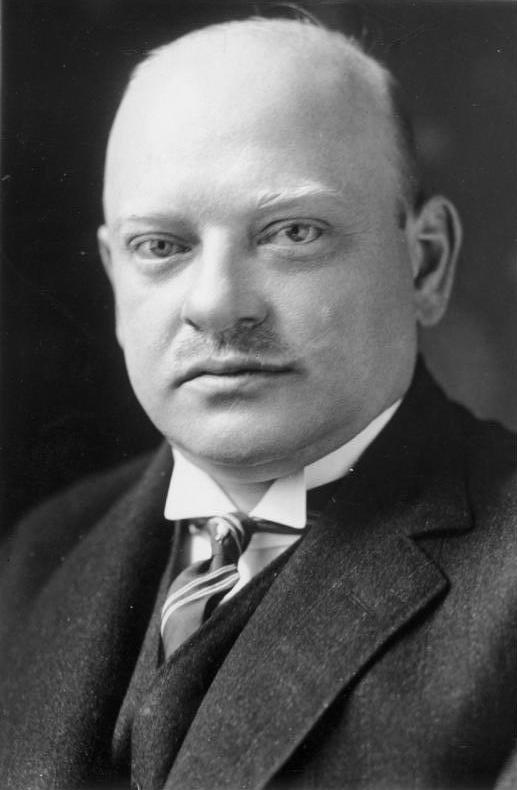
Gustav Stresemann
 Germany
politician•diplomat•head of government
Birthday
+1878-05-10
Birth Sign
Taurus
Birthplace
Berlin
Age
Died at 51
About
Gustav Stresemann was a German statesman who navigated the Weimar Republic through some of its most turbulent years. Born in Berlin on May 10, 1878, he studied political economy, history, and international law at the University of Berlin and Leipzig University, where he forged a political philosophy blending liberalism and nationalism. After earning his doctorate, he worked in trade associations before entering politics, winning a Reichstag seat in 1907 as a National Liberal. He lost that seat in 1912 but returned in 1914. During World War I, Stresemann vocally supported German militarism and expansionism, and despite poor health that kept him from military service, he rose to lead the National Liberals by 1917. Germany's defeat and the fall of the monarchy forced a painful reassessment. He founded the German People's Party (DVP) and, though a monarchist at heart, gradually came to accept Weimar democracy and cooperate with center-left parties.
Fame & Fandom
Gustav Stresemann's enduring fame rests not on fan clubs or viral moments, but on the quiet, persistent admiration of historians, political scientists, and devoted students of the Weimar Republic. His is a legacy kept alive through scholarly tomes, commemorative essays, and the occasional documentary that finds a new audience, like the Sir Manatee video that has drawn over 139,000 views, a modest but engaged following for a statesman who died in 1929.
His admirers tell a story of a man who might have changed the course of the 20th century, had he lived. The 2021 Engelsberg Ideas essay called him 'The man who almost saved the world,' a phrase that captures the counterfactual longing that defines his fandom. They point to his Nobel Peace Prize in 1926, his deft handling of the Locarno Treaties, and his stabilizing hand during the hyperinflation crisis. Yet, there is no formal fandom name, no organized campaigns, no inside jokes, only a shared reverence for a diplomat who tried to anchor Germany in a fragile peace.
As of August 2026, the iFANN Global Fame Engine has evaluated Gustav Stresemann, but he does not currently hold a placement in the published rankings, neither in the Global Top 1,000 nor in any Top-100 scope list. This unranked status is a reflection of his niche appeal, a fame that lives in archives and lecture halls rather than in the global spotlight. For those who study him, however, his place in history is beyond measure.
Interesting Facts and Legends
Stresemann's sudden death on October 3, 1929, at age 51, just weeks before the Wall Street Crash, has fueled one of history's most poignant 'what-ifs.' Many fans and historians still tell the story that his passing may have sealed the Weimar Republic's fate, allowing the rise of Nazism, a narrative that remains unverifiable but deeply cherished.
A photograph by Felix H. Man, 'Gustav Stresemann and Count Zech, Evening Conversation in The Hague, August 1929,' now in the Museum of Modern Art, captures him in his final diplomatic push, negotiating the Young Plan. This image has become an iconic visual symbol of his last efforts.
German conceptual artist Hanne Darboven created a work titled 'Gustav Stresemann Posthum,' a posthumous artistic tribute that underscores his lasting cultural resonance. Stresemann's Nobel Peace Prize in 1926, shared with Aristide Briand, remains his most celebrated achievement, and his speech at the League of Nations in September 1926, when Germany was admitted as a permanent Council member, is remembered as a moment of national vindication.
Death & Aftermath
Died
+1929-10-03 (aged 51)
Death Place
Berlin, Germany
Cause of Death
Reported acute cerebral hemorrhage
The news of Gustav Stresemann's passing sent a profound shock through Germany and the international community, with political peers across the spectrum mourning the loss of the man who had stabilized the fragile Weimar Republic. Tributes poured in from leaders like Aristide Briand, his fellow Nobel Peace Prize laureate, while massive spontaneous gatherings and moments of silence filled Berlin and other major cities to honor his contributions to European peace. Just weeks before his death on October 3, 1929, Stresemann had been deeply immersed in negotiating the Young Plan regarding German reparations, a task that reportedly exacerbated his deteriorating health as he worked tirelessly in Berlin.
He succumbed to an acute cerebral hemorrhage following severe physical exhaustion, though some historical accounts suggest complications from previous abdominal surgery or a blood clot; the official determination rested solely on clinical observation by attending physicians. The state funeral held on October 6, 1929, served as a significant display of respect, attended by high-ranking officials, foreign diplomats, and representatives from various parties before he was laid to rest in Zehlendorf Cemetery. His legacy endured through the Gustav-Stresemann-Stiftung, which promotes democracy and civic engagement, while his papers were preserved by his family and the German state for future scholarly research.
Awards & Accolades
Keywords
Quick Facts
- Profession
- politician, diplomat, head of government
- Born
- +1878-05-10
- Birthplace
- Berlin
- Died
- +1929-10-03
- Death Place
- Berlin
- Gender
- Male
- Spouse
- Käte Stresemann
- Birth Sign
- Taurus
Personal Details
- Spouse
- Käte Stresemann
Join the community
fans discussing