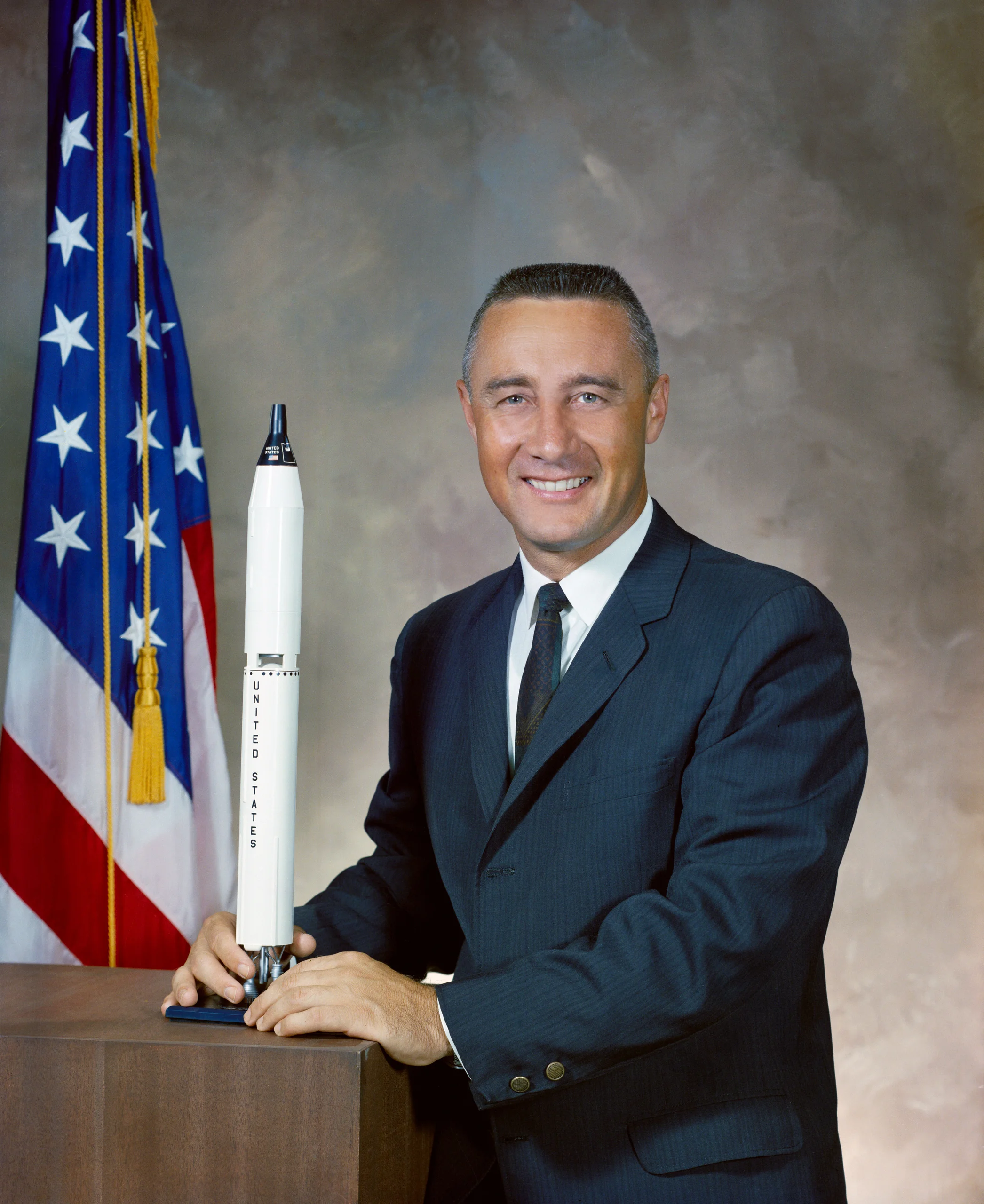
Gus Grissom
 United States
air force officer•astronaut•test pilot
Also known as: Gus Grissom, Virgil Ivan Grissom
Birthday
April 3, 1926
Birth Sign
Aries
Birthplace
Mitchell, Indiana, USA
Age
Died at 40
About
Gus Grissom was an American astronaut and U.S. Air Force officer, one of the original Mercury Seven selected by NASA in 1959. He became the second American in space on July 21, 1961, and later commanded Gemini 3, the first crewed flight of the Gemini program. At the time of his death he was the designated commander of the first crewed Apollo mission.
Grissom is remembered for his engineering discipline and his calm under pressure, qualities that shaped the early American space program. His death in the Apollo 1 fire on January 27, 1967, along with crewmates Ed White and Roger B. Chaffee, led to a redesign of the Apollo command module. He was 40 years old. His awards include the Distinguished Flying Cross, the Air Medal with oak leaf cluster, two NASA Distinguished Service Medals, and the Congressional Space Medal of Honor, awarded posthumously.
Early Life & Background
Virgil Ivan Grissom was born on April 3, 1926, in Mitchell, Indiana, the second of four children of Dennis and Cecile Grissom. His father worked as a railroad brakeman, and the family was working-class. Known as "Gus" from childhood, he attended public schools in Mitchell and graduated from Mitchell High School.
Aviation interested him early, and he earned his pilot's license before entering military service. During World War II he enlisted in the U.S. Army Air Forces, trained as a pilot, and flew combat missions. After the war he enrolled at Purdue University, graduating in 1950 with a Bachelor of Science in mechanical engineering. Purdue later called him "our first astronaut."
Commissioned in the U.S. Air Force, Grissom became a fighter pilot and flew combat missions in the Korean War. He then attended test pilot school and served as an Air Force test pilot at Wright-Patterson Air Force Base, accumulating thousands of flight hours and becoming one of the most experienced test pilots in the country. That record led to his selection as one of the Mercury Seven, introduced by NASA on April 9, 1959.
Career Growth
NASA introduced the Mercury Seven on April 9, 1959, and Grissom was among them. On July 21, 1961, he flew Liberty Bell 7 on a suborbital flight lasting about 15 minutes, becoming the second American in space. After splashdown the hatch blew, the capsule flooded and sank, and Grissom nearly drowned before a helicopter crew pulled him out. The capsule was recovered from roughly 5,000 meters in the Atlantic 38 years later.
In 1963 Grissom commanded Gemini 3, the first crewed flight of the Gemini program, becoming the second American to travel to space twice. He later served as backup command pilot for Gemini 6A before being transferred to the Apollo program. He was named commander of AS-204, the first crewed Apollo mission, with Ed White and Roger B. Chaffee.
Career Timeline
Public Image & Style
Grissom was portrayed as a calm, engineering-minded, no-nonsense pilot, the archetypal test pilot turned astronaut. Media coverage emphasized his working-class Indiana roots, his technical skill, and his tragic death. As a pre-internet figure, his public image was shaped by NASA press materials, contemporary newspapers, and LIFE magazine's Mercury Seven coverage.
Fame & Fandom (iFAMOUS Rankings)
iFANN has not yet collected fame data for Gus Grissom, so no ranking is available. He is not on the September 2026 iFAMOUS Rankings flagship list. His renown rests on his place in the Mercury Seven and his death in the Apollo 1 fire, events that predate modern celebrity metrics.
No formal fandom name or organized fanbase exists in the modern sense; Grissom predates internet fandom culture. His admirers are space-history enthusiasts, Purdue alumni, and Indiana locals. Commemorative efforts such as museum events, centennial tributes, and library dedications are institution-driven rather than fan-driven. No documented fan campaigns, charity drives, or fan-funded projects exist under a fandom name.
Interesting Facts and Legends
The Liberty Bell 7 capsule sank after splashdown in 1961 and was recovered from the Atlantic floor 38 years later. Grissom's near-drowning after splashdown became one of the most retold stories of the Mercury program. A 1965 Corvette once owned by Grissom surfaced in 2026, bearing his name in faded ink. His 100th birthday fell in 2026, prompting a wave of commemorations.
A story fans still retell concerns whether Grissom blew the hatch himself; the cause remains disputed folklore rather than confirmed fact. His most famous attributed remark, about the Apollo 1 capsule and a "lemon," is widely repeated but not verbatim-confirmed in available sources.
Family & Personal Life
Notable Connections
Relationships & Dating History
Grissom married Betty Moore, his high-school sweetheart from Mitchell, Indiana. The marriage lasted until his death on January 27, 1967. No other public relationships, engagements, or rumored flings are documented in credible sources. Betty Grissom was widowed at the time of his death and later died in 2000.
- MarriedBetty Grissom1940s - 1967High-school sweetheart from Mitchell, Indiana; married until his death in 1967.
Death & Aftermath
Died
January 27, 1967 (aged 40)
Death Place
Cape Kennedy, Florida, USA
Cause of Death
Reported asphyxiation in Apollo 1 fire
By January 1967, Grissom was commander of AS-204, the first crewed Apollo mission, and the crew was running through a "plugs-out" test at Launch Complex 34 at Cape Kennedy, Florida, with the launch set for February 21. On the evening of January 27, a flash fire broke out inside the command module. Grissom, Ed White and Roger B. Chaffee were killed. Grissom was 40. The crew is reported to have died of asphyxiation from the fire's toxic gases, though the sources do not name an official who established that.
The investigation and legal aftermath are not documented in the material available. NASA convened an accident review board after the fire; no lawsuit, trial or settlement connected to the deaths is described in these sources, so that ground is best left unstated rather than filled in.
The commemorative record is long and still growing. Purdue University, his alma mater, calls him "our first astronaut" and has published retrospective tributes. The Space Museum in Bonne Terre, Missouri, planned special events for what would have been his 100th birthday on April 3, 2026, including an Apollo 1 documentary screening and NASA artifacts. Indiana Public Media produced "A Hoosier Amongst the Stars: The Wild Ride of Gus Grissom" in April 2026, and a 2026 Hagerty feature recounted how a 1965 Corvette once owned by Grissom surfaced, bearing his name in faded ink. Grissom received the Congressional Space Medal of Honor and the NASA Distinguished Service Medal, and is inducted into the National Aviation Hall of Fame and the National Museum of the U.S. Air Force's astronaut roster. The Astronauts Memorial Foundation maintains a profile of him, and NASA keeps an official biography page.
Institutional dedications followed across the decades. The Virgil I. "Gus" Grissom Library in Newport News, Virginia, broke ground in Denbigh in July 2026 on a new $40 million facility. The Space Museum and Gus Grissom Center, long based in Bonne Terre, Missouri, was set to relocate to downtown Neosho, Missouri, per a May 2026 report. The Liberty Bell 7 capsule from his 1961 Mercury flight, which sank after splashdown, was recovered from roughly 5,000 meters in the Atlantic 38 years later.
Net Worth (Estate Value)
$1 Million
iFANN Editorial Team estimate
No credible net-worth estimate exists for Gus Grissom. He was a career military officer and civil servant, not a commercial celebrity, and his earnings came from Air Force pay and NASA salary. The iFANN Editorial Team does not publish a figure for him because the available record does not support one. His estate value is not documented in available sources. Any figure would be speculation, and we report it as unknown rather than estimating.
Awards Won (4)
Grissom received the Distinguished Flying Cross, the Air Medal with oak leaf cluster, two NASA Distinguished Service Medals, and the Congressional Space Medal of Honor, awarded posthumously.
1967 · Space Medal of Honor
Posthumous
1960s · NASA Award
Mercury and Gemini programs
Known For
Liberty Bell 7
1961 · Pilot
Gemini 3
1963 · Commander
Apollo 1 (AS-204)
1967 · Commander
Keywords
Sources
Quick Facts
- Profession
- air force officer, astronaut, test pilot
- Born
- April 3, 1926
- Birthplace
- Mitchell, Indiana
- Died
- January 27, 1967
- Death Place
- Cape Kennedy, Florida
- Gender
- Male
- Spouse
- Betty Grissom
- Birth Sign
- Aries
Personal Details
- Full Name
- Virgil Ivan Grissom
- Spouse
- Betty Grissom
- Children
- Scott Grissom, Mark Grissom
- Education
- Purdue University (B.S. mechanical engineering, 1950)
Frequently Asked Questions
What happened to Gus Grissom?
How old was Gus Grissom when he died?
What was Gus Grissom famous for?
What happened to Gus Grissom's capsule?
What happened to Gus Grissom's wife?
Similar People
Join the community
fans discussing