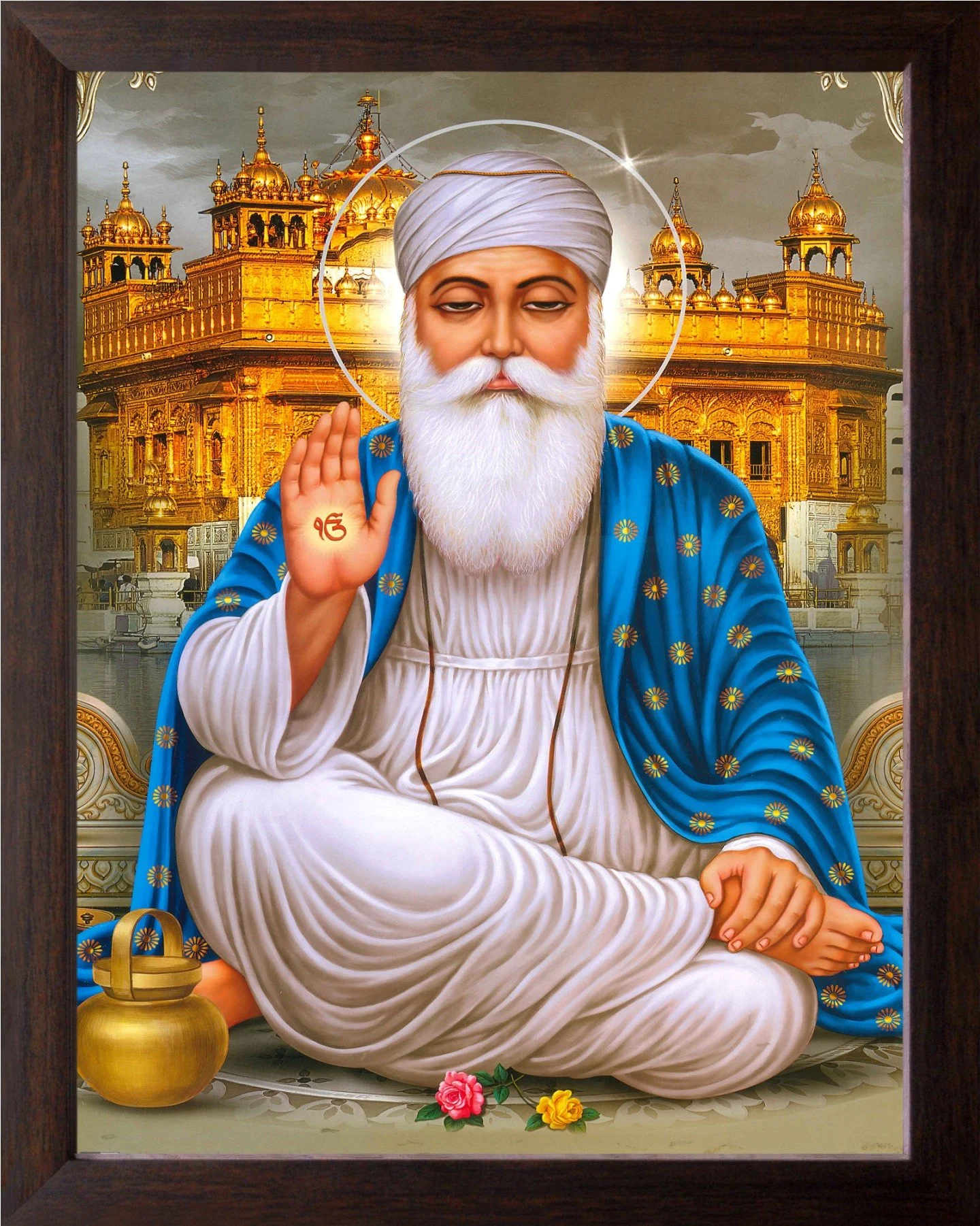
Guru Nanak
 Kiribati
Also known as: Nanak, Baba Nanak, Nanak Dev
Birthday
April 15, 1469
Birth Sign
Aries
Birthplace
Rai Bhoi Ki Talwandi (now Nankana Sahib, Pakistan)
Age
Died at 70
About
Guru Nanak was the founder of Sikhism and the first of the ten Sikh Gurus. He was a spiritual teacher, mystic, and poet who lived from 1469 to 1539. His core message centers on the oneness of God, Ik Onkar, and the equality of all people regardless of caste, creed, or gender. Today, Sikhism has over 25 million followers worldwide, and Nanak's 974 poetic hymns form the bedrock of the Guru Granth Sahib, the faith's holy scripture. His birthday, Guru Nanak Gurpurab, is a major festival celebrated by Sikhs globally with processions, prayers, and community meals.
Early Life & Background
Guru Nanak was born on April 15, 1469, in the village of Rai Bhoi Ki Talwandi, now known as Nankana Sahib in present-day Pakistan. His father, Mehta Kalu, was a village accountant, and his mother, Mata Tripta, was a homemaker. He had an older sister, Bebe Nanaki, who was deeply devoted to him. From childhood, Nanak displayed a contemplative nature, often questioning the rituals and social divisions around him. He learned Hindi and Sanskrit from a Hindu teacher and later studied Persian under a Muslim scholar, giving him fluency in both religious traditions. At age 16, he married Mata Sulakhni, and they had two sons. For a time, he worked as a storekeeper for the local Muslim ruler, but his spiritual restlessness grew. Around age 30, after a three-day disappearance during which he bathed in a river and emerged proclaiming, 'There is no Hindu, no Muslim,' he began his mission.
Career Growth
After his spiritual awakening, Guru Nanak embarked on the first of five major journeys, or udasis, that spanned over two decades. He traveled on foot across India, Tibet, Sri Lanka, the Middle East, and Arabia, covering thousands of miles. In Mecca, he famously challenged religious orthodoxy by placing his feet toward the Kaaba, declaring that God is everywhere. He composed hymns in Punjabi, a language of the common people, set to various ragas. His most celebrated works include Japji Sahib, a morning prayer, and Asa di Var, a hymn about divine justice. He established a community at Kartarpur, where he introduced the practice of langar, a free communal kitchen open to all. Before his death in 1539, he appointed Bhai Lehna as his successor, renaming him Guru Angad, ensuring the continuity of his teachings.
Career Timeline
Public Image & Style
Guru Nanak is revered as a humble, compassionate, and fearless teacher who challenged social injustice. In Sikh tradition, he is described as the 'Guru' who dispels darkness. His image in popular culture is often depicted with a flowing beard, a simple robe, and a serene expression. He is remembered for his wit and directness, as in the story of the 'sharabi' (drunkard) who he said was more honest than those who prayed but lived hypocritically. The annual celebration of Gurpurab includes processions called nagar kirtan, where devotees sing his hymns. His message of equality has resonated beyond Sikhism, influencing global interfaith dialogues.
Fame & Fandom
Guru Nanak commanded a devotion that transcended centuries, evolving from the teachings of a 15th-century mystic into a global movement of millions. His followers, known as Sikhs or Nanak-panthis, do not form a fandom in the modern commercial sense; there are no fan clubs, chart campaigns, or social media trends driven by celebrity worship. Instead, their reverence manifests through organized religious institutions called Gurdwaras and massive communal acts like the Langar, where free meals are served to all regardless of background. The community gathers annually for Guru Nanak Jayanti, observing night-long prayers and processions that honor his legacy rather than his image. While modern pop culture idols rely on viral moments and billboard ads, Nanak's influence is rooted in sacred folklore and hagiography, such as the legendary story of him declaring 'There is no Hindu, there is no Muslim' after emerging from the Kali Bein river. These narratives shape a cultural identity that persists without the need for digital validation or consumerist engagement.
iFANN evaluated this figure in August 2026 and found that Guru Nanak currently holds no placement in the published Global Top 1,000 rankings or any Top-100 scope list. The evaluation confirms he does not appear on the current fame charts.
Interesting Facts and Legends
Historical records note that Guru Nanak traveled to Baghdad to debate with Sufi mystics and visited Haridwar, where he famously threw water westward instead of toward the sun to challenge ritualistic beliefs about ancestors. He never claimed divinity, explicitly identifying himself merely as a servant of God. Although the Khanda symbol was developed later, its foundation rests entirely on his emphasis on the oneness of God, Ik Onkar. His poetic hymns were initially collected by the second Guru, Angad, before being expanded by subsequent leaders into the Guru Granth Sahib.
Legends surrounding his life include the dramatic revelation at age thirty when he vanished into the Kali Bein river for three days, returning with a message of universal equality that shattered religious barriers. Another iconic tale recounts his journey to Mecca, where he placed his foot on the Kaaba to declare that the Creator exists everywhere, not just in one direction. Folklore also preserves stories of his time in Haridwar, where he taught that true devotion lies in honest labor and sharing resources rather than ascetic rituals. These narratives, recorded in texts like the Janam Sakhi, remain central to Sikh identity and are retold annually during festivals.
Notable Quotes
“There is but one God, He is the supreme truth, He is the creator of all.”
“Speak the truth, live truthfully, and walk the path of truth.”
“Recognize that there is one God, and His ways are true.”
“I am neither Hindu nor Muslim; I am a follower of God.”
“The world is a drama, and God is the only director.”
Family & Personal Life
Guru Nanak's father, Mehta Kalu, was a Hindu accountant in the service of a Muslim landlord. His mother, Mata Tripta, was known for her piety. His older sister, Bebe Nanaki, played a significant role in his early life; she was the first to recognize his spiritual depth. Nanak married Mata Sulakhni, the daughter of a merchant, and they had two sons: Sri Chand, who later founded the ascetic Udasi sect, and Lakhmi Das, who remained a householder. After Nanak's death, his sons did not succeed him; instead, his disciple Guru Angad carried forward the spiritual lineage.
Notable Connections
Guru Nanak's successor was Bhai Lehna, who became Guru Angad. His wife Mata Sulakhni supported his mission. His sons Sri Chand and Lakhmi Das did not follow his spiritual path. His sister Bebe Nanaki was an early supporter. The Mughal emperor Babur is mentioned in Nanak's hymns as a tyrant.
Relationships & Dating History
Guru Nanak married Mata Sulakhni around 1485. She was the daughter of a merchant named Mula from the town of Batala. The marriage was arranged by his parents. They had two sons together: Sri Chand, born around 1494, and Lakhmi Das, born around 1497. Mata Sulakhni accompanied Nanak during his early travels and later lived with him in Kartarpur. She died after Nanak, though the exact year is not recorded. As of his death in 1539, Nanak was married to her.
- MarriedMata Sulakhni1485 - 1539Arranged marriage; they had two sons, Sri Chand and Lakhmi Das.
Death & Aftermath
Died
September 22, 1539 (aged 70)
Death Place
Kartarpur
Cause of Death
Illness and advanced age
According to tradition, when Hindu and Muslim followers arrived at Kartarpur in 1539 to perform last rites, they found flowers covering his body, symbolizing that his legacy belonged to all humanity. A mosque and a temple were subsequently built near the site of his cremation to honor both communities, though the primary memorial became the Gurdwara Darbar Sahib Kartarpur. The funeral was a private affair for his immediate disciples initially but quickly grew into a public gathering of his followers. Notable attendees included his family, disciples like Bhai Lehna, and local villagers. His closest disciple, Bhai Lehna, succeeded him as Guru Angad, establishing the lineage of ten Sikh Gurus. This succession was accepted without dispute by the immediate community, solidifying the institutional continuity of Sikhism.
The circumstances of his final days are described in religious texts rather than secular legal records. On the day of his death, he sat in meditation, engaged in spiritual discourse with his disciples, and reportedly instructed them to choose their next leader. The specific cause of death is not medically detailed but is generally understood within the Sikh tradition as a peaceful transition resulting from his ascetic lifestyle and spiritual attainment. Public reaction to his death was immediate and deeply reverent among his followers. Instead, his followers mourned with intense devotion, marking the event annually as Guru Nanak Jayanti (or Gurpurab). Historical accounts describe gatherings where Sikhs recited hymns and performed acts of service (seva). Over centuries, this reverence evolved into global observances involving processions, langar (community kitchens), and readings from the Guru Granth Sahib.
Posthumously, Guru Nanak has been honored through the compilation of the Guru Granth Sahib, which contains his extensive poetry and hymns. Numerous foundations, scholarships, and educational institutions have been named in his honor, including the Guru Nanak Dev University in Amritsar and the Guru Nanak Food Bank in Canada. Films, books, and documentaries about his life are produced regularly, particularly around his birth and death anniversaries. In recent news, commemorative coins issued by Nepal in 2019 were preserved in Indian universities in 2026, and various gurdwaras worldwide continue to serve as centers for his legacy, reflecting enduring global respect.
Awards & Accolades
View 4 records, honours and achievementsKnown For
Founding of Sikhism
1499 · Founder
Japji Sahib
1521 · Composer
Asa di Var
1521 · Composer
Keywords
Quick Facts
- Profession
- guru, religious leader, poet
- Born
- +1469-04-15
- Birthplace
- Nankana Sahib
- Died
- +1539-09-22
- Death Place
- Kartarpur
- Gender
- Male
- Spouse
- Mata Sulakhni
- Birth Sign
- Aries
Personal Details
- Full Name
- Nanak
- Spouse
- Mata Sulakhni
- Children
- Sri Chand, Lakhmi Das
- Education
- Traditional education in Hindi, Sanskrit, and Persian
Frequently Asked Questions
Who was Guru Nanak?
What is Guru Nanak's net worth?
What are Guru Nanak's main teachings?
Is Guru Nanak considered God in Sikhism?
Where is Guru Nanak buried?
Similar People
Join the community
fans discussing