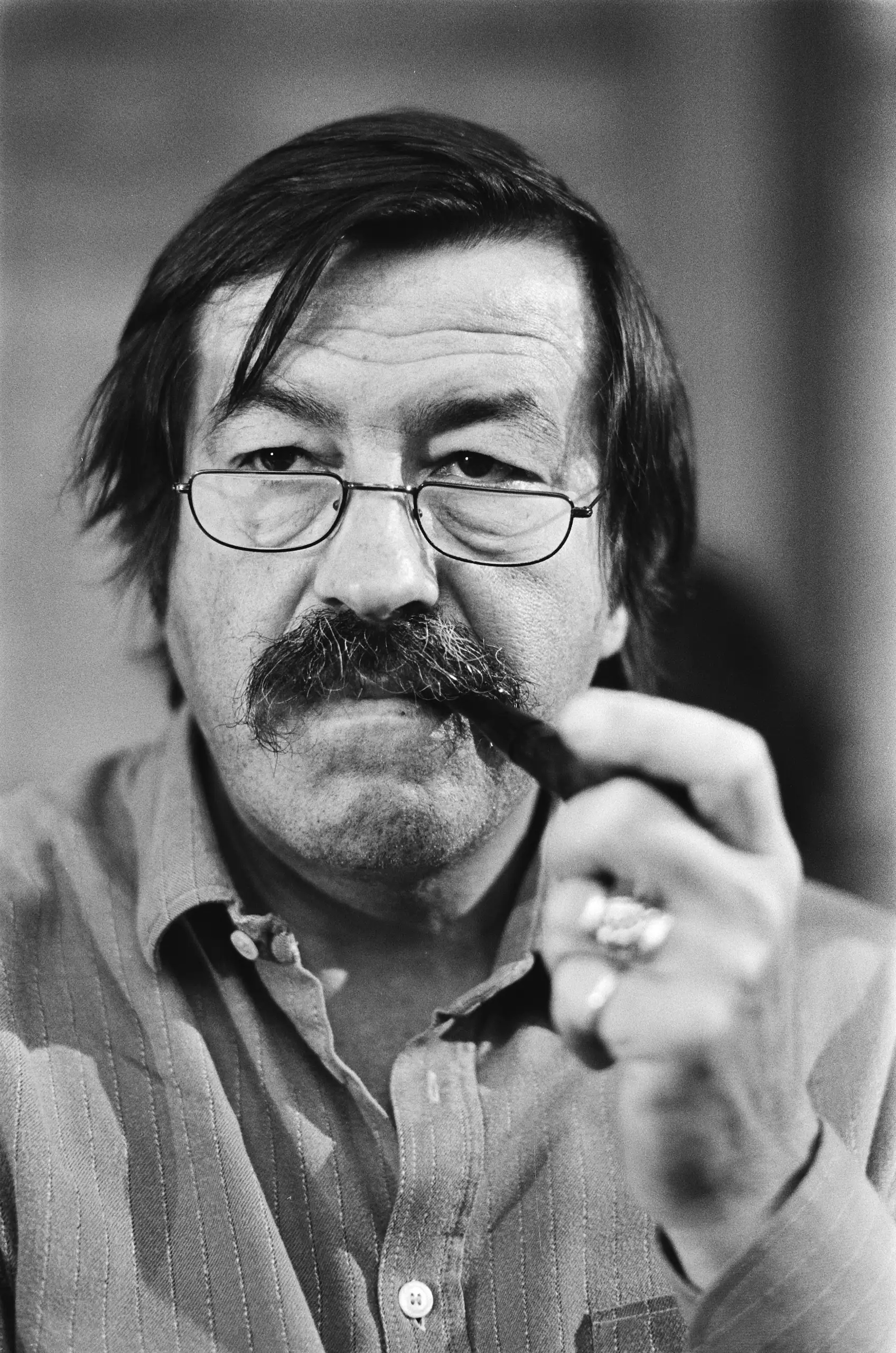
Günter Grass
 Germany
novelist•poet•playwright•illustrator•sculptor
Also known as: Günter Graß, Günter Wilhelm Graß, Gunter Grass
Birthday
October 16, 1927
Birth Sign
Libra
Birthplace
Free City of Danzig (now Gdańsk, Poland)
Age
Died at 87
Height
5 ft 9 in (175 cm)
About
Günter Grass, born Günter Wilhelm Grass on October 16, 1927, in the Free City of Danzig (now Gdańsk, Poland), was a German novelist, poet, playwright, illustrator, graphic artist, and sculptor. He is best known for his 1959 novel The Tin Drum, a cornerstone of European magic realism and the first book in his Danzig Trilogy, which also includes Cat and Mouse and Dog Years. Grass's fiction often returned to the Danzig of his childhood, blending political commentary with fantastical elements. He was an active supporter of the Social Democratic Party of Germany (SPD) and his works frequently carried a left-wing political dimension. Grass's life was marked by early controversy. At age 17, he was drafted into the military and served in the Waffen-SS from late 1944 until the end of World War II, when he was taken prisoner by US forces. He was released in April 1946. After the war, he trained as a stonemason and sculptor before turning to writing in the 1950s. His debut novel, The Tin Drum, was adapted into a film of the same name, which won the Palme d'Or at the 1979 Cannes Film Festival and the Academy Award for Best Foreign Language Film. In 1999, the Swedish Academy awarded Grass the Nobel Prize in Literature, praising him as a writer "whose frolicsome black fables portray the forgotten face of history." Over his career, he wrote more than 30 books, including novels, plays, and poetry collections, and also created numerous illustrations and sculptures. Grass passed away on April 13, 2015, at the age of 87, leaving behind a complex legacy as one of Germany's most significant and provocative literary figures.
Early Life & Background
Günter Wilhelm Grass entered the world on October 16, 1927, in Langfuhr, a district of the Free City of Danzig. His upbringing took place in a household where religious differences were a daily reality; his father Hermann worked as a merchant and was Protestant, while his mother Hedwig was a seamstress and Catholic. This environment of clashing identities within a city where German and Polish cultures intersected shaped his early understanding of division. As Nazism rose through the 1930s, the atmosphere shifted dramatically. At just 15 years old, Grass joined the Hitler Youth, and by late 1944, at age 17, he was conscripted into the Wehrmacht before transferring to the Waffen-SS, serving until the war ended in May 1945. Following his release from an American POW camp near Hamburg in April 1946, Grass did not immediately pursue higher education. Instead, he trained as a stonemason and took on odd jobs to survive. He studied sculpture at the Academy of Fine Arts in Düsseldorf from 1948 to 1950 and later at the Academy of Fine Arts in Berlin from 1952 to 1954. During these formative years, he worked as a lithographer and actor while honing his skills as an illustrator and printmaker. His early artistic output focused on the grotesque and satirical, often depicting the horrors of war and the absurdity of human existence through woodcuts and drawings. This period of visual exploration laid the groundwork for his transition into literature. His move toward writing began in the late 1940s and early 1950s, influenced by surrealism and dark comedy. A pivotal moment arrived in 1953 when he joined the literary group Gruppe 47, a collective of post-war German writers providing a platform for emerging talent. Grass read his early prose pieces there, garnering significant attention. In 1954, he won the first prize of the Gruppe 47 competition for his novella Drums in the Night, which served as the precursor to his first major novel. This victory marked the end of his apprenticeship and the beginning of his professional literary career.
Career Growth
Grass's career exploded with the publication of The Tin Drum in 1959. The novel, set in Danzig during the rise of the Nazis and World War II, told the story of Oskar Matzerath, a boy who decides to stop growing at the age of three and uses his drum to express his rebellion against the adult world. The book was an immediate international sensation, establishing Grass as the literary spokesman for the generation that came of age during the Third Reich. It was adapted into a film by Volker Schlöndorff in 1979, which won the Palme d'Or at the Cannes Film Festival and the Academy Award for Best Foreign Language Film. Throughout the 1960s and 1970s, Grass continued to produce a steady stream of novels, plays, and essays. Key works include Cat and Mouse (Katz und Maus, 1961) and Dog Years (Hundejahre, 1963), completing the Danzig Trilogy. His political activism also intensified; he became a vocal supporter of the Social Democratic Party of Germany (SPD) and frequently used his public platform to critique nuclear weapons, advocate for social justice, and engage in debates about German reunification. In 1999, the Swedish Academy awarded Grass the Nobel Prize in Literature, citing him as a writer "whose frolicsome black fables portray the forgotten face of history." The award cemented his status as a global literary icon. Despite his fame, Grass remained a controversial figure due to his admission in 2006 that he had served in the Waffen-SS, a fact he had kept hidden for over six decades. This revelation sparked intense debate about memory, guilt, and the moral authority of artists, yet it did not diminish his literary legacy. Grass continued to write and publish until his death, releasing works such as Crab Walk (Im Krebsgang, 2002) and Peeling the Onion (Beim Häuten der Zwiebel, 2006), a memoir that detailed his SS membership. He died on April 13, 2015, in Lübeck, leaving behind a vast body of work that includes over 30 books, numerous plays, and thousands of illustrations and sculptures.
Career Timeline
Public Image & Style
Günter Grass was portrayed as a moral conscience of Germany, a man who dared to speak uncomfortable truths. His public image was that of a serious, intellectual, and sometimes controversial figure who was deeply engaged with the political and social issues of his time. His signature style included a blend of satire, magic realism, and historical reflection. He was known for his distinctive appearance, often sporting a beard and wearing casual, working-class attire that contrasted with his elite literary status. His willingness to confront the darkest chapters of German history earned him both reverence and criticism, solidifying his position as a provocateur in the public sphere.
Fame & Fandom (iFAMOUS Rankings)
Günter Grass commanded a global audience defined by intellectual engagement rather than celebrity worship, with his literary works serving as the primary vector for international recognition. The iFANN Global Fame Engine has evaluated this person, but they do not currently hold a placement in the published rankings such as the Global Top 1,000 or any Top-100 scope list. Consequently, no specific numerical rank or score is assigned to his current standing in the database. While his fame was once concentrated within German-speaking regions and academic circles, it remains substantial among those studying post-war European history and literature. The fanbase associated with his work has no formal name documented in available records, reflecting an audience that engages with his texts as historical documents rather than participating in organized fandom rituals. Unlike modern entertainers who cultivate specific subcultures, Grass's legacy rests on the solitary impact of his writing and his role as a moral voice for Germany.
Interesting Facts and Legends
Before becoming a famous writer, Grass was a skilled sculptor and illustrator who created many of the illustrations for his own books. His artistic versatility extended to lithography and printmaking, skills he developed during his vocational training. The film adaptation of The Tin Drum was notable for its use of child actors and its depiction of the grotesque, which was groundbreaking for the time. Grass was a staunch critic of nuclear weapons and was involved in numerous peace movements throughout his life. The 2006 revelation of his Waffen-SS service shocked the public, transforming his biography from a story of triumph into a complex narrative of guilt and confession. This incident sparked intense debate about the nature of truth, memory, and the responsibilities of public intellectuals. His ability to "pry open" Germany's past forced the nation to look at its dark history without flinching, a legacy central to his cultural mythology. Even in his later years, he remained a figure of intense scrutiny and admiration, balancing his role as a moral conscience with the weight of his own concealed history.
Notable Quotes
“No idea stays pure, even the flowering of art isn't pure and the sun has...”
“I realized it was through language that I could define myself as a German.”
“The past is not dead; it is not even past.”
Family & Personal Life
Günter Grass was married twice and had two children. His first marriage was to Anna Schwarz from 1950 to 1955. They met while he was studying art in Düsseldorf, and the union ended in divorce after five years. Together they had one son, Felix Grass, who became a photographer and filmmaker. His second marriage was to Ute Gräfin von der Schulenburg, a noblewoman from a prominent German family, whom he met in 1956. They married in 1957, and their union lasted nearly 60 years. Together, they had a second son, Florian Grass, who is a journalist and author. Ute von der Schulenburg died in 2014, just before Günter Grass. Grass was widowed for approximately one year before his own passing. He was interred in her grave in Lübeck.
Notable Connections
Relationships & Dating History
Günter Grass was married twice and had two children. His first marriage was to Anna Schwarz from 1950 to 1955. They met while he was studying art in Düsseldorf, and the union ended in divorce after five years. Together they had one son, Felix Grass, who became a photographer and filmmaker. His second marriage was to Ute Gräfin von der Schulenburg, a noblewoman from a prominent German family, whom he met in 1956. They married in 1957, and their union lasted nearly 60 years. Together, they had a second son, Florian Grass, who is a journalist and author. Ute von der Schulenburg died in 2014, just before Günter Grass. Grass was widowed for approximately one year before his own passing. He was interred in her grave in Lübeck.
- MarriedAnna Schwarz1950 - 1955Met while studying art in Düsseldorf; divorced after five years.
- MarriedUte Gräfin von der Schulenburg1957 - 2014Noblewoman from a prominent German family; she died in 2014, leaving him widowed.
Death & Aftermath
Died
April 13, 2015 (aged 87)
Death Place
Lübeck, Germany
Cause of Death
Complications from long-term illness and age
Günter Grass died on April 13, 2015, at his home in Lübeck, Germany, at the age of 87. The cause of death was reported by his family as resulting from complications related to a long-term illness and advanced age. In his final years, he had suffered from various health issues, including injuries sustained from a fall in 2014, though no specific acute medical event was publicly detailed as the immediate trigger. His passing marked the end of a career that spanned nearly seven decades of literary production and public activism.
Public reaction to his death was marked by widespread tributes from government officials, peers, and institutions across Germany and internationally. Chancellor Angela Merkel praised his courage in confronting Germany's Nazi past, and the German government issued statements honoring him as a voice of conscience for his generation. Tributes highlighted his role as the literary spokesman for those who grew up during the Third Reich, with moments of silence observed in cultural institutions. His funeral was held privately on April 20, 2015, at St. Mary's Church in Lübeck. The service was attended by close family members, fellow writers, and representatives from the Swedish Academy. He was cremated and interred in the Lübeck cemetery in the grave of his wife, Ute Gräfin von der Schulenburg, who had died the previous year.
Posthumously, a documentary titled Günter Grass, Documentary was released by the Nobel Prize organization in 2017 to commemorate his life and work. While no new major books or films were directly attributed to him after 2015, reprints of his complete works continued to be published, and the Günter Grass Foundation continues to support cultural projects related to literature and art. His estate remains under the administration of his family, with no public disputes over inheritance reported.
Net Worth (Estate Value)
$11 Million
iFANN Editorial Team estimate
As Günter Grass passed away in 2015, his net worth as of 2026 refers to the value of his estate. Specific figures for celebrity net worth sites are generally not applicable to authors of his stature in the same way as entertainers, as their wealth is tied to royalties and estate management rather than active salary. However, estimates suggest his estate remains highly valuable due to the enduring sales of his works and licensing deals. Research by the iFANN Editorial Team puts his estate's fortune at around $11 million.
The annual royalty income from his estate is estimated to be in the millions of euros, driven by the continuous publication of his works in multiple languages and translations. Real estate holdings in Lübeck and intellectual property rights contribute significantly to the total value. Sources indicate that the commercial success of The Tin Drum and other works ensures ongoing revenue streams. The estate is managed by his family, with no public disputes over inheritance reported. The financial trajectory of the estate reflects the sustained interest in his literary contributions and the cultural significance of his work.
Awards Won (9)
Günter Grass received numerous accolades throughout his career, including the prestigious Nobel Prize in Literature in 1999. He was also awarded the Georg Büchner Prize in 1965, the Order of Merit of the Federal Republic of Germany, and the Peace Prize of the German Book Trade in 2005. His novel The Tin Drum was adapted into a film that won the Academy Award for Best Foreign Language Film and the Palme d'Or at the Cannes Film Festival in 1979. These honors reflect his profound impact on German literature and culture.
1979 · Best Foreign Language Film
The Tin Drum
1958 · Literature
Contributions to literature
Known For
The Tin Drum
1959 · Author
Cat and Mouse
1961 · Author
Dog Years
1963 · Author
The Tin Drum
1979 · Co-writer/Producer
Keywords
Sources
Quick Facts
- Profession
- Novelist, poet, playwright, illustrator, sculptor
- Born
- October 16, 1927
- Birthplace
- Free City of Danzig
- Died
- April 13, 2015
- Death Place
- Lübeck
- Gender
- Male
- Spouse
- Ute Gräfin von der Schulenburg
- Birth Sign
- Libra
Personal Details
- Full Name
- Günter Wilhelm Grass
- Height
- 5 ft 9 in (175 cm)
- Spouse
- Ute Gräfin von der Schulenburg
- Children
- Felix Grass, Florian Grass
- Education
- Academy of Fine Arts Düsseldorf, Academy of Fine Arts Berlin
Filmography
1
Total
1
Film
0
TV
Frequently Asked Questions
How did Günter Grass die?
What is Günter Grass best known for?
Did Günter Grass serve in the SS?
What awards did Günter Grass win?
Who was Günter Grass married to?
Similar People
Join the community
fans discussing