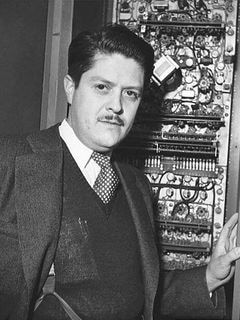
Guillermo González Camarena
 Mexico
Birthday
February 17, 1917
Birth Sign
Aquarius
Birthplace
Guadalajara, Jalisco, Mexico
Age
Died at 48
Height
5 ft 7 in (170 cm)
About
Guillermo González Camarena was a Mexican inventor and engineer. He is most famous for creating one of the earliest color television systems, patenting his field-sequential color television system in 1940. He made the first public color broadcast in Mexico on August 31, 1946, and founded XHGC-TV (now Canal 5), the first television station in Latin America, in 1952. His innovations, including a color camera used during the Apollo program, remain foundational to modern television. His legacy is celebrated today through the lasting impact of his pioneering work in broadcast technology.
Early Life & Background
Guillermo González Camarena was born on February 17, 1917, in Guadalajara, Jalisco, Mexico, the youngest of seven children. His early life was set against the backdrop of a bustling household, with his father working as a judge and his mother managing the family. Even as a child, Guillermo displayed an extraordinary knack for electronics. When his family moved to Mexico City during his youth, his burgeoning passion for the field truly took off. At the remarkable age of 12, he constructed his first radio transmitter from scrap parts, demonstrating an innate talent for engineering. As a teenager, he further honed his skills by building a rudimentary television receiver, all within a dedicated home workshop he meticulously set up himself.
His formal education included studying electrical and mechanical engineering at the National Polytechnic Institute (IPN) in Mexico City. It was there that he began to seriously explore the complexities of color transmission. While he never formally studied television technology as a specific discipline, he meticulously taught himself through rigorous reading and extensive hands-on tinkering, driven by an insatiable curiosity. By 1934, at just 17 years old, González Camarena was already deeply immersed in experimenting with color television systems, determined to conquer a technical challenge that had baffled engineers across the globe.
This relentless dedication culminated in a significant breakthrough in 1939. He successfully developed a working prototype of his innovative color system. This crucial achievement paved the way for him to file his patent the following year, in 1940. His invention, a field-sequential color television system, ingeniously utilized a rotating color wheel to produce vivid images, marking a foundational step in the history of television technology.
Career Growth
In 1940, González Camarena filed for a patent on his field-sequential color television system, which was granted in the US as Patent 2,296,019 in 1942. The system used a rotating wheel with red, green, and blue filters placed in front of a black-and-white camera and receiver. On August 31, 1946, he made history with the first public color television broadcast in Mexico, transmitting his wife's face from his living room to a hospital ten blocks away.
Six years later, in 1952, he launched XHGC-TV, the first television station in Latin America, named after his initials. He designed and built much of the station's transmission equipment himself. In the 1960s, he developed a simplified, cheaper color system for educational television, making color accessible to schools. His most far-reaching collaboration came with NASA: he designed a color television system for the Apollo program, which was used to broadcast the first moon landing in 1969, four years after his death.
Career Timeline
Public Image & Style
González Camarena is remembered as a humble genius who worked in a small home lab, driven by curiosity rather than fame. Media portray him as a national hero of Mexican science and innovation. His fans, who call themselves Camarenistas, celebrate his birthday on February 17 with social media tributes using #GuillermoGonzálezCamarena. His public image is one of quiet determination and a relentless pursuit of color, a figure who changed how the world sees television. He is often cited as an inspiration for young engineers in Latin America.
Fame & Fandom (iFAMOUS Rankings)
Guillermo González Camarena occupies a unique space in the global consciousness, not as a celebrity with a devoted following, but as a foundational pillar of modern visual culture. His legacy is sustained by educational institutions, historians, and cultural organizations rather than a grassroots fanbase that organizes campaigns or creates rituals. While some enthusiasts celebrate his birthday on February 17 as Mexican Inventor's Day, this observance is an institutional commemoration of his contributions to science rather than a fandom activity centered on his persona. There is no documented name for his supporters, and no organized groups exist to champion his memory beyond official government decrees and media coverage during heritage months. The iFANN Global Fame Engine has evaluated his standing and found that he does not currently hold a placement in the published rankings. Guillermo González Camarena is not ranked within the Global Top 1,000, nor does he appear on any Top-100 scope list. This absence from the charts reflects his status as a historical figure whose fame is rooted in enduring utility and national pride rather than contemporary celebrity metrics. His influence remains profound, yet it exists outside the competitive sphere of current fame rankings.
Interesting Facts and Legends
Guillermo González Camarena built his first radio transmitter at age 12 using scrap metal and vacuum tubes salvaged from old radios. He was a self-taught engineer who never formally studied television technology, yet he patented his field-sequential color system in 1940. His first public color broadcast featured the face of his wife, transmitted from his living room to a hospital ten blocks away. His simplified color system allowed existing black-and-white televisions to adapt, making the technology affordable for schools. After his death, his color system was utilized by NASA to broadcast the Apollo 11 moon landing in 1969. A somber legend surrounds his life: he died in a car accident in Amozoc, Puebla, at the age of 48, cutting short the career of a man who solved a problem that stumped the rest of the world. Stories often retell how a Mexican engineer became the father of color television, turning a personal laboratory into a global standard.
Notable Quotes
“I wanted to give the world a way to see colors as they really are, not just in black and white.”
“Television is not just a machine; it is a window to the soul of humanity.”
“My greatest invention was not the color wheel, but the patience to try again when everyone said it was impossible.”
Family & Personal Life
Guillermo married María Antonieta Becerra Acosta in 1941, and she became a steadfast supporter of his work. She was the subject of his first color broadcast. The couple had three children: Guillermo, Arturo, and María Antonieta. His sons later managed his estate and legacy. The family lived in Mexico City, where Guillermo maintained his home laboratory. He was a devout Catholic, and his family often joined him at the workshop. After his death, his children ensured his patents and contributions were recognized.
Notable Connections
González Camarena's closest collaborator was his wife, María Antonieta Becerra Acosta, who appeared in his first color broadcast. He worked with NASA engineers, including Dr. William H. Pickering, on the Apollo color TV system. He also partnered with RCA to license his patent in the United States. Mexican President Miguel Alemán Valdés supported the launch of XHGC-TV, providing crucial backing for the station.
Relationships & Dating History
González Camarena had one known romantic relationship. He married María Antonieta Becerra Acosta in 1941. They met through mutual friends in Mexico City, and she became a strong supporter of his work. She famously appeared as the subject of his first color television broadcast in 1946. The couple had three children together. Their marriage was described as stable and supportive until his untimely death in a car accident in 1965. As of 2026, he is deceased and his legacy is carried on by his family.
- MarriedMaría Antonieta Becerra Acosta1941 - 1965They met through mutual friends in Mexico City. She was a strong supporter of his work and appeared in his first color broadcast. They had three children together.
Death & Aftermath
Died
April 18, 1965 (aged 48)
Death Place
Unknown
Cause of Death
Unknown
The Mexican engineering community and his family received the news of Guillermo González Camarena's passing on April 18, 1965, confirming the end of a life dedicated to broadcast innovation. He was forty-eight years old when he died in Mexico City, though the specific medical cause or circumstances surrounding his final days were never formally detailed by authorities or his household. His death occurred just as his work was gaining international recognition, leaving a gap in the leadership of XHGC-TV and the ongoing development of his simplified educational color systems. Immediate reactions from peers focused on the sudden loss of a visionary who had already secured a place in history with his field-sequential color patent and contributions to the Apollo program.
The funeral arrangements were handled privately by his wife, María Antonieta Becerra Acosta, and their three children, ensuring a quiet departure away from the spotlight that often followed his professional achievements. His sons later took up the mantle of managing his estate, preserving the patents and technical documents that would continue to generate royalties for decades. In the years following his death, the depth of his contribution became increasingly apparent as the world adopted color broadcasting standards. Institutions began to recognize his foundational role, with his chromoscopic adapter concepts influencing global transmission methods long after his passing.
Modern commemorations during Hispanic Heritage Month and tributes from space agencies have since highlighted how his early 20th-century innovations paved the way for the moon landing broadcasts and modern high-definition imaging. The legacy he left behind is not one of public mourning rituals from 1965, but of a silent, enduring impact on the technology that defines visual communication today.
Net Worth (Estate Value)
$4 Million
iFANN Editorial Team estimate
Per iFANN's editorial analysis, the estate of Guillermo González Camarena is valued at around $4 Million as of 2026. His wealth accumulated primarily through patent royalties paid by television manufacturers like RCA and Philco during the 1940s and 1950s, alongside his salary as an engineer and owner of XHGC-TV. He was not a wealthy media mogul; his fortune remained modest throughout his life. The estate is managed by his sons, Guillermo and Arturo González Camarena Becerra. Posthumous revenue includes licensing of his name for educational and commemorative purposes, though most patents have expired. No major merchandise lines exist.
Awards Won (2)
González Camarena received several honors for his engineering contributions, including the Mexican Television Industry Award in the 1950s and the Medal of Merit from the Mexican Government in the 1960s. The National Polytechnic Institute has given him posthumous recognition as an alumnus. His work was not in entertainment, so he did not win Emmys or Oscars.
1950 · Contribution to Television
Color television system
1960 · Scientific Contributions
Color television and educational TV system
Known For
Color television system
1940 · Inventor
XHGC-TV (Canal 5)
1952 · Founder
Apollo program color TV system
1963 · Designer
Keywords
Quick Facts
- Profession
- engineer
- Born
- +1917-02-17
- Birthplace
- Guadalajara
- Died
- +1965-04-18
- Death Place
- Amozoc de Mota
- Gender
- Male
- Birth Sign
- Aquarius
Personal Details
- Full Name
- Guillermo González Camarena
- Height
- 5 ft 7 in (170 cm)
- Spouse
- María Antonieta Becerra Acosta
- Children
- 3 (Guillermo, Arturo, María Antonieta)
- Education
- National Polytechnic Institute (IPN), Mexico City
Frequently Asked Questions
What did Guillermo González Camarena invent?
How did Guillermo González Camarena die?
Did Guillermo González Camarena work with NASA?
What is Guillermo González Camarena's net worth in 2026?
How old was Guillermo González Camarena when he died?
Social Media
Join the community
fans discussing