 United States
About
Yngwie J. Malmsteen's Rising Force remains active today, with Malmsteen still at the helm, delivering his signature neoclassical shred to audiences worldwide. The band has sold millions of records and continues to draw devoted fans to festivals and club shows, where Malmsteen's virtuosic solos remain the main draw. His current lineup, as of the mid-2020s, features a rotating cast of young musicians, but the sound is unmistakable: harmonic minor runs, sweeping arpeggios, and classical flourishes.
The project's legacy is defined by its 1984 debut, which effectively created a new subgenre. Malmsteen's technical prowess and refusal to compromise have made him a polarizing figure, but his influence on guitar playing is undeniable. He has inspired countless players, from power metal guitarists to progressive rockers, and his albums continue to sell steadily to a dedicated niche audience.
Fans, known simply as Malmsteen fans, celebrate his unapologetic bombast and his relentless pursuit of guitar perfection. They pack venues to hear him reimagine his classics and showcase new material, always delivered with theatrical flair. As of 2026, Malmsteen shows no signs of slowing down, still releasing albums and touring internationally.
Formation Story
Yngwie Malmsteen's path to creating Rising Force began in Stockholm, where he was born in 1963. A childhood fascination with the guitar, sparked by seeing Jimi Hendrix on TV, quickly turned into an obsession. But it was classical music that truly captured his imagination. He studied the works of Bach, Vivaldi, and Paganini, transcribing their compositions for guitar and developing a technique that fused classical precision with rock aggression.
In 1982, Malmsteen moved to Los Angeles, seeking fame and fortune. He briefly joined the band Steeler, recording one album before moving on to Alcatrazz, a heavier outfit fronted by Graham Bonnet. It was during his time in Alcatrazz that the seeds of Rising Force were planted. Malmsteen began writing instrumental pieces that he felt were too complex and ambitious for the band's direction. He planned to record them as a side project, purely instrumental, with keyboardist Jens Johansson and drummer Barriemore Barlow.
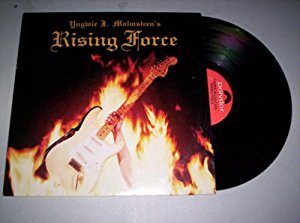
To his surprise, the label insisted on adding vocals. Malmsteen recruited a young singer named Jeff Scott Soto, whose powerful range and melodic instincts perfectly complemented the music. With Soto's contributions, the project transformed from a side experiment into a full-fledged band. The debut album, titled Rising Force, was recorded in late 1983 and released on March 5, 1984. Malmsteen played all guitars and bass himself, using a Moog Taurus bass pedal for extra low-end. The album was a revelation, showcasing Malmsteen's jaw-dropping speed and classical phrasing. It was named the Album of the Year by Guitar Player magazine, and Malmsteen was hailed as a new guitar hero.
The follow-up, Marching Out, arrived in 1985, with Anders Johansson on drums and Marcel Jacob on bass, solidifying the band's lineup. Touring relentlessly, Malmsteen and company brought their brand of neoclassical metal to audiences across the globe. Despite lineup changes that would become a hallmark of the project, Malmsteen's vision never wavered. He continued to release albums throughout the 1980s and beyond, each one showcasing his remarkable technique and his unyielding commitment to his musical ideals.
Members
Musical Style
Yngwie J. Malmsteen's Rising Force is synonymous with neoclassical metal, a genre Malmsteen essentially invented. His music draws directly from the Baroque and Classical eras, using harmonic minor scales, diminished arpeggios, and intricate counterpoint. The guitar is the undisputed star, with Malmsteen's lightning-fast alternate picking and sweeping arpeggios taking center stage. His solos are often extended, showcasing his technical mastery and his love for flashy, over-the-top displays.
The debut album was more classically oriented than his later work, with many tracks featuring intricate, multi-part compositions. Songs like "Black Star" and "Far Beyond the Sun" became anthems for aspiring shredders. As the band evolved, the music incorporated more vocal-driven hooks, as heard on Marching Out and Odyssey. Yet the signature elements remained: the neoclassical scales, the virtuosic solos, and the bombastic arrangements.
Malmsteen's production style is often criticized for being cold and sterile, but it fits his aesthetic. He favors a pristine, high-gain guitar tone that cuts through the mix. The rhythm section provides a powerful, driving foundation, but the spotlight is always on the guitar. Lyrically, the band explores themes of fantasy, mythology, and personal triumph, often delivered with a melodramatic flair.
Discography
| Title | Year |
|---|---|
| Parabellum | 2021 |
| Blue Lightning | 2019 |
| World on Fire | 2016 |
| Spellbound | 2012 |
| Relentless | 2010 |
| Perpetual Flame | 2008 |
| Unleash the Fury | 2005 |
| Attack!! | 2002 |
| War to End All Wars | 2000 |
| Alchemy | 1999 |
| Facing the Animal | 1997 |
| Magnum Opus | 1995 |
| The Seventh Sign | 1994 |
| Fire & Ice | 1992 |
| Eclipse | 1990 |
| Trial by Fire: Live in Leningrad | 1989 |
| Odyssey | 1988 |
| Trilogy | 1986 |
| Marching Out | 1985 |
| Rising Force | 1984 |
Cultural Impact
The impact of Yngwie J. Malmsteen's Rising Force on guitar culture cannot be overstated. The 1984 debut effectively split the 1980s guitar world into two camps: those who followed Eddie Van Halen's blues-based approach and those who embraced Malmsteen's classical virtuosity. This dichotomy defined the decade's guitar playing and influenced countless musicians.
Malmsteen's technique, including his use of sweep picking and harmonic minor scales, became a template for the entire shred genre. Bands like Racer X, Cacophony, and countless power metal acts owe a debt to his innovations. His influence extended to Japan, where he developed a massive following, and across Europe, where neoclassical metal thrived.
Beyond music, Malmsteen's persona, arrogant, uncompromising, and fiercely dedicated to his art, helped shape the archetype of the guitar hero. He was featured on the cover of Guitar Player magazine multiple times and was a major draw at guitar clinics and trade shows. While he never achieved mainstream commercial success, his legacy as one of the most influential guitarists in rock history is secure.
Fandom Culture
Fans of Yngwie J. Malmsteen's Rising Force are a dedicated and passionate bunch. They congregate on online forums and social media to dissect his solos, debate his albums, and share bootleg recordings. Many are guitar players themselves, inspired by Malmsteen to pick up the instrument and master the neoclassical style.
The band's live shows are a ritual for fans, who often know every note of the setlist. Malmsteen's onstage antics, his signature guitar spins, his scowling intensity, and his occasional rants, are part of the experience. Fans have created a vibrant bootleg trading community, preserving rare live performances from across the decades.
There's no official fandom name or lightstick, but the community is bound by a shared appreciation for technical excellence and unapologetic bombast. Malmsteen's annual tours, especially in Japan and Europe, are highlights for fans, who travel great distances to see him perform.
Awards & Accolades
View 2 records, honours and achievementsMilestones
Debut album 'Rising Force' released, creating the neoclassical metal genre.
Released 'Marching Out', expanding the band's lineup and sound.
Released 'Odyssey', a landmark album in the neoclassical metal catalog.
Performed in the Soviet Union, one of the first Western metal bands to do so.
Trivia
The debut album Rising Force was originally intended as an instrumental side project for Malmsteen while he was in Alcatrazz. The addition of vocalist Jeff Scott Soto changed its direction completely.
Malmsteen played bass on the debut album himself, using a Moog Taurus bass pedal for additional low-end. No dedicated bassist was hired.
The album's recording engineers were Lester Claypool and Peter Vargo, with Malmsteen handling production duties.
Malmsteen's stage name is a phonetic spelling of his birth name, Yngve Lannerbäck. He adopted it early in his career.
Despite being known for his speed and technique, Malmsteen has often cited classical composers like Bach and Paganini as his primary influences, not other guitarists.
Keywords
Sources
Quick Facts
- Origin
- United States
- Members
- 6
- Status
- Active
- Formed
- 1984
Group Info
- Formed
- 1984
- Debut
- 1984-03-05
- Debut Song
- Black Star
- Origin
- United States
- Label
- Polydor Records
- Status
- Active
Join the community
fans discussing