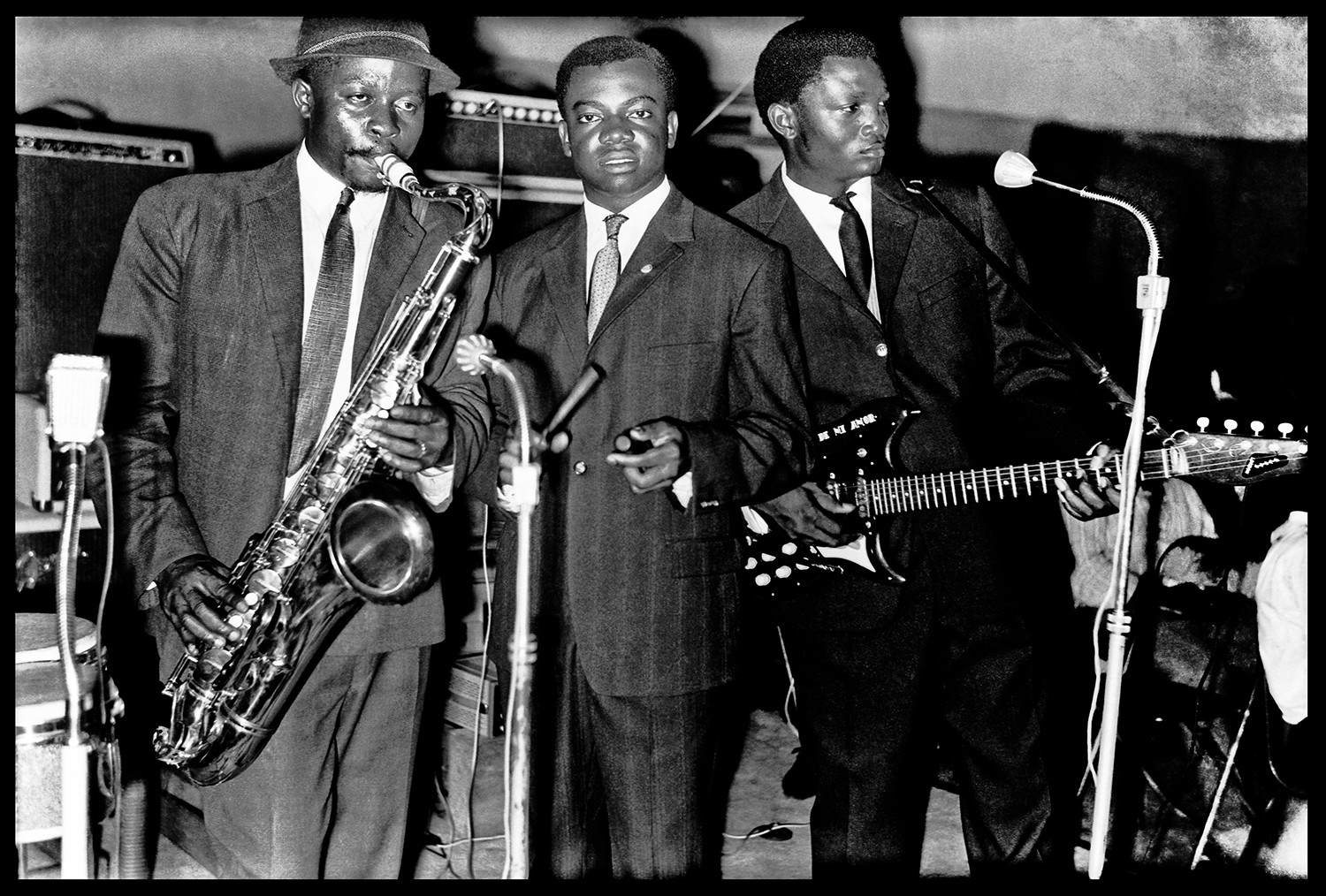
TPOK Jazz
 DR Congo
The Grand Masters of Congolese Rumba
6
Members
About
TPOK Jazz, a name synonymous with the vibrant pulse of Congolese rumba, continues to resonate as a foundational force in African music. Formed in 1956 in Kinshasa, Democratic Republic of the Congo, the band, initially known as OK Jazz, was masterfully steered by the iconic guitarist and songwriter Franco Luambo Makiadi. His vision and talent were central to the group's identity, shaping a sound that became a blueprint for generations. TPOK Jazz is credited with laying the foundation for the Congolese sound and significantly shaping African music, with a discography spanning many decades and showcasing a remarkable ability to adapt and innovate within the rumba framework.
The band's journey saw significant transitions, particularly after Franco's passing in 1989. Simaro Lutumba, a key figure as vice-president and principal songwriter, stepped into the leadership role. Although the band continued, internal dynamics led to a major shift in 1993 when disputes with Franco's family over finances and assets prompted Lutumba and most members to depart and form a new ensemble, Bana OK. In an effort to revive TPOK Jazz, Franco's son, Yves Emongo Luambo, recruited former members Youlou Mabiala and Michel Boyibanda. While both initially agreed, Boyibanda later withdrew, and Mabiala proceeded with the revival, officially reinstating TPOK Jazz on December 24, 1996. Musicologist Clément Ossinondé notes that this revived iteration of the band had become inactive by August 2004.
Formation Story
The story of TPOK Jazz begins in 1956, not in a grand studio, but around the lively atmosphere of the OK Bar in Kinshasa. It was here that the seeds of what would become one of Africa's most influential bands were sown. Initially named OK Jazz, the group quickly gained a reputation for its captivating performances, drawing crowds and establishing a loyal following. At the heart of this burgeoning ensemble was Franco Luambo Makiadi, a guitarist whose innovative style and prolific songwriting would define the band's sound and trajectory.
Under Franco's charismatic leadership, OK Jazz (which later evolved into TPOK Jazz, an abbreviation often expanded as Tout Puissant Orchestre Kinois de Jazz) blossomed. The band members were not just musicians; they were storytellers, weaving tales of everyday life, love, and social commentary into their music. Their early years were marked by a relentless drive to create, perform, and record, laying the groundwork for an immense catalog that would span over three decades. This period was characterized by intense musical exploration and the consolidation of a sound that would become the benchmark for Congolese rumba. Franco's ability to nurture talent and foster a collaborative environment meant that TPOK Jazz was more than just a band; it was a musical academy. Musicians like Simaro Lutumba, who would later play a pivotal role, joined and contributed significantly to the band's creative output. Their debut was not a single event but a continuous unfolding of musical expression, cementing their place as pioneers from their very inception.
Following Franco's death in 1989, Simaro Lutumba, who had served as the band's vice-president and principal songwriter, took over as bandleader. Initially, TPOK Jazz continued with minimal disruption, as Lutumba had previously managed administrative duties and the Kinshasa branch of the band. However, in 1993, disputes arose between the musicians and Franco's family over income division and instrument ownership. The family reportedly sought a 60–40 revenue split in their favor, which the musicians rejected. Further disagreements surfaced regarding performances organized without the family's consent, leading to attempts to repossess instruments. An ultimatum to Lutumba resulted in his resignation, and most members followed him to form a new group, Bana OK.
Members
Musical Style
TPOK Jazz's sound is intrinsically linked to the evolution of Congolese rumba, a genre they not only popularized but also profoundly shaped. Their music is characterized by intricate, interlocking guitar lines, often featuring a distinctive call-and-response pattern between lead and rhythm guitars. The rhythmic foundation is typically built on a driving bassline and percussion that encourages dancing, a hallmark of the soukous style that emerged from rumba.
Lyrically, TPOK Jazz often explored themes relevant to Congolese society, touching upon romance, social issues, and daily life with poetic depth. Their arrangements were known for their sophisticated layering of vocals and instruments, creating a rich and dynamic listening experience. Over the years, the band absorbed various influences, subtly incorporating elements that kept their sound fresh while remaining true to its rumba roots. This adaptability allowed them to maintain relevance across different eras, from the early days of Congolese popular music to the more energetic soukous sound of the 1980s. Notable releases include albums and singles from the 1970s, 1980s, and 1990s, such as 'Likambo ya ngana' (1971/1972), 'Franco, Le TP OK Jazz - 1972 / 1973 / 1974', and 'OK Jazz - Animation Non Stop' (1987).
Discography
| Title | Year |
|---|---|
| Francophonic, Vol. 2: 1980-1989 | 2010 |
| Grand Maître Franco & Seigneur Rochereau : Lisanga Ya Banganga | 1991 |
| OK Jazz - Animation Non Stop | 1987 |
| Franco, Le TP OK Jazz - 1972 / 1973 / 1974 | 1974 |
| Likambo ya ngana | 1971 |
| 1960/1961/1962 | 1962 |
Cultural Impact
The influence of TPOK Jazz extends far beyond the borders of the Democratic Republic of the Congo, having played a pivotal role in popularizing African music globally. Their unique brand of Congolese rumba, characterized by its infectious rhythms and sophisticated guitar interplay, became a dominant sound across the African continent. Bands and musicians from West Africa to East Africa drew inspiration from TPOK Jazz's arrangements, lyrical themes, and performance style. Nana Akumu is noted for helping shape the TPOK Jazz legacy, and Papa Noël, a Congolese guitarist and songwriter, toured with the band.
Beyond music, TPOK Jazz, and particularly its frontman Franco, became cultural icons. They represented a modern, vibrant African identity, influencing fashion and social trends. The band's extensive touring and the widespread availability of their music through records and radio broadcasts fostered a sense of shared cultural experience among diverse African populations. Their longevity and consistent output solidified their status not just as musicians but as cultural ambassadors, demonstrating the power of music to transcend borders and connect people. A recent concert in Belgium featuring Congo legends highlights the enduring remembrance events and activity surrounding their legacy.
Fandom Culture
While a specific fandom name for TPOK Jazz isn't widely documented in the way modern K-pop groups have them, the band cultivated an immense and dedicated following across Africa and among the Congolese diaspora. Fans were often referred to simply as supporters of Franco and TPOK Jazz, deeply connected to the music through its relatable themes and irresistible dance rhythms. The band's performances were major events, drawing enthusiastic crowds eager to witness the legendary musicians live.
Concert attendance was a significant form of fan engagement, with audiences often singing along to beloved hits and dancing for hours. The band's music became the soundtrack to countless social gatherings, celebrations, and everyday moments for its listeners. The enduring popularity of Franco's music means that fan communities continue to celebrate the band's legacy through tribute concerts, online discussions, and the continued appreciation and sharing of their vast musical catalog. While the revived version of the band became inactive by August 2004, the spirit of TPOK Jazz lives on through its dedicated fanbase.
Awards & Accolades
View 2 records, honours and achievementsTrivia
Original Name: The band was initially known as OK Jazz, a name derived from the OK Bar where they frequently performed in their early days., Prolific Output: Throughout their active years, TPOK Jazz released an astonishing number of albums and singles, with estimates suggesting hundreds of songs recorded over Franco's career., Post-Franco Leadership: Following the death of Franco Luambo Makiadi in 1989, long-time collaborator Simaro Lutumba took over as bandleader, attempting to continue the band's legacy., Internal Strife: In the early 1990s, disputes between the band members and Franco's family over finances led to a significant split, with many musicians forming a new group called Bana OK.
Keywords
Sources
Quick Facts
- Formed
- 1956
- Origin
- Kinshasa, Democratic Republic of the Congo
- Genre
- Congolese Rumba
- Key Figure
- Franco Luambo Makiadi
Group Info
- Formed
- 1956-01-01
- Origin
- Kinshasa, Democratic Republic of the Congo
- Status
- Active
Also Known As
Join the community
fans discussing