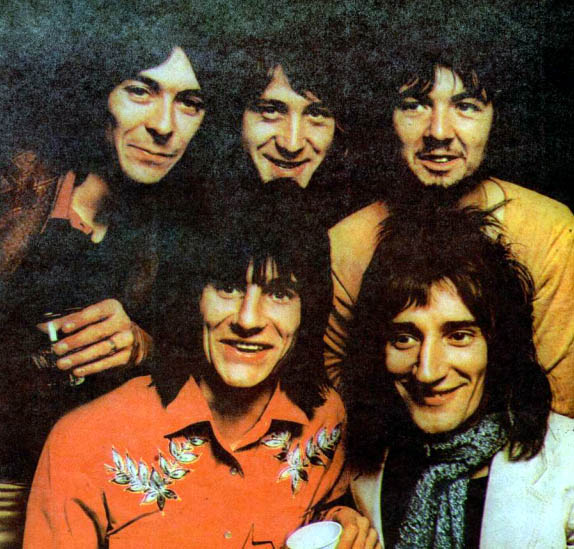
Faces
 United Kingdom
Rough, sloppy rock & roll of the '70s
5
Members
About
Faces are an English rock band formed in London in 1969. They came together after Small Faces lead singer and guitarist Steve Marriott left to form Humble Pie. The remaining Small Faces members, bassist Ronnie Lane, drummer Kenney Jones, and keyboardist Ian McLagan, recruited lead vocalist Rod Stewart and guitarist Ronnie Wood, both formerly of the Jeff Beck Group, and shortened the band's name to Faces.
Their first two albums, First Step (1970) and Long Player (1971), were modest successes. Their third, A Nod Is As Good As a Wink... to a Blind Horse (1971), became a worldwide hit, peaking at number 2 in the UK and number 6 in the US, and spawned the hit single "Stay with Me". After releasing their fourth and final studio album Ooh La La (1973), Lane was replaced by Tetsu Yamauchi on bass. This lineup released two non-album singles, "Pool Hall Richard" (1973) and "You Can Make Me Dance, Sing or Anything" (1974), and a live album, Coast to Coast: Overture and Beginners (1973), before the band officially split in 1975. A greatest hits album, Snakes and Ladders / The Best of Faces, appeared the following year.
Stewart continued his successful solo career, while Wood joined the Rolling Stones. Following a short-lived Small Faces reunion, Jones joined the Who in 1978, and McLagan worked as a session and touring musician with many acts until his death in 2014. Lane's activities were severely curtailed by multiple sclerosis, which forced his retirement by the early 1990s; he died in 1997.
Partial reunions were rumoured throughout the 2000s, with one-off performances involving surviving members. In 2010–2011, a brief reunion tour occurred with Mick Hucknall and Glen Matlock on vocals and bass respectively. The Faces and Small Faces were jointly inducted into the Rock and Roll Hall of Fame in 2012. Stewart was scheduled to perform but was unable due to illness; Hucknall replaced him. Since 2021, Jones, Stewart, and Wood have periodically reunited to record tracks for a new album under the Faces name.
Formation Story
The story of Faces begins with the collapse of two of the late 1960s' most exciting bands. In early 1969, Steve Marriott walked out of Small Faces, leaving his bandmates Ronnie Lane, Kenney Jones, and Ian McLagan in the lurch. Around the same time, the Jeff Beck Group was falling apart, and its two frontmen, Rod Stewart and Ronnie Wood, were looking for a new home. The five musicians quickly found each other. Lane, Jones, and McLagan asked Stewart and Wood to join them, and by the summer of 1969, the new lineup was rehearsing in a cramped London basement. They dropped the "Small" from their name and became simply Faces.
The chemistry was immediate. Stewart's gravelly voice and Wood's slide guitar gave the band a rawer, more bluesy edge than Small Faces had ever had. They signed with Warner Bros. Records and released their debut album, First Step, in March 1970. It sold modestly, but the band's live shows were already building a reputation for chaotic, joyous energy. Their second album, Long Player, followed in 1971 and did a little better, cracking the US Top 30.
The real breakthrough came with A Nod Is As Good As a Wink... to a Blind Horse later that year. The album, recorded in just a few weeks, captured the band's loose, spontaneous sound perfectly. It hit number 2 in the UK and number 6 in the US, and the single "Stay with Me" became their biggest hit, reaching the Top 10 on both sides of the Atlantic. The band was riding high, but tensions were brewing. Stewart's solo career was exploding, and his fame began to overshadow the group. Lane, who had been the band's spiritual anchor, felt increasingly sidelined.
Their fourth album, Ooh La La, released in 1973, became their only UK number 1, but it was also their last with Lane. He left during the recording sessions, frustrated with the direction the band was taking. Tetsu Yamauchi, formerly of Free, stepped in on bass. The band carried on, releasing two more singles and a live album, but the magic was fading. In 1975, they called it quits. Stewart went on to become one of the biggest solo stars in the world, Wood joined the Rolling Stones, and Jones later joined the Who. The band's brief, brilliant burst of creativity left an outsized mark on rock music.
Members
Former Members
Musical Style
Faces built their sound on a foundation of blues, boogie, and R&B, played with a loose, live-in-the-studio feel that set them apart from the polished arena rock of the early 1970s. Their music was rough around the edges, driven by Ronnie Wood's slashing guitar lines and Ian McLagan's rollicking piano and organ. Rod Stewart's raspy, soulful vocals gave the band a gritty, streetwise edge, while Ronnie Lane's melodic basslines anchored the groove. Kenney Jones kept the beat loose and swinging, never afraid to let a song breathe.
Their albums captured the energy of their legendary live shows, where the band would stretch songs out into extended jams, trading solos and banter with the crowd. Tracks like "Had Me a Real Good Time" and "Stay with Me" were built for the stage, with an infectious, singalong quality that made them instant classics. The band's approach was deliberately unpolished; they often recorded in a few takes, preferring spontaneity over perfection.
Lyrically, Faces sang about good times, drinking, and romance, but there was also a melancholy undercurrent, especially in Ronnie Lane's songs like "Debris" and "Ooh La La". This mix of raucous party anthems and tender, introspective ballads gave the band a depth that belied their reputation as mere good-time rockers.
Discography
| Title | Year |
|---|---|
| Ooh La La | 1973 |
| A Nod Is As Good As a Wink... to a Blind Horse | 1971 |
| Long Player | 1971 |
| First Step | 1970 |
| Coast to Coast: Overture and Beginners | 1973 |
| Snakes and Ladders / The Best of Faces | 1976 |
Tours
Faces Reunion Tour
2010
Cultural Impact
Faces were one of the most influential rock bands of the early 1970s, even though their time together was brief. Their loose, spontaneous approach to rock and roll inspired a generation of musicians, from punk to Britpop. The Sex Pistols' Glen Matlock and the Clash's Mick Jones have both cited Faces as a major influence, and the band's raw, unpolished aesthetic was a direct precursor to the punk movement.
Their live performances were the stuff of legend, filled with chaotic energy and unpredictable moments. They were one of the first bands to truly blur the line between performer and audience, with Rod Stewart often wading into the crowd. This sense of abandon and immediacy influenced countless bands, including the Rolling Stones, who later recruited Ronnie Wood.
Faces also helped shape the visual style of rock in the 1970s, with their shaggy hair, flamboyant clothes, and general air of debauchery. They embodied the rock star lifestyle in a way that was both glamorous and down-to-earth. The band's influence can be heard in the music of Oasis, the Black Crowes, and the Faces-inspired revival of the 1990s. Their legacy is one of joyful, unpretentious rock and roll that continues to resonate with fans today.
Fandom Culture
Faces fans, known informally as "Faces freaks," are a devoted bunch who treasure the band's raw, unpolished energy. The band never had an official fandom name, but their followers have always been passionate about preserving their legacy. Fan sites and social media groups keep the flame alive, sharing rare recordings and live footage.
The band's official website and Facebook page are hubs for this community, where fans can pre-order the new box set and share memories of seeing the band live. The 2010–2011 reunion tour brought a new generation of fans into the fold, and the 2012 Rock and Roll Hall of Fame induction was a major moment for the fandom, even if Rod Stewart's absence was a disappointment.
Fans also celebrate the individual members' later careers, from Rod Stewart's solo hits to Ronnie Wood's work with the Rolling Stones. The Faces' music has a timeless quality that keeps attracting new listeners, ensuring that the band's spirit lives on.
Awards Won (2)
Performer
for: Faces and Small Faces
Milestones
Band formed in London
Debut album 'First Step' released
Breakthrough album 'A Nod Is As Good As a Wink...' and hit single 'Stay with Me'
Final studio album 'Ooh La La' reaches UK #1
Band splits
Inducted into Rock and Roll Hall of Fame
Partial reunion for recording sessions
Trivia
Faces were originally called Small Faces until Steve Marriott left in 1969. The remaining members recruited Rod Stewart and Ronnie Wood and dropped the "Small" to avoid confusion.
Their only UK number 1 album was Ooh La La, which topped the chart in 1973.
Rod Stewart's solo success often overshadowed the band, and he was sometimes criticized for treating Faces as a backing band.
Ronnie Lane was diagnosed with multiple sclerosis in the late 1970s, which eventually forced him to stop performing. He died in 1997.
After Faces split, Kenney Jones joined the Who in 1978, replacing Keith Moon.
Keywords
Sources
Quick Facts
- Type
- Rock Band
- Formed
- 1969
- Origin
- London, England
- Label
- Warner Bros. Records
- Genres
- Hard rock, blues rock, boogie rock
- Members
- 5
- Status
- Active
Group Info
- Formed
- 1969-01-01
- Debut
- 1970-01-01
- Origin
- London, England
- Company
- Warner Bros. Records
- Label
- Warner Bros. Records
- Status
- Disbanded (1975-01-01)
Social Media
Also Known As
Join the community
fans discussing