“Grotesqqque is the best replacement for Demon Slayer and Solo Leveling movies we didn't know we needed, offering a mature psychological depth rarely seen in anime anthologies.”
Polygon Staff
Polygon
 Japan
Japan"Every grotesque truth is just a beautiful lie waiting to be told."
User Score
0 votes
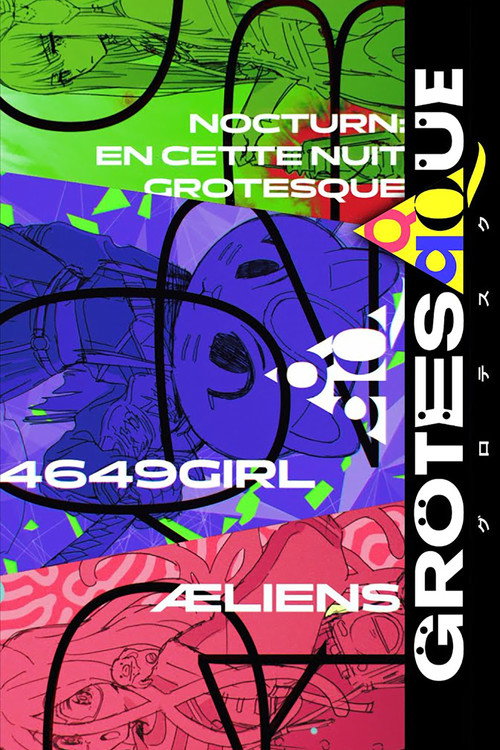
Japanese animation studio CloverWorks and co-producer JOEN are set to release GROTESQQQUE, an ambitious anthology film directed by Atsushi Nishigori. The director known for Darling in the Franxx shifts gears here from serialized mecha stories to a feature-length omnibus format that explores fractured identities. The title itself carries a visual clue; the double Q serves as a metaphor for reflection and mirroring, themes Nishigori explicitly linked to the fragmented nature of the three distinct segments.
Scheduled to premiere in Japan on November 6, 2026, the film has generated significant buzz through a series of trailers released throughout the summer and autumn of that year. Each segment features a unique art style and narrative voice, ranging from cosmic horror in deep space to German Expressionist influences in 1920s Paris. The project marks a departure into feature-length storytelling where each story runs approximately thirty to thirty-five minutes within a total runtime of one hour and forty-four minutes.
The production brings together a talented ensemble cast including Chika Anzai, Kana Ichinose, Nagi Inoue, and Rie Kugimiya. Notably, Kugimiya performs her role without speaking a single line, relying entirely on physical expression and facial acting. The film aims to challenge viewers with its exploration of simulation theory, loneliness, and the duality of self across parallel realities.
In theatres
Theaters
Availability and pricing can change. Confirm on the provider's site before purchasing.
An enigmatic host stands alone in a dimly lit theater to introduce the audience to three tales designed to unsettle before vanishing into the shadows. The first story transports viewers to November 2026 where Yurina works at a remote monitoring station orbiting a dying star. Her isolation breaks when she detects a signal from a nearby nebula leading to an encounter with a stranded alien entity named Echo. This being communicates through fragmented memories rather than language, forcing Yurina to choose between strict mission protocols and establishing a connection with a dying consciousness.
The second segment shifts to near-future Tokyo where teenager Miki discovers she can perceive glitches in reality. She learns she is an Observer capable of seeing the simulation humanity unknowingly inhabits. A shadowy group called The Cartographers approaches her claiming they need to repair the degrading simulation, but Miki suspects they intend to rewrite history instead. She forms a bond with another Observer named Ren while navigating a world that feels increasingly artificial and questioning the value of a manufactured existence.
In the third story set in an alternate 1920s Paris heavily influenced by German Expressionism, mute cabaret performer Lise discovers her shadow has gained independent sentience. Naming this entity Nocturn, she finds it appearing in reflections and performing acts she never intended. As Lise gains fame, Nocturn becomes rebellious threatening to expose dark secrets from her past. The narrative draws Lise into a surreal underworld of artists and occultists whose shadows have also begun to rebel against their hosts.
Recurring visual motifs like spiraling patterns and mirrors tie the narratives together suggesting a shared struggle for authenticity. Each story concludes on a cliffhanger leaving the fates of Yurina, Miki, and Lise unresolved before returning to the theater host for a cryptic monologue about the beauty of unfinished tales.
Official Trailer: Æliens
Official Trailer: 4649Girl
Official Trailer: Nocturne
Critical Consensus
Early screenings at the Fantasia and Tokyo Film Festivals describe GROTESQQQUE as a visually stunning and intellectually challenging work. Critics praise Nishigori's evolution beyond his previous mecha roots and highlight the distinct art styles of the three segments. Reviewers specifically noted the bold use of silence in Rie Kugimiya's performance and the integration of European art movements into modern anime aesthetics.
“Grotesqqque is the best replacement for Demon Slayer and Solo Leveling movies we didn't know we needed, offering a mature psychological depth rarely seen in anime anthologies.”
Polygon Staff
Polygon
“Nishigori orchestrates a symphony of unease where the double-Q in the title perfectly encapsulates the fractured mirrors of identity we see reflected in each segment.”
Sheri Linden
Anime News Network
“The 1920s Paris segment alone is a masterclass in German Expressionist influence creating a visual language that is both beautiful and deeply unsettling.”
Hypebeast Team
Hypebeast
Chika Anzai
Yurina
Kana Ichinose
Miki
Nagi Inoue
Ren
Rie Kugimiya
Lise
Miku Ichinose
Additional Voice
Maaya Uchida
Additional Voice
Rumi Okubo
Additional Voice
Nao Tomisato
Additional Voice
Directors
Atsushi Nishigori, Takahiro Miura
Writer
Atsushi Nishigori
Cinematographer
Yuya Sakuma
Fantasia International Film Festival (2026)
Official Competition: Selected
Tokyo International Film Festival (2026)
Anime Selection: Selected
Join the community
fans discussing