 Iraq
IraqAbout
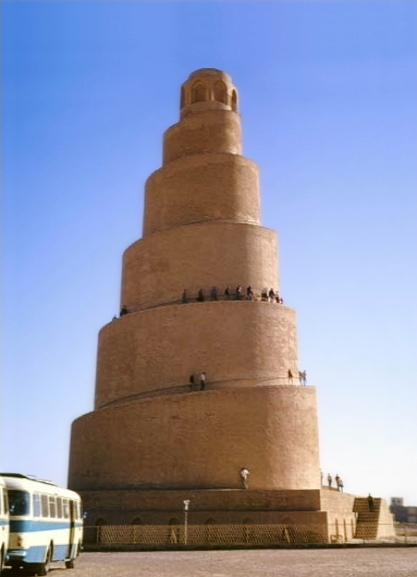
The Great Mosque of Samarra, often called the Al-Malwiya Mosque, is a monumental ruin in Samarra, Iraq. Commissioned by Abbasid Caliph Al-Mutawakkil in 848 CE and completed in 851, it was once the largest mosque on earth. Its most striking feature is the Malwiya Tower, a spiraling minaret that still dominates the skyline. The mosque's construction marked the height of Abbasid architectural ambition, reflecting the empire's power and cultural flourishing. Today, it stands as a UNESCO World Heritage Site, a haunting reminder of medieval Islamic grandeur, though much of its structure lies in partial ruins. The site attracts historians, architects, and travelers, offering a glimpse into a bygone era. Its scale and design continue to inspire awe, even in its dilapidated state.
Built as a congregational mosque, the complex was designed to accommodate the entire male population of Samarra for Friday prayers. The prayer hall featured seventeen aisles supported by hundreds of octagonal brick columns, leading to a qibla wall adorned with intricate mosaics. The entire structure was enclosed by a massive perimeter wall about 35 feet high, punctuated by numerous semi-circular towers. This architectural ambition was part of Al-Mutawakkil's grand vision for Samarra, which he had made the Abbasid capital in 836, moving the seat of power from Baghdad to this new city on the Tigris.
Though the mosque no longer functions as a place of worship, its significance endures. It is a cornerstone of the Samarra Archaeological City, a UNESCO World Heritage Site inscribed in 2007, and a powerful symbol of Iraq's rich heritage. The Malwiya minaret, in particular, has become a national icon, celebrated in photographs and travelogues, and a point of pride for Iraqis as the country recovers from decades of conflict.
Mission
The original mission of the Great Mosque of Samarra was to serve as the central congregational mosque for the Abbasid capital, providing a space for Friday prayers, religious instruction, and community gatherings. In its current state, its purpose has shifted to that of a historical monument and archaeological site, dedicated to education, cultural preservation, and tourism. As part of the Samarra Archaeological City, it contributes to the understanding of Islamic architectural history and serves as a tangible link to Iraq's Abbasid past.
History
The story of the Great Mosque begins with Caliph Al-Mutawakkil, who ruled the Abbasid Empire from 847 to 861. He moved the capital from Baghdad to Samarra, a city his father had built, and embarked on an ambitious construction spree. The mosque was part of this grand plan, intended to be the largest in the Islamic world. Construction started in 848 and took just three years to complete, a testament to the empire's vast resources and labor force.
At its peak, the mosque could hold up to 80,000 worshippers, a staggering number for the 9th century. The design was innovative, particularly the Malwiya minaret with its unique spiral form, a departure from traditional square or cylindrical minarets. The mosque served as the spiritual heart of Samarra for several decades, but its prominence waned after the capital moved back to Baghdad in 892. Over the centuries, the structure fell into disrepair, and by the 13th century, much of it was in ruins.
The site remained largely forgotten until the 20th century, when archaeological interest revived. In the 1930s, the Iraqi Directorate of Antiquities began excavations, revealing the mosque's foundations and the surviving minaret. The Malwiya Tower, standing at 52 meters, became a symbol of Samarra's ancient glory. In 2007, the mosque was inscribed as part of the Samarra Archaeological City on the UNESCO World Heritage List, recognizing its outstanding universal value.
The recent history has been fraught with challenges. During the Iraq War, Samarra became a flashpoint for sectarian violence, and the nearby al-Askari Shrine was bombed in 2006 and 2007, causing widespread devastation. The Great Mosque itself suffered some damage from looting and neglect, but the Malwiya minaret survived. In 2014, the advance of ISIS threatened the region, though Iraqi forces managed to hold Samarra, sparing the mosque from the destruction seen in other sites like Palmyra. Since then, efforts have focused on preservation and promoting tourism, with the minaret becoming a symbol of resilience for Iraq.
Subdivisions
Malwiya Minaret
The iconic spiral minaret, 52 meters tall, with a helical ramp that narrows as it ascends, offering panoramic views of Samarra.
Prayer Hall
The vast hypostyle hall that originally had 17 aisles and hundreds of octagonal columns, now mostly in ruins but still traceable.
Perimeter Wall
A massive brick wall, about 35 feet high, enclosing the mosque complex, with semi-circular towers at intervals.
Notable People
Al-Mutawakkil
Founder and Caliph · 847-861
Commissioned the Great Mosque and moved the Abbasid capital to Samarra, initiating a major building campaign.
Milestones
848
Construction of the Great Mosque commissioned by Caliph Al-Mutawakkil.
851
Construction completed; the mosque becomes the largest in the world.
892
Abbasid capital returns to Baghdad, leading to the mosque's gradual decline.
1930s
Iraqi Directorate of Antiquities begins archaeological excavations at the site.
2007
Samarra Archaeological City, including the Great Mosque, inscribed as a UNESCO World Heritage Site.
2014
ISIS advances on Samarra; Iraqi forces defend the city, and the mosque remains intact.
Sources
Organization Info
- Founded
- 848
- Headquarters
- Samarra, Saladin Governorate, Iraq
- Country
- Iraq
- Type
- Religious
- Founder
- Al-Mutawakkil
- UNESCO World Heritage
- Yes (2007)
- Height of Malwiya Minaret
- 52 meters
Join the community
fans discussing