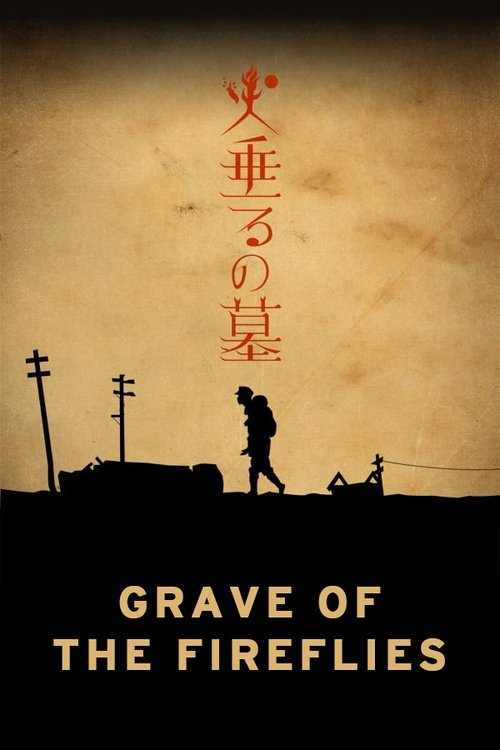
 Japan
“This is a film that will leave you sobbing, but it is not a sad movie in the conventional sense. It is a testament to the power of art to evoke empathy and understanding.”
Roger Ebert
Chicago Sun-Times
On September 21, 1945, a skeletal figure sits in the darkness of a railway station in Kobe. Beside him lies a pile of bones and scattered candy wrappers. This quiet scene sets the stage for a story that unfolds in reverse, moving from the aftermath back to the beginning of a tragedy.
The film follows Seita, a fourteen-year-old boy, and his four-year-old sister Setsuko as they navigate the ruins of their world following a devastating American firebombing raid on Kobe. After their mother dies from severe burns sustained during the attack, Seita takes it upon himself to protect his younger sibling. They initially seek refuge with their aunt in the countryside, but the tension between them grows as food becomes scarce and resources dwindle.
Unable to bear the constant criticism and feeling like a burden, Seita moves Setsuko into an abandoned bomb shelter near a lake. The narrative meticulously details their slow decline as they struggle against starvation and the indifference of a society at war. Grave of the Fireflies serves as a harrowing meditation on the cost of conflict, focusing entirely on the intimate suffering of two innocent children rather than the battles fought by soldiers.
Stream
Availability and pricing can change. Confirm on the provider's site before purchasing.
The story opens with the ghostly image of Seita sitting beside a pile of bones in a railway station, setting a somber tone before flashing back to the events leading up to their demise. In April 1945, the air raid sirens wail over Kobe, signaling another catastrophic bombing run. Seita and Setsuko watch helplessly as their home is engulfed in flames. Their mother, who had been injured earlier, succumbs to her burns in the hospital shortly after the attack. Seita, having served as a naval cadet, promises their dying mother he will look after Setsuko, carrying the weight of this vow as he navigates the chaos.
Seeking safety, Seita takes his sister to live with their aunt Kyoko in the countryside. The initial days are marked by a fragile truce, but the reality of wartime scarcity quickly erodes any warmth. As rations shrink and the aunt's resentment grows, she views the children as a drain on limited household supplies. She criticizes Seita for not contributing enough to the family effort and mocks his refusal to trade their mother's valuable kimono for immediate food. The atmosphere in the house turns toxic, filled with passive-aggressive comments and silent judgment that Seita finds impossible to endure.
Frustrated by the constant friction and unwilling to compromise his dignity or his sister's well-being, Seita decides to leave. He packs a small bag with rice and canned food, taking Setsuko to an abandoned concrete bomb shelter near a lake. For a brief period, the shelter offers a semblance of peace and independence. Seita works tirelessly to provide for his sister, stealing rice from fields and scavenging for supplies. He tries to maintain a sense of normalcy, buying candy and toys to keep Setsuko's spirits high despite the grim surroundings.
However, the harsh reality of starvation soon sets in. The city is in ruins, and resources are nonexistent. Setsuko begins to suffer from malnutrition, developing sores and losing her appetite. Seita struggles with guilt and exhaustion as he watches his sister grow weaker day by day. He tries everything he can think of to save her, but the war has stripped away all safety nets. The bond between the siblings remains the emotional core of the film, with Seita constantly trying to be the parent he lost, even as his own physical and mental state crumbles.
As the days turn into weeks, the situation becomes increasingly dire. Setsuko grows weaker, her body wasting away until she can barely move. She begins to hallucinate, seeing fireflies that seem to dance around her in the dark. Seita, desperate to save her, tries to catch these insects to give to her, hoping they might bring some comfort. But the fireflies die quickly, just like the hope that flickers in their small world. The film meticulously details the slow, agonizing decline of the children, focusing not on the battles or political maneuvers of the war, but on the intimate, quiet tragedy of two innocent lives extinguished by indifference and scarcity.
The central conflict is internal and external: Seita's struggle to survive with dignity versus the overwhelming forces of nature and human neglect, and Setsuko's fight to stay alive in a world that has forgotten her. The story builds toward a heartbreaking conclusion where the brothers' final moments are marked by a poignant blend of innocence and despair. Seita's efforts to protect his sister become futile as the war continues to claim its victims, leaving behind only silence and emptiness.
Trailer
Critical Consensus
Grave of the Fireflies stands as one of the most emotionally devastating films ever made, offering an unflinching look at the civilian cost of war. Its masterful storytelling, coupled with breathtaking animation and a haunting score, creates a profound meditation on loss, innocence, and the fragility of life.
“This is a film that will leave you sobbing, but it is not a sad movie in the conventional sense. It is a testament to the power of art to evoke empathy and understanding.”
Roger Ebert
Chicago Sun-Times
“A masterpiece of animation that transcends its medium to become a universal parable about the horrors of war and the resilience of the human spirit.”
A.O. Scott
The New York Times
“One of the most powerful anti-war films ever made, Grave of the Fireflies is a heartbreaking journey that leaves an indelible mark on the soul.”
Peter Bradshaw
The Guardian
Tsutomu Tatsumi
Seita Sekino
Ayano Shiraishi
Setsuko Sekino
Akemi Yamaguchi
Aunt Kyoko
Yōko Ogawa
Mother
Ichiro Nagai
Narrator / Train Conductor
Director
Isao Takahata
Writer
Akiyuki Nosaka
Composer
Michio Mamiya
Cinematographer
Yoshiharu Ashino
Producer
Toshio Suzuki
Mainichi Film Awards (1988)
Best Animation Film: Won
Kinema Junpo Awards (1988)
Best Film: Won
Blue Ribbon Awards (1989)
Best Film: Won
Japan Academy Prize (1989)
Outstanding Achievement Award: Won
Join the community
fans discussing