“A muddle of psychoanalysis and supernatural hokum that never quite coheres into the thriller it wants to be.”
Manohla Dargis
Los Angeles Times
 United States
"She woke up a suspect. The ghost knows the truth."
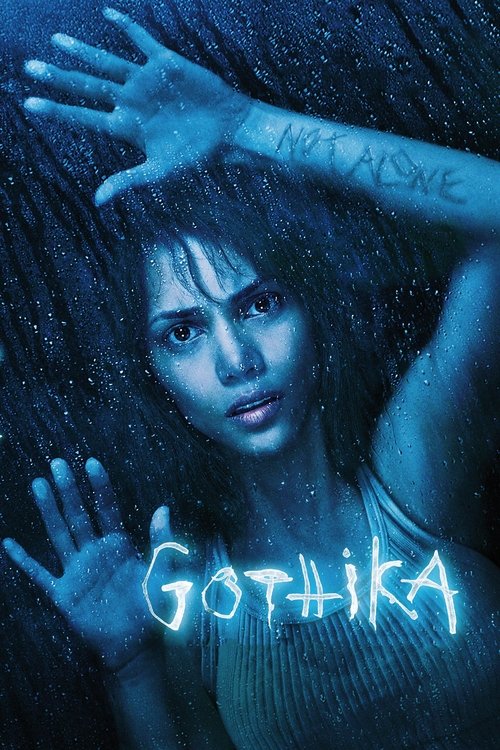
Gothika landed in theaters on November 21, 2003, carrying the weight of a post-Oscar Halle Berry and the curiosity of a Mathieu Kassovitz English-language debut. Kassovitz, the French director behind La Haine, took the helm of this Dark Castle Entertainment production, working from a script by Sebastian Gutierrez. The film pairs Berry with Robert Downey Jr., Charles S. Dutton, Penélope Cruz, John Carroll Lynch, and Bernard Hill, and it was shot in and around Montreal during a cold, wet autumn that seeps into every frame.
The premise is a tidy reversal: a criminal psychiatrist wakes up as an inmate in her own hospital, accused of a murder she cannot remember. That setup gave the marketing plenty to work with, and the film opened strong, finishing its theatrical run with roughly $141.6 million worldwide against a $40 million budget. Critics were another story. Reviews were largely hostile, with many faulting the plot's convoluted turns and its reliance on familiar asylum-horror beats. Still, the cast committed, and Matthew Libatique's cinematography gave the material a glossy, rain-slicked look that has aged better than some of the dialogue.
What keeps Gothika circulating is its place in the early-2000s supernatural cycle and a twist that reframes everything before it. It is also a footnote in two major careers: Berry's first big genre vehicle after her Oscar win, and the set where Downey met producer Susan Levin, whom he married in 2005. For fans of the era's ghost stories, it is a familiar but watchable entry, and its central question, whether a woman's account of her own experience can be trusted, has only grown more resonant.
Availability and pricing can change. Confirm on the provider's site before purchasing.
Dr. Miranda Grey (Halle Berry) works at Woodward Penitentiary for the Criminally Insane, a women's forensic psychiatric hospital where her husband, Dr. Douglas Grey (Charles S. Dutton), serves as chief administrator. Miranda is good at her job: calm, precise, and able to meet patients on their own terms without losing authority. One patient, Chloe Sava (Penélope Cruz), keeps insisting that something comes to her at night, a presence she describes as demonic and violating. Miranda listens, but she files it under trauma and psychosis, the way she has been trained to.
Driving home in heavy rain, Miranda swerves to avoid a girl standing in the middle of the road and crashes. She wakes up inside Woodward, but not as staff. She is in a cell, wearing a patient's clothes, and the days between the crash and her waking are gone. The charge is murder: Douglas is dead, and the evidence points at her. Her blood is on the scene, and the hospital has records suggesting a history she does not recognize. Dr. Pete Graham (Robert Downey Jr.), a colleague and friend, is assigned to her case. He wants to help, but he also believes she may have had a genuine break.
From inside the ward, Miranda tries to build a defense. She has no memory of the killing, and the staff treat her claims of innocence as symptoms. The ghost of the girl from the road begins appearing to her, in mirrors, in reflections, at the edge of darkened corridors. These visitations are not random. The girl seems to be pushing Miranda toward something, and Miranda starts to suspect she is being used rather than haunted. Sheriff Ryan (John Carroll Lynch) is openly hostile, and the hospital's internal politics make every ally unreliable. Chloe, meanwhile, becomes a strange kind of anchor, the one person whose impossible story now sounds less impossible.
The film tightens the screws by keeping the audience inside Miranda's uncertainty. We see what she sees, and we have no more proof than she does that any of it is real. The asylum setting does double duty: it is a physical trap and a metaphor for the credibility problem she faces. Every attempt to assert her sanity makes her sound less sane to the people holding the keys. As the supernatural pressure mounts and the human conspiracy around her begins to show cracks, Miranda has to decide whether the ghost is a threat, a guide, or something she has been chosen to carry.
Original Theatrical Trailer
Critical Consensus
Critics mostly agreed that Gothika wastes a committed Halle Berry performance and Matthew Libatique's moody cinematography on a tangled plot and familiar asylum-horror tropes. The twist drew praise for ambition but complaints that it arrives too late to rescue a muddled story. Audiences were kinder than reviewers, and the film has since settled into cult-adjacent streaming rotation.
“A muddle of psychoanalysis and supernatural hokum that never quite coheres into the thriller it wants to be.”
Manohla Dargis
Los Angeles Times
“A soggy, underlit thriller whose scares are telegraphed well in advance and whose plot ties itself in knots.”
A.O. Scott
The New York Times
“The film has a good performance by Halle Berry but a plot that ties itself in knots trying to surprise us.”
Roger Ebert
Chicago Sun-Times
“A slick but silly supernatural thriller that squanders a strong cast on implausible twists and cheap jolts.”
Todd McCarthy
Variety
“A hokey, muddled chiller that never decides whether it wants to be a psychological drama or a ghost story.”
Peter Bradshaw
The Guardian
Director
Mathieu Kassovitz
Writer
Sebastian Gutierrez
Composer
John Ottman
Cinematographer
Matthew Libatique
Producers
Susan Downey, Joel Silver, Robert Zemeckis, L. Levin
Razzie Award (2004)
Worst Actress: Nominated
Teen Choice Award (2004)
Choice Movie: Horror/Thriller: Nominated
Join the community
fans discussing