 Taiwan
“A work of almost unbearable beauty and sadness, a ghost story about the disappearance of a certain kind of public space and the community that once inhabited it.”
A.O. Scott
The New York Times
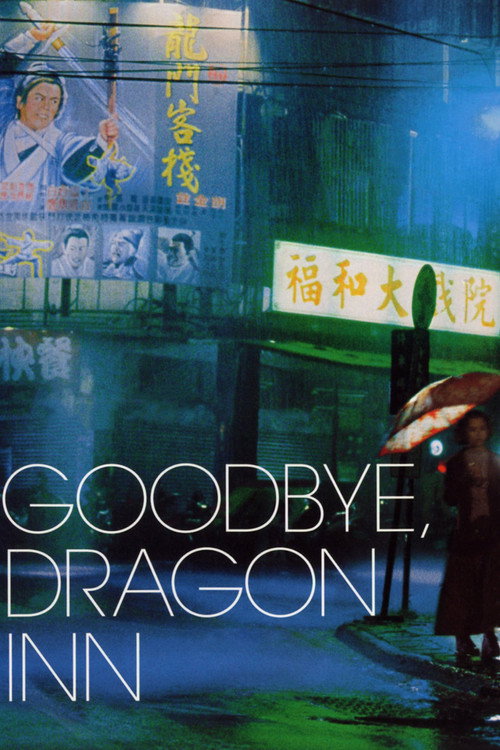
On a dark, wet night in Taipei, a cavernous old movie theater is about to close forever. The few remaining patrons and staff watch King Hu's wuxia classic Dragon Inn, each haunted by memories and desires stirred by the film itself. Directed by Tsai Ming-liang, this 2003 Taiwanese drama stars Lee Kang-sheng as the projectionist and Chen Shiang-Chyi as the ticket woman, alongside Kiyonobu Mitamura as a Japanese tourist. Produced by Homegreen Films, Goodbye, Dragon Inn runs 82 minutes and unfolds in near-real time, capturing the quiet melancholy of a dying cinema. With its slow pace and minimal dialogue, the film earned a 6.8/10 rating from 180 votes, resonating deeply with fans of art-house and slow cinema. It is a standalone work, not part of any franchise, that meditates on loneliness, mortality, and the magic of film.
Availability and pricing can change. Confirm on the provider's site before purchasing.
The Fu-Ho Grand Theater, a once-grand movie palace in Taipei, is screening its final film before permanent closure. Rain pours outside as the film begins: King Hu's 1967 wuxia masterpiece Dragon Inn. The audience is sparse. The ticket woman, played by Chen Shiang-Chyi, moves through the empty corridors with a quiet sadness. She makes tea, sells a few tickets, and repeatedly attempts to bring food to the projectionist, a limping man played by Lee Kang-sheng, who operates the reels high above the auditorium. Her efforts are thwarted by locked doors and missed timing.
A Japanese tourist, played by Kiyonobu Mitamura, wanders the theater's labyrinthine hallways, restrooms, and stairwells. He appears captivated by the film but also acutely aware of the other solitary figures around him. Among them are a woman eating peanuts (Yang Kuei-mei) and two elderly men (Miao Tian and Shih Chun) who sit together in silent communion. The theater itself becomes a character: its leaking roof, creaking floors, dimly lit corridors, and ghostly emptiness all contribute to an atmosphere of mourning. The patrons move through the space like ghosts, each lost in their own reverie, occasionally making awkward, wordless attempts at connection.
The film unfolds in near-real time, with long, static shots that capture the slow decay of a once-grand space. The rain outside mirrors the melancholy inside, and the sounds of the wuxia film's clashing swords and dramatic score echo through the empty hallways, creating a haunting juxtaposition between the heroic past and the mundane, lonely present. The central tension is not dramatic but existential: the fading world of cinema versus the encroaching reality of closure.
Official Trailer
Critical Consensus
Goodbye, Dragon Inn is a profoundly melancholic meditation on the death of cinema, using long takes and minimal dialogue to create an almost spiritual experience. Its patience rewards viewers willing to surrender to its rhythm, though its extreme slow pace may frustrate mainstream audiences.
“A work of almost unbearable beauty and sadness, a ghost story about the disappearance of a certain kind of public space and the community that once inhabited it.”
A.O. Scott
The New York Times
“Tsai's film is a requiem for a kind of cinema that is vanishing, but it's also a love letter to the sensory experience of watching a movie in a dark room with strangers.”
David Bordwell
Observations on Film Art
“A haunting, almost wordless poem about loneliness and the communal magic of cinema. It's slow, yes, but every frame is composed with exquisite care.”
Peter Bradshaw
The Guardian
“One of the most beautiful films I've ever seen about the experience of watching movies. Tsai Ming-liang has made a masterpiece of stillness and silence.”
Jonathan Rosenbaum
Chicago Reader
“A film that feels like a shared dream, or a shared memory. Tsai captures the ache of something precious slipping away, and the result is both heartbreaking and transcendent.”
Manohla Dargis
Los Angeles Times
Lee Kang-sheng
Projectionist
Chen Shiang-Chyi
Ticket Woman
Kiyonobu Mitamura
Japanese Tourist
Miao Tian
Himself
Shih Chun
Himself
Chen Chao-jung
Himself
Yang Kuei-mei
Peanut-Eating Woman
Director
Tsai Ming-liang
Writer
Tsai Ming-liang
Cinematographer
Liao Pen-jung
Producers
Hung-Chih Liang, Vincent Wang
Venice Film Festival - FIPRESCI Prize (2003)
FIPRESCI Prize: Won
Venice Film Festival - Golden Lion (2003)
Golden Lion: Nominated
Chicago International Film Festival - Gold Hugo (2003)
Best Feature: Nominated
Taipei Golden Horse Film Festival - Best Taiwanese Film of the Year (2004)
Best Taiwanese Film of the Year: Won
Taiwan Film Critics Society Award - Best Film (2004)
Best Film: Won
International Film Festival Rotterdam - Audience Award (2005)
Audience Award: Nominated
Join the community
fans discussing