 United States
“It is a picture that is as long as it is wide, and as deep as it is long.”
Frank S. Nugent
The New York Times
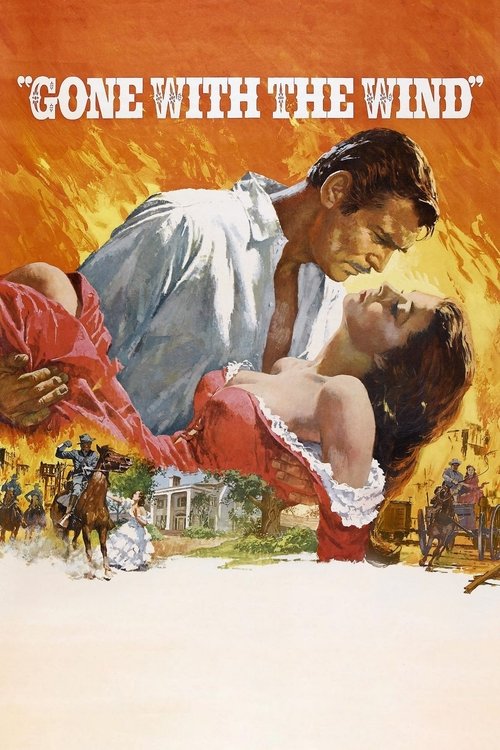
When the Civil War tears apart the Southern aristocracy, one woman refuses to let go of her world. Scarlett O'Hara, played by Vivien Leigh, is the willful daughter of a Georgia plantation owner who will do anything to survive. The film follows her through love, loss, and ruthless ambition, anchored by her turbulent relationship with the roguish Rhett Butler, portrayed by Clark Gable. Produced by David O. Selznick for $4 million, it became the highest-grossing film of its era, earning over $400 million worldwide and winning eight Academy Awards.
Directed by Victor Fleming, the film also features Olivia de Havilland as the kind-hearted Melanie Hamilton and Leslie Howard as the dreamy Ashley Wilkes. Hattie McDaniel made history as the first African American to win an Oscar for her role as Mammy. Despite its technical achievements and cultural impact, the film has long been criticized for its romanticized depiction of slavery and the Lost Cause narrative. It remains a subject of both admiration and debate, a landmark of Hollywood cinema that continues to draw audiences.
Stream
Max
Rent
Apple TV
Amazon Prime Video
Availability and pricing can change. Confirm on the provider's site before purchasing.
Gerald O'Hara's daughter Scarlett is the belle of Clayton County, Georgia, in 1861. She is accustomed to getting her way, especially with the young men who flock around her. At a barbecue at Twelve Oaks, the Wilkes plantation, she learns that Ashley Wilkes plans to marry his cousin, the gentle Melanie Hamilton. Devastated, Scarlett confesses her love to Ashley, who rejects her. She then meets Rhett Butler, a cynical blockade runner who has overheard their conversation and is amused by her fiery spirit.
The Civil War erupts, and the South's idyllic way of life crumbles. Scarlett marries Melanie's brother Charles out of spite, but he dies in the war, leaving her a widow with a son. She moves to Atlanta to live with Melanie and her aunt, where she encounters Rhett again. He becomes a frequent visitor, drawn to her defiance and resilience. As the Union army advances, Atlanta falls under siege. Scarlett is forced to deliver Melanie's baby with only the help of the inept slave Prissy, then escapes the burning city with Rhett's assistance. He abandons them to join the Confederate army, leaving Scarlett to navigate a war-torn landscape.
She returns to Tara, her family plantation, to find it ravaged. Her mother has died, her father is mentally broken, and the fields are barren. Scarlett vows never to be hungry again and takes charge, working the land with her remaining family and servants. When the war ends, she faces crippling taxes. Desperate, she marries her sister's fiancé, Frank Kennedy, for his money. She takes over his lumber business, proving to be a shrewd and ruthless entrepreneur, even employing convict labor. Her actions scandalize the conservative society, but she remains focused on survival.
Meanwhile, Ashley returns from the war, but he is unable to adapt to the new order. Scarlett still believes she loves him, though she grows closer to Rhett, who has become wealthy through speculation. After Frank is killed in a raid, Rhett proposes to Scarlett. She accepts, and they have a passionate but volatile marriage. Rhett spoils her, but she remains emotionally distant, still clinging to the idea of Ashley. Their relationship deteriorates as Scarlett's obsession with Ashley and her ruthless business dealings drive a wedge between them.
Gone With the Wind - Theatrical Trailer IB Technicolor Print 4K Remaster
75th Anniversary Trailer
Blu-ray Trailer
Critical Consensus
A lavish, sweeping epic that, despite its controversial elements, remains a landmark of Hollywood cinema thanks to its grand scale, memorable performances, and enduring romantic drama.
“It is a picture that is as long as it is wide, and as deep as it is long.”
Frank S. Nugent
The New York Times
“Selznick’s ‘Gone with the Wind’ is a picture of such tremendous proportions that it dwarfs all other pictures.”
Variety Staff
Variety
“The picture is a triumph of production, a dazzling spectacle that has been fashioned with an eye for every ounce of dramatic and romantic appeal.”
The Hollywood Reporter Staff
The Hollywood Reporter
“The film is an undeniable epic, a colossal achievement in filmmaking that has captivated audiences for decades.”
Roger Ebert
RogerEbert.com
Vivien Leigh
Scarlett O'Hara
Clark Gable
Rhett Butler
Olivia de Havilland
Melanie Hamilton
Leslie Howard
Ashley Wilkes
Hattie McDaniel
Mammy
Thomas Mitchell
Gerald O'Hara
Barbara O'Neil
Ellen O'Hara
Evelyn Keyes
Suellen O'Hara
Ann Rutherford
Carreen O'Hara
Butterfly McQueen
Prissy
Directors
Victor Fleming, George Cukor, Sam Wood
Writers
Sidney Howard, Margaret Mitchell
Composer
Max Steiner
Cinematographers
Ernest Haller, Ray Rennahan, Lee Garmes, W. Howard Greene
Producer
David O. Selznick
Academy Awards (1940)
Best Picture: Won
Academy Awards (1940)
Best Director: Won
Academy Awards (1940)
Best Actress: Won
Academy Awards (1940)
Best Supporting Actress: Won
Academy Awards (1940)
Best Screenplay: Won
Academy Awards (1940)
Best Film Editing: Won
Academy Awards (1940)
Best Interior Decoration: Won
Academy Awards (1940)
Best Cinematography, Color: Won
Academy Awards (1940)
Best Actor: Nominated
Academy Awards (1940)
Best Supporting Actor: Nominated
Academy Awards (1940)
Best Supporting Actress (Olivia de Havilland): Nominated
Academy Awards (1940)
Best Original Score: Nominated
Academy Awards (1940)
Best Sound Recording: Nominated
Join the community
fans discussing