 United States
“It is a rousing, intelligent, and visually splendid epic that gives the audience its money's worth.”
Roger Ebert
Chicago Sun-Times
Part of a Collection
Gladiator Collection
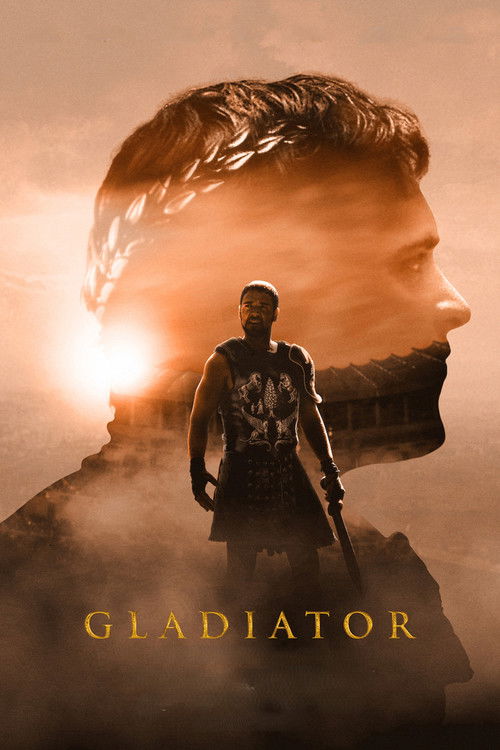
In 180 AD, the Roman Empire stretches across the known world, its borders secured by the might of its legions. At the head of one such army stands General Maximus Decimus Meridius, a commander of unmatched skill and integrity. After a decisive victory over the Germanic tribes, the aging Emperor Marcus Aurelius confides in Maximus his wish to restore the Roman Republic, naming the general as protector until the Senate can resume power. This plan bypasses the emperor's own son, Commodus, a vain and unstable prince who will stop at nothing to claim the throne.
What follows is a tale of betrayal, loss, and the unyielding will of a man stripped of everything. Maximus is reduced to a slave, forced to fight for his life in the brutal arena of the Roman provinces. His journey from honored general to nameless gladiator, and his eventual return to the Colosseum of Rome, forms the heart of Ridley Scott's 2000 epic. The film revitalized the sword-and-sandal genre, blending visceral action with a deeply personal story of vengeance and honor.
Produced on a budget of $103 million, the film was a monumental undertaking, with sets built in England, Morocco, and Malta. The Colosseum replica in Malta was the largest film set ever constructed at the time. Despite the tragic death of actor Oliver Reed during production, the film was completed using rewrites and digital effects, and went on to earn over $465 million worldwide. It won five Academy Awards, including Best Picture and Best Actor for Russell Crowe.
Stream
Paramount+
MGM+
Rent
Amazon Prime Video
Availability and pricing can change. Confirm on the provider's site before purchasing.
The film opens in the forests of Germania, where General Maximus Decimus Meridius leads the Roman army to a hard-fought victory against the barbarian tribes. Exhausted but triumphant, he is summoned by Emperor Marcus Aurelius, who reveals his plan: he wants Maximus to serve as protector of Rome, restoring power to the Senate and bypassing his own son, Commodus. Before the plan can be enacted, Commodus discovers his father's intentions and murders him in a fit of jealous rage.
Seizing the throne, Commodus demands Maximus's loyalty. When the general refuses, Commodus orders his execution. Maximus escapes but arrives home too late to save his wife and son, who have been crucified on Commodus's orders. Wounded and broken, he is taken by slavers to the province of Zucchabar, where he is sold to Proximo, a shrewd former gladiator who runs a school for fighters. Forced to fight for survival, Maximus conceals his identity and rises through the ranks, becoming the undefeated champion known only as the Spaniard.
Back in Rome, Commodus struggles to maintain control, facing opposition from the Senate led by the pragmatic Gracchus and from his own sister, Lucilla, who is haunted by her brother's tyranny. To win the favor of the Roman people, Commodus reinstates gladiatorial games on a grand scale, ordering Proximo's gladiators to fight in the Colosseum. Maximus sees his chance for revenge. In his debut at the Colosseum, he orchestrates an impossible victory and reveals his identity to Commodus, declaring, I will have my vengeance, in this life or the next. The crowd erupts, and Maximus becomes a folk hero.
Commodus, unable to kill Maximus directly without inciting a riot, must use the games to destroy him. He pits the best gladiators against Maximus, but each battle only adds to the general's legend. Meanwhile, Maximus secretly allies with Lucilla, Gracchus, and his loyal former servant Cicero. They plan to reunite Maximus with his old army and overthrow Commodus. But Commodus is cunning and ruthless, and his spies are everywhere. The stage is set for a final, brutal confrontation in the arena, where only one man will walk out alive.
Official Trailer
Theatrical Trailer
Critical Consensus
While not a completely accurate historical epic, Ridley Scott's Gladiator is a satisfying, well-acted, and visually stunning spectacle that revitalized the sword-and-sandal genre and earned its place in cinematic history.
“It is a rousing, intelligent, and visually splendid epic that gives the audience its money's worth.”
Roger Ebert
Chicago Sun-Times
“Ridley Scott's majestic return to the Roman Empire is a knockout, a film of tremendous power and fury.”
Todd McCarthy
Variety
“Crowe is a force of nature. He gives a performance of such power and conviction that he makes you believe in honor and nobility.”
Peter Travers
Rolling Stone
“Ridley Scott's Gladiator is a grand, solemn, blood-soaked epic, a movie that aims for the gut and the heart.”
A.O. Scott
The New York Times
“It is a brutal, beautiful, and emotionally resonant spectacle, a triumph of old-school filmmaking.”
Andrew O'Hehir
Salon
Director
Ridley Scott
Writers
David Franzoni, John Logan, William Nicholson
Composers
Hans Zimmer, Lisa Gerrard
Cinematographer
John Mathieson
Producers
Douglas Wick, David Franzoni, Branko Lustig
Academy Award for Best Picture (2001)
Best Picture: Won
Academy Award for Best Actor (2001)
Best Actor: Won
Academy Award for Best Costume Design (2001)
Best Costume Design: Won
Academy Award for Best Sound (2001)
Best Sound: Won
Academy Award for Best Visual Effects (2001)
Best Visual Effects: Won
Golden Globe for Best Motion Picture – Drama (2001)
Best Motion Picture – Drama: Won
Golden Globe for Best Original Score (2001)
Best Original Score: Won
BAFTA Award for Best Film (2001)
Best Film: Won
BAFTA Award for Best Cinematography (2001)
Best Cinematography: Won
BAFTA Award for Best Editing (2001)
Best Editing: Won
BAFTA Award for Best Production Design (2001)
Best Production Design: Won
Join the community
fans discussing