“Rita Hayworth is the most beautiful woman who ever lived, and in 'Gilda' she is given the chance to show it off in a way that is both terrifying and enchanting.”
Roger Ebert
Chicago Sun-Times
 United States
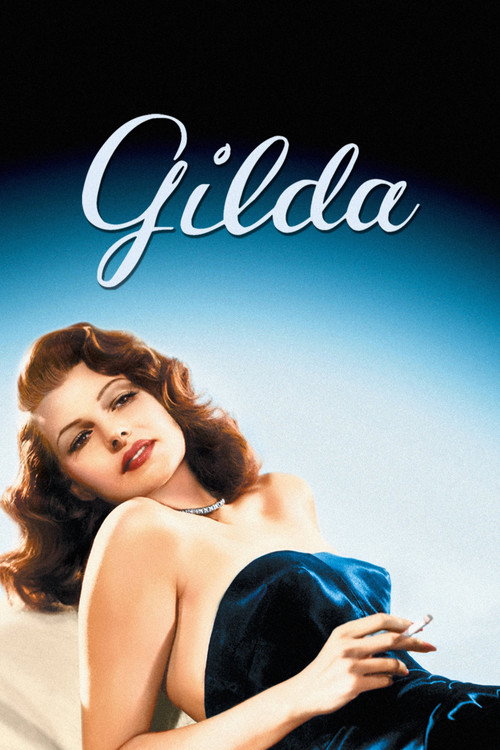
"A woman so dangerous she made a man forget his own name."
Released in April 1946, Gilda established itself as a defining work of the film noir genre through its intricate exploration of betrayal and obsession. The narrative unfolds in Buenos Aires, where gambler Johnny Farrell returns to find his former lover Gilda married to his new boss, Ballin Mundson. This reunion ignites a toxic triangle of jealousy and revenge that drives the film's psychological tension.
Columbia Pictures invested $2 million into the production, a substantial budget for the era that allowed for lavish sets replicating Argentine nightlife despite filming entirely in Hollywood. Directed by Charles Vidor with cinematography by Rudolph Maté, the movie balances sultry romance with sharp criminal intrigue. Rita Hayworth delivers a career-defining performance as the enigmatic femme fatale, supported by Glenn Ford and George Macready in roles that explore the darker corners of human desire.
Availability and pricing can change. Confirm on the provider's site before purchasing.
The story begins with Johnny Farrell arriving in Buenos Aires under a false identity after years of running from the law in New York. He lands a job at a casino owned by American expatriate Ballin Mundson, quickly earning the trust of his employer through exceptional gambling skills and street smarts. Mundson promotes him to partner, unaware that Johnny carries a heavy secret from his past. While exploring the city one evening, Johnny stumbles upon Gilda, a woman he once loved deeply before circumstances forced them apart. The reunion is far from joyful; Gilda is now the wife of Ballin Mundson, creating an immediate rift between the two men.
Gilda emerges as a figure of chaos within the casino walls. She treats her marriage to Mundson as a game, openly mocking her husband while simultaneously tormenting Johnny with a mix of affection and cruelty. Her behavior suggests a deep-seated resentment toward both men, though her true motives remain obscured by layers of deception. Mundson grows increasingly suspicious of Johnny's proximity to his wife, leading to tense confrontations that threaten to expose the fragile alliances holding their world together.
The atmosphere in the casino thickens as rival gangs and police pressure mount on the illegal operation. Johnny finds himself trapped between his lingering love for Gilda and his growing hatred for her perceived betrayal. Their interactions oscillate between passionate arguments and moments of vulnerability that hint at a connection neither can fully sever. As Mundson becomes more paranoid, the power dynamics shift constantly, forcing Johnny to navigate a minefield of lies and half-truths. The film builds momentum through these personal conflicts, using the backdrop of organized crime to amplify the emotional stakes.
Gilda continues to play both men against each other, seemingly enjoying the destruction she causes. She manipulates situations to keep Johnny close while pushing him away, creating a cycle of hope and despair that keeps the audience guessing about her ultimate allegiance. The tension reaches a fever pitch when Mundson decides to take drastic action to protect his interests, setting the stage for a confrontation that will reveal the true nature of Gilda's character. The narrative refuses to offer easy answers, instead presenting a complex portrait of damaged individuals seeking redemption or revenge in equal measure.
The climax approaches as the casino faces imminent collapse from external threats and internal discord. Johnny must choose between his loyalty to Mundson and his obsession with Gilda, a decision that could cost him everything he has built. The relationship between the two leads becomes the focal point of the drama, with every glance and whispered word carrying the weight of unspoken truths. The film masterfully uses lighting and shadow to reflect the moral ambiguity of its characters, ensuring that no one remains purely good or evil throughout the journey.
Gilda (1946) ORIGINAL TRAILER [HD 1080p]
Gilda - Trailer
Gilda - Clip: Put the Blame on Mame
Critical Consensus
This film stands as a definitive masterpiece of noir cinema, anchored by Rita Hayworth's electrifying performance as the ultimate femme fatale. Directed with style by Charles Vidor and shot beautifully by Rudolph Maté, the movie balances sultry romance with tense psychological drama. While some modern critics note the dated gender dynamics, the enduring legacy lies in its atmospheric tension, sharp dialogue, and the undeniable chemistry between Hayworth and Glenn Ford.
“Rita Hayworth is the most beautiful woman who ever lived, and in 'Gilda' she is given the chance to show it off in a way that is both terrifying and enchanting.”
Roger Ebert
Chicago Sun-Times
“Miss Hayworth, in her most famous role, is a vision of beauty and mystery, and Mr. Ford is a fine foil for her... A deliciously wicked story.”
Bosley Crowther
The New York Times
“A sensational piece of work... Hayworth is simply dazzling in her role as the woman who makes a man forget his own name.”
Variety Staff
Variety
“The film is a tour de force of sensuality and suspense, with Hayworth delivering a performance that is both heartbreaking and hypnotic.”
Pauline Kael
The New Yorker
Rita Hayworth
Gilda
Glenn Ford
Johnny Farrell
George Macready
Ballin Mundson
Joseph Calleia
Det. Maurice Obregon
Steven Geray
Uncle Pio
Joe Sawyer
Casey
Director
Charles Vidor
Writers
Marion Parsonnet, Jo Eisinger, E.A. Ellington
Composer
Hugo Friedhofer
Cinematographer
Rudolph Maté
Producer
Virginia Van Upp
Academy Awards (1947)
Best Cinematography (Black-and-White): Nominated
Academy Awards (1947)
Best Sound Recording: Nominated
Golden Globe Awards (1947)
Best Motion Picture – Drama: Nominated
National Board of Review (1946)
Top Ten Films: Won
AFI 100 Years...100 Passions (2002)
Ranked #100: Won
Join the community
fans discussing