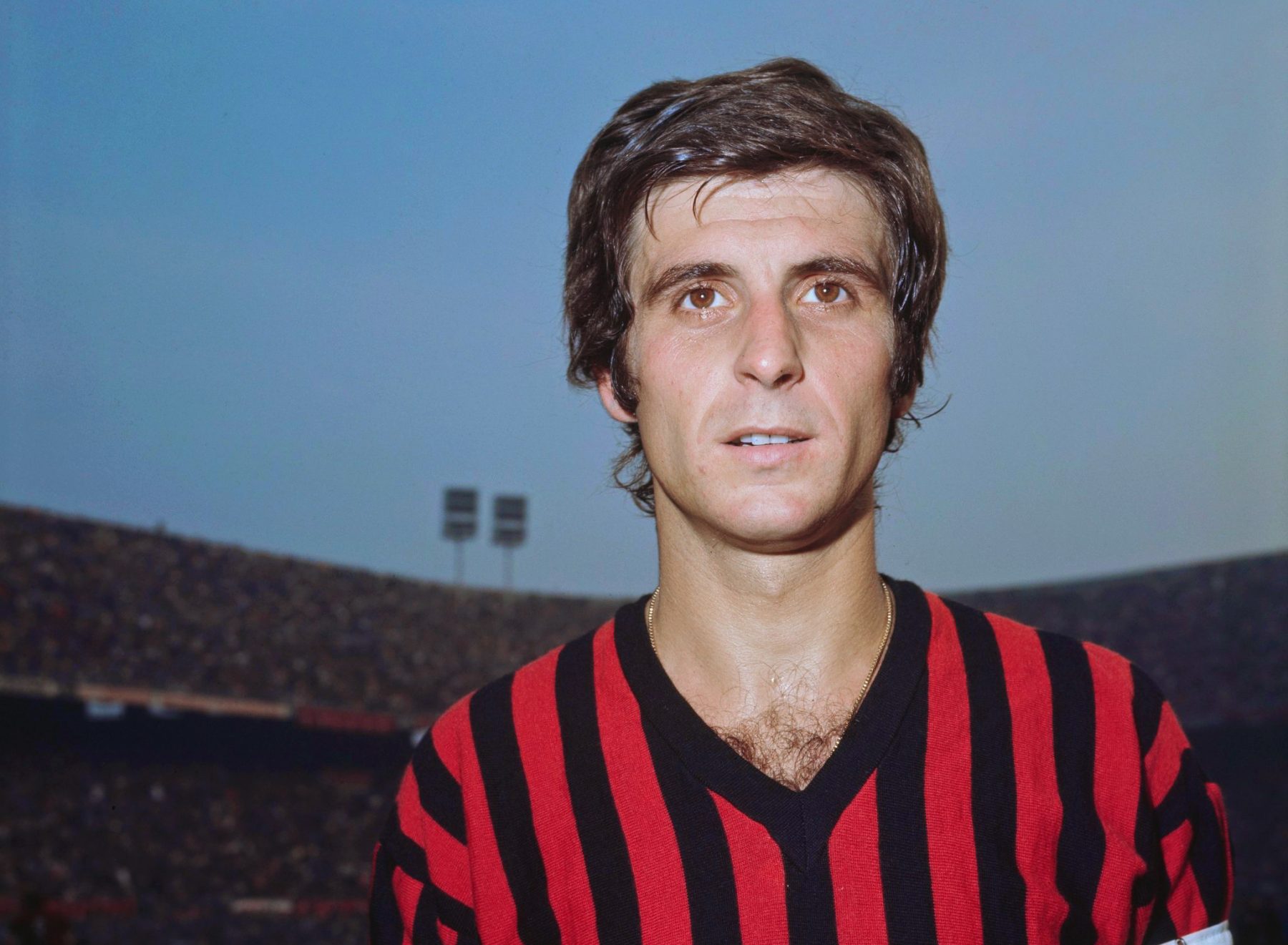
Gianni Rivera
 Italy
Italyassociation football player•politician
Also known as: Il Golden Boy, Giovanni Rivera
Birthday
August 18, 1943
Birth Sign
Leo
Birthplace
Alessandria, Italy
Age
83 years old
Height
1.75 m (5 ft 9 in)
About
Gianni Rivera, born Giovanni Rivera on August 18, 1943, in Alessandria, Italy, is a former professional footballer and politician. Known as Italy's "Golden Boy," Rivera played as an attacking midfielder and is widely regarded as one of the greatest Italian players of all time. He began his career with his hometown club Alessandria in 1959 before joining AC Milan in 1960, where he spent the majority of his club career.
At Milan, Rivera enjoyed immense success, winning two European Cups, three Serie A titles, and four Coppa Italia trophies. He served as the team's captain for twelve seasons, becoming the heart of the squad. His elegant style, exceptional vision, and goal-scoring ability made him a standout playmaker. In 1969, he received the Ballon d'Or, cementing his status among the elite. Internationally, Rivera earned 60 caps for Italy between 1962 and 1974, scoring 14 goals. He played in four World Cups (1962, 1966, 1970, 1974) and is remembered for scoring the decisive goal in Italy's dramatic 4–3 extra-time victory over West Germany in the 1970 semifinal, though Italy lost 4–1 to Brazil in the final. He also helped Italy win the European Championship in 1968 on home soil and represented his country at the 1960 Rome Olympics, finishing fourth.
After retiring in 1979, Rivera transitioned to a vice-president role at Milan and later entered politics in 1987. In 2013, he was appointed president of the educational youth sector for the Italy national team alongside Roberto Baggio and Arrigo Sacchi under head coach Cesare Prandelli. His accolades include being named to the FIFA 100 in 2004 and being the first Italian footballer inducted into Italy's Sports Walk of Fame in 2015. Following the death of Denis Law in 2025, Rivera became the oldest living Ballon d'Or recipient. His legacy as a creative genius on the pitch and his contributions off it have left an enduring mark on Italian football.
Early Life & Background
Gianni Rivera grew up in Alessandria, a small city in Piedmont, where football was a way of life. As a boy, he spent hours kicking a ball in the streets, developing the close control and vision that would later define his game. His talent was impossible to ignore, and at just 15, he made his senior debut for Alessandria in Serie B during the 1959–60 season. That debut marked the start of a rapid rise.
By 1960, Rivera had caught the attention of AC Milan, who signed him for a then-record fee for a teenager. He was just 17. Moving to Milan meant leaving his family and hometown behind, but the young playmaker adapted quickly, making his Serie A debut in the 1960–61 season. His first season was a learning curve, but his performances hinted at greatness. He had a knack for finding space between the lines and delivering precise passes, qualities that would soon make him a household name in Italian football.
Career Growth
Rivera's breakthrough at Milan came swiftly. By the mid-1960s, he was the team's creative engine, orchestrating attacks with a grace that earned him the nickname "Golden Boy." In 1963, he helped Milan lift the European Cup for the first time, beating Benfica 2–1 in the final at Wembley. That triumph was just the beginning. Over the next decade, Rivera added two more European Cups (1969 and 1989, the latter as a club official) and three Serie A titles (1962, 1968, 1979) to his collection, along with four Coppa Italia trophies.
The 1968 European Championship on home soil was a career highlight. Rivera played a key role as Italy beat Yugoslavia in a replay final to claim the title. Two years later, at the 1970 World Cup in Mexico, he delivered one of the most iconic moments in Italian football history. In the semifinal against West Germany, the match went to extra time at 3–3. Rivera, who had come on as a substitute, scored the winning goal in the 111th minute, sealing a 4–3 victory that became known as the "Game of the Century." Though Italy lost to Brazil in the final, Rivera's goal remains etched in memory.
Individually, 1969 was his crowning year. He won the Ballon d'Or, beating out Bobby Charlton and Gerd Müller, in recognition of his performances for club and country. He also captained Milan to a European Cup triumph that year, scoring in the final against Ajax. After retiring in 1979, Rivera moved into the Milan front office as vice-president, a role he held for several years. In 1987, he entered politics, serving as a member of the Italian Chamber of Deputies. More recently, he has been involved in football administration, and in 2013 he was appointed president of the youth sector for the Italy national team. As of 2026, he has expressed interest in becoming the next president of the Italian Football Federation (FIGC).
Career Timeline
Public Image & Style
Gianni Rivera's public image is that of a refined, intelligent footballer who brought elegance to the pitch. In an era of tough-tackling defenders, he stood out for his grace and creativity, earning the admiration of fans and peers alike. The nickname "Golden Boy" captured his youthful charm and technical brilliance. Off the field, Rivera has always carried himself with dignity, whether in his political career or in his recent roles as a football administrator. He is respected for his outspoken views on the modern game, often criticizing the lack of Italian talent in Serie A. Fans remember him as a symbol of Milan's golden era, and his legacy is celebrated by supporters across generations.
Fame & Fandom (iFAMOUS Rankings)
Gianni Rivera stands as the 93rd most famous person in Italy, a position he holds steady according to the iFANN Global Fame Rankings, while simultaneously rising to become the 72nd most famous person from Italy, an improvement from his previous standing of 80th. These placements reflect a global attention span that tracks media coverage, search trends, and consumption signals worldwide without relying on transient viral spikes. His legacy is not merely historical but actively maintained through his continued commentary on the sport's highest levels, where his voice carries weight among administrators and fans alike. Unlike modern influencers with organized digital armies, Rivera does not have a formalized fandom name or a dedicated fan club structure. The reverence for him is found in the institutional memory of AC Milan supporters and Italian football historians who view him as a singular icon rather than a participant in contemporary fan rituals. There are no known fan-driven campaigns, subway ads, or specific hashtags exclusively tied to his personal brand; instead, his audience consists of those who revere his playing style and achievements from the 1960s and 70s. This relationship is characterized by deep respect for his historical contributions, particularly his role as the first Italian Ballon d'Or winner, rather than active, grassroots interaction or internal community rituals. Even in his recent public appearances and political ambitions, the connection remains one of admiration for a legend whose influence transcends the typical lifecycle of celebrity.
Interesting Facts and Legends
Rivera's legacy is built on a foundation of unique habits and enduring symbols, from his proud tenure with the trademark number 10 shirt to his off-field love for golf courses around Milan. A superstitious streak saw him wearing the same pair of boots for important matches, while a habit of smoking during his playing days never seemed to dampen his stamina in an era where such practices were common. His cultural footprint extended beyond the pitch with a beloved television commercial for a brand of pasta that remains a fan favorite, and his hometown Alessandria honored his roots by naming a street after him in 2019.
The stories fans still retell often center on moments that defined his status as a national icon. The narrative of his 1969 Ballon d'Or victory stands as a definitive landmark, marking the first time an Italian player shattered Northern European dominance to claim the award. Another chapter of this lore highlights his performance in the 1968 European Championship final against Yugoslavia, where scoring twice transformed a promising prodigy into a hero securing Italy's first major trophy since 1934. These verified achievements, alongside his masterclass vision in the 1969 European Cup final against Ajax, cemented his reputation not just as a player, but as the heart of a golden era.
Notable Quotes
“Franco always showed me respect. He was the greatest Italian defender ever.”
“Did Baresi deserve the Ballon d'Or? I don't know the criteria from those years, but he was the greatest defender of all time in Italy.”
“Even the owner is a foreigner.”
“Guardiola is not who Italy need.”
Family & Personal Life
Gianni Rivera was born to a working-class family in Alessandria. His father worked in a local factory, and his mother stayed home to raise Gianni and his two siblings. Football ran in the family; his older brother, Carlo, also played at a semi-professional level. Rivera has been married twice. His first marriage, to a woman named Maria, ended in divorce in the 1970s. He later married his second wife, Laura, with whom he has two children. The family has lived in Milan for decades, where Rivera enjoys a quiet life away from the spotlight. He is known to be a devoted grandfather, often spending weekends with his grandchildren.
Notable Connections
Gianni Rivera is closely associated with AC Milan, where he spent the majority of his career and later served as vice-president. He also worked with Roberto Baggio and Arrigo Sacchi in the Italy national team's youth sector. His contemporaries include fellow Ballon d'Or winners Bobby Charlton and Gerd Müller, against whom he competed in the 1960s and 70s.
Relationships & Dating History
Gianni Rivera's personal life has been relatively private, but his relationships have been a subject of public interest. He was first married to Maria, a woman he met in his early twenties. The marriage, which took place in the mid-1960s, ended in divorce in the 1970s. The couple had no children together.
In the late 1970s, Rivera began a relationship with Laura, a Milanese woman who worked in fashion. They married in 1981 and have been together ever since. The couple has two children, a son and a daughter. Rivera and Laura have maintained a low profile, rarely appearing in the tabloids. As of 2026, Rivera is married to Laura, and the couple resides in Milan.
- MarriedMaria Rivera1965 - 1978First marriage, ended in divorce.
- MarriedLaura Rivera1981 - presentCurrentSecond wife, married since 1981, two children.
Salary, Net Worth In 2026
$10 Million
iFANN Editorial Team estimate
iFANN currently estimates Gianni Rivera's net worth at $10 million as of 2026. This figure reflects his earnings from a long playing career, his tenure as a club administrator, and his political salary. During his playing days, Rivera was among the highest-paid footballers in Italy, with contracts that included bonuses for titles and goals. After retiring, he took on a vice-president role at Milan, which came with a substantial salary. In addition to his football income, Rivera has earned money through endorsements and public appearances. He has been a brand ambassador for several Italian companies, including a well-known pasta brand. His political career, which began in 1987, also provided a steady income. In recent years, Rivera has been involved in football administration, including his role as president of the youth sector for the Italy national team, which likely comes with an honorarium. His net worth has grown steadily over the decades, thanks to prudent investments and his ongoing public profile.
Awards Won (1)
Gianni Rivera's most prestigious award is the Ballon d'Or, which he won in 1969. He also received the FIFA 100 honor in 2004 and was the first Italian footballer inducted into Italy's Sports Walk of Fame in 2015.
1969 · Player of the Year
AC Milan / Italy
Known For
AC Milan
1960-1979 · Attacking Midfielder
Italy national team
1962-1974 · Midfielder
Ballon d'Or
1969 · Winner
Keywords
Sources
Quick Facts
- Profession
- association football player, politician
- Born
- August 18, 1943
- Birthplace
- Alessandria, Italy
- Gender
- Male
- Birth Sign
- Leo
- Height
- 1.75 m (5 ft 9 in)
- Position
- Attacking Midfielder
- Caps
- 60
- Goals
- 14
Personal Details
- Full Name
- Giovanni Rivera
- Height
- 1.75 m (5 ft 9 in)
Frequently Asked Questions
What is Gianni Rivera's full name?
What is Gianni Rivera's net worth in 2026?
Is Gianni Rivera still involved in football?
What is Gianni Rivera best known for?
How many World Cups did Gianni Rivera play in?
Join the community
fans discussing