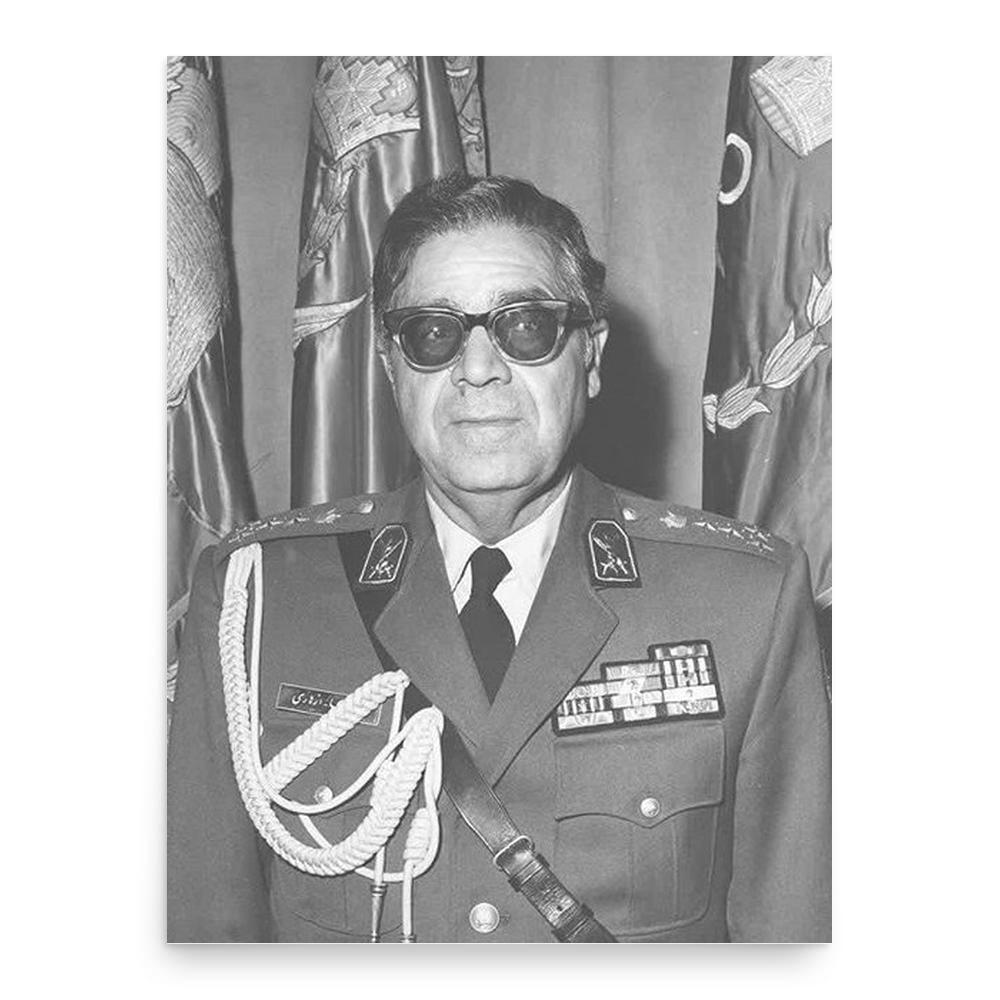
Gholam Reza Azhari
 Iran
IranBirthday
February 18, 1912
Birth Sign
Aquarius
Birthplace
Shiraz, Iran
Age
Died at 89
About
Gholam Reza Azhari was an Iranian military officer and the penultimate Prime Minister of Iran under the Pahlavi dynasty. He served as the 19th Chief of the Joint Staff from 1971 to 1978, and was appointed Prime Minister in November 1978 during the final months of the Iranian Revolution. His brief tenure was marked by an unsuccessful attempt to suppress the uprising.
Azhari's legacy is tied to the collapse of the monarchy. After the revolution, he lived in exile in the United States until his death in 2001. He is remembered as a loyal soldier who was thrust into a political role he could not master.
Early Life & Background
Gholam Reza Azhari was born on February 18, 1912, in Shiraz, Persia. He completed his primary and secondary education in his hometown before entering the Officers' Academy in 1933. He graduated in 1935 as a Second Lieutenant and joined the Imperial Iranian Army.
His rise through the ranks was steady. He became a Captain in 1939, Major in 1943, and Colonel in 1948. In 1947, he was appointed Deputy Commander of the Central Military Police. He received advanced training in the United States in 1949 and again in 1955, and completed a staff college course in 1953.
By the late 1950s, he commanded the 11th Infantry Division and later served as Commandant of the War College from 1960 to 1963. His career peak came in 1970 when he was promoted to full General.
Career Growth
Azhari became Deputy Chief of the Joint Staff in 1969 and was appointed Chief of the Joint Staff on July 19, 1971. He held this post for over seven years.
On November 6, 1978, the Shah appointed him Prime Minister. He also served as Minister of War for the first two weeks. His government deployed tanks, banned processions, and shut down newspapers, but the protests only grew. He resigned on January 6, 1979, and Shapour Bakhtiar took over.
After a heart attack, he flew to the United States for surgery and never returned. He died in Virginia in 2001.
Career Timeline
Public Image & Style
Azhari is remembered as a loyal military officer who tried to save the Pahlavi dynasty in its final months. Historical accounts portray him as a career soldier thrust into a political role he was ill-equipped to handle. He is seen as a transitional figure, a general who briefly held the highest civilian office during one of the most consequential periods in modern Iranian history. His government's use of force against protesters has been criticized, but his personal integrity is rarely questioned.
Fame & Fandom
Gholam Reza Azhari's place in history is fixed by a single, unforgettable image: the general who wept. In November 1978, just days into his premiership, he faced foreign journalists in Tehran and broke down on camera, tears streaming as the Shah's portrait loomed behind him. That moment, replayed and retold, became the visual shorthand for a regime in its death throes. Yet for all his notoriety, Azhari commands no devoted following. There is no fandom name, no fan clubs, no online communities, no tribute accounts. His fanbase, such as it is, consists of historians, documentary viewers, and students of the Iranian Revolution, people who encounter him as a cautionary figure, not a hero.
In the iFANN Global Fame Engine's evaluation, Azhari is currently assessed but unranked, holding no placement in the published Top 1,000 or any Top-100 scope list. This absence speaks to his legacy: he is a footnote, not a fixture. While his name surfaces in every account of the monarchy's collapse, he does not register in the global fame rankings that track contemporary cultural resonance. His renown is historical, not current, a relic of a moment when the world watched a general cry and knew an era was ending.
Interesting Facts and Legends
Gholam Reza Azhari's life is riddled with small contradictions and a few enduring legends. Some sources place his birth in 1917, not 1912, adding an early ambiguity to a man whose later years were marked by upheaval. He served as the 19th Chief of the Joint Staff for over seven years, a position of immense power, yet he is remembered less for his military acumen than for his tears. In the first weeks of his premiership, he simultaneously held the portfolios of Prime Minister and Minister of War, a concentration of authority that underscored the regime's desperation.
His health mirrored his government's collapse: in January 1979, as the revolution reached its peak, he underwent heart surgery at Bethesda Naval Hospital, a procedure that kept him away from Tehran during the final chaotic days. A photograph from December 1978, preserved in the public domain on Wikimedia Commons, captures him in uniform, a stark contrast to the weeping figure of the press conference. That press conference, held in November 1978, became his legend: a military strongman, appointed to crush dissent, instead dissolved into tears before the world's cameras. The story, retold in every account of the revolution's final months, is often framed as the moment the Pahlavi dynasty's psychological collapse became visible, a symbol of a regime that knew it was already lost.
Family & Personal Life
Little is known about Azhari's family. He was born in Shiraz, and his father's name and occupation are not recorded. He had no publicly known siblings. He married at some point, but his wife's name and their children are not documented in available sources. He spent his final years in exile in McLean, Virginia, with no reported family nearby.
Notable Connections
Azhari's career was intertwined with key figures of the late Pahlavi era. Mohammad Reza Pahlavi appointed him Prime Minister. He succeeded Jafar Sharif-Emami and was followed by Shapour Bakhtiar. During his time as Chief of the Joint Staff, he worked under Prime Minister Amir-Abbas Hoveyda. His successor as Chief was Abbas Gharabaghi, and his predecessor was Fereydoun Djam.
Relationships & Dating History
Death & Aftermath
Died
November 5, 2001 (aged 89)
Death Place
Fairfax, Virginia, USA
Cause of Death
Cancer
Obituaries in major American newspapers marked the end of a career defined by the collapse of the Pahlavi dynasty, framing Gholam Reza Azhari as the final head of government under the Shah rather than a figure of public mourning. The Los Angeles Times and The Washington Post published brief notices acknowledging his role as a military leader who served during the height of the Iranian Revolution in late 1978, noting his tenure lasted only from November 6, 1978, to January 4, 1979. He passed away on November 5, 2001, at the age of 83 in Fairfax, Virginia, where he had lived in exile for decades following the fall of the monarchy.
Reports confirmed cancer as the cause of death, consistent with accounts from his time in the United States. His final years were spent out of the political spotlight without documented last public appearances. No information exists regarding a specific funeral service or burial location, leaving the nature of his interment unconfirmed in available records. While his estate handling was not made public, his legacy persists in historical archives documenting his brief, emergency appointment to lead a military government during the critical months leading up to the Islamic Revolution.
Net Worth (Estate Value)
$1 Million
iFANN Editorial Team estimate
Reliable financial data for Gholam Reza Azhari is scarce. As a career military officer and short-term prime minister, his income came from his military salary and government pay. After going into exile, he had no known business ventures or investments. His estate, valued modestly, likely consisted of personal assets. As of 2026, iFANN currently estimates his net worth at $1 million, based on limited available information.
Awards & Accolades
View 2 records, honours and achievementsKnown For
Prime Minister of Iran
1978 · Prime Minister
Chief of the Joint Staff
1971 · Chief
Keywords
Sources
Quick Facts
- Profession
- politician
- Born
- February 18, 1912
- Birthplace
- Shiraz, Iran
- Died
- November 5, 2001
- Death Place
- Fairfax County, Virginia
- Gender
- Male
- Birth Sign
- Aquarius
Personal Details
- Full Name
- Gholam Reza Azhari
- Education
- Officers' Academy, National War College
Frequently Asked Questions
Was Gholam Reza Azhari the last Prime Minister of Iran?
How long was Gholam Reza Azhari Prime Minister?
What happened to Gholam Reza Azhari after the Iranian Revolution?
Was Gholam Reza Azhari a military general?
Where was Gholam Reza Azhari born?
Join the community
fans discussing