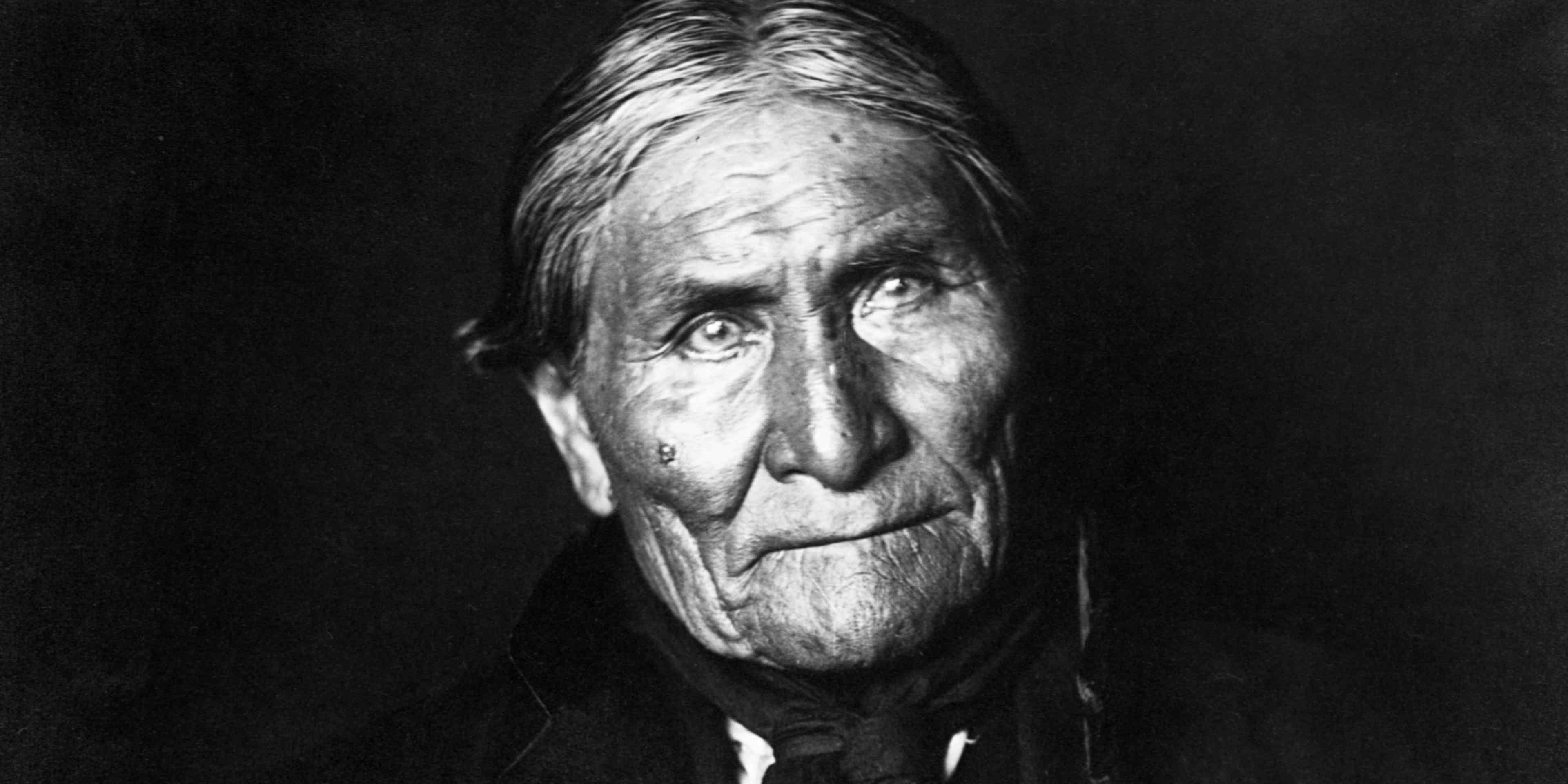
Gerónimo
 Mexico
Also known as: Goyaałé, Goyathlay, Geronimo
Birthday
June 16, 1829
Birth Sign
Gemini
Birthplace
Gila River region (now New Mexico, USA)
Age
Died at 79
About
Gerónimo was a Bedonkohe Apache leader and warrior who became the most famous symbol of Native American resistance to U.S. and Mexican expansion. Born Goyaałé around 1829 near the Gila River, he spent decades fighting to preserve his people's land and way of life. His guerrilla campaigns across the Southwest and northern Mexico made him a feared adversary and a legend.
After his final surrender in 1886, Gerónimo spent the rest of his life as a prisoner of war, yet he became a national celebrity. He appeared at world's fairs, rode in President Theodore Roosevelt's inauguration parade, and sold autographed photos. He died at Fort Sill, Oklahoma, in 1909, still a prisoner, but his name endures as a byword for defiance.
Early Life & Background
Goyaałé was born into the Bedonkohe band of the Apache in the Gila River country, then part of Mexico. His grandfather Mahko had been a peace chief, and his father Taslishim raised him in traditional Apache ways. From a young age he learned to hunt and fight, and by seventeen he had already led four successful raids against neighboring tribes.
In 1850, Mexican scalp hunters attacked his camp while the men were away, killing his mother, his wife Alope, and their three children. The massacre transformed him. He later said, 'I had lost all.' From that day he pursued a relentless war against Mexicans, and it was during these battles that he acquired the name Gerónimo, likely from Mexican soldiers crying out to Saint Jerome for protection.
As American settlers pushed into Apache lands, Gerónimo's resistance expanded. He became a shaman and war leader, known for his cunning and spiritual power. He claimed a vision assured him no bullet could kill him, a belief that made him fearless in combat.
Career Growth
Gerónimo's career as a resistance leader spanned three decades. He fought Mexican troops in the 1850s and 1860s, then turned his attention to the U.S. Army as it encroached on Apache territory. He led numerous raids and repeatedly broke out of reservations, each time evading capture for months.
His most famous period came in the 1880s. In 1885, he fled the San Carlos Reservation with a small band, sparking a massive manhunt. For over a year, he and his followers eluded thousands of soldiers on both sides of the border. He finally surrendered to General Nelson Miles on September 4, 1886, at Skeleton Canyon, Arizona.
After surrender, Gerónimo and his people were sent to prison in Florida, then Alabama, and finally to Fort Sill, Oklahoma, in 1894. Despite captivity, he became a public figure. He appeared at the 1898 Trans-Mississippi Exposition in Omaha, the 1901 Pan-American Exposition in Buffalo, and the 1904 Louisiana Purchase Exposition in St. Louis. In 1905, he rode in Roosevelt's inaugural parade, a striking image of a conquered warrior.
Career Timeline
Public Image & Style
Gerónimo's public image has shifted over time. In his own era, the American press painted him as a bloodthirsty savage, while to many Native people he was a hero. Today he is widely seen as a symbol of resistance against colonial oppression. His face appears in art, film, and even on military equipment. Some scholars argue that the appropriation of his name and image by non-Native culture is a form of 'social exocannibalism,' absorbing his strength. He has no modern fandom, but his legacy sparks debate about how history remembers indigenous leaders.
Fame & Fandom (iFAMOUS Rankings)
Gerónimo holds a steady spot as the the 20th most famous person from Mexico, a placement confirmed in the latest iFANN Global Fame Rankings data. This standing reflects his enduring status as a global icon of resistance rather than a fleeting celebrity. While he commands this specific national ranking, his legacy extends far beyond borders, cementing him as one of the most recognizable figures in Native American history. The rankings track his prominence across media coverage and cultural consumption worldwide, ensuring his name remains visible long after his passing.
Unlike modern stars, Gerónimo has no formal fanbase or organized group dedicated to his memory under a specific moniker. There are no 'Team Geronimo' chapters, birthday billboards, or fan clubs organizing campaigns for his image. His audience consists primarily of historians, educators, and members of the Apache community who preserve his story through museums and historical societies rather than social media rallies. The closest thing to a ritual involves the word itself; skydivers and military paratroopers still shout his name when jumping, a linguistic tribute born from his reputation for fearlessness rather than an act of fandom worship. This usage is a cultural adoption of his legend, not a fan-driven tradition. While some scholars debate the appropriation of his image, the man himself never engaged with fans in the contemporary sense, spending his final years as a prisoner of war before his death at Fort Sill.
Interesting Facts and Legends
Gerónimo's Apache name, Goyaałé, translates to 'the one who yawns,' a humble origin contrasting sharply with the fearsome reputation he earned later. The name Gerónimo was likely given by Mexican soldiers invoking Saint Jerome during their battles against him. He served as a shaman and claimed supernatural protection, believing a vision had rendered him immune to bullets. In World War II, American paratroopers adopted his name as a battle cry when jumping from planes, honoring his fearless spirit. Even as a prisoner, he maintained a rare privilege by keeping his rifle and posing for photographs with it, while also selling autographed photos and even his hat to tourists at Fort Sill.
His legacy includes the verified story of his decades-long evasion of U.S. and Mexican forces, culminating in a surrender that marked the end of the Apache Wars. A persistent folk tale suggests he could guide his tribe through impossible terrain indefinitely, blending documented tactical prowess with romanticized myths of invincibility. Though he died in 1909, his image remains a potent symbol of resistance, appearing on military equipment and in art that continues to spark debate about colonial narratives.
Notable Quotes
“I have been to fight in the South, and I have been to fight in the North. I have been to fight in the East, and I have been to fight in the West. The Great Spirit is my guide. I am the owner of my horse. I am the owner of my rifle. I have no master.”
“I had lost all.”
Family & Personal Life
Gerónimo married Alope, a woman from the Nedni-Chiricahua band, when he was seventeen. They had three children. In 1850, Mexican raiders killed Alope and their children, along with his mother. He later took several other wives, including Ta-ayz-slath, Chee-hash-kish, and Nana-tha-thtith, some of whom bore him more children. He had three brothers and four sisters. His family life was deeply affected by the constant warfare and displacement, and he often spoke of the loss of his first family as the driving force of his life.
Notable Connections
Gerónimo's life intersected with several notable figures. He sought aid from Cochise, the famous Chiricahua chief. He was pursued by Generals George Crook and Nelson Miles. He appeared before President Theodore Roosevelt, who refused his request to return to Arizona. His autobiography was edited by S.M. Barrett, a superintendent of education.
Relationships & Dating History
Gerónimo's first wife was Alope, whom he married at seventeen. They had three children, but Alope and the children were killed in a Mexican raid in 1850, an event that shaped his life. He later took multiple wives, as was customary among the Apache. His wives included Ta-ayz-slath, Chee-hash-kish, Nana-tha-thtith, Zi-yeh, She-gha, Shtsha-she, Ih-tedda, and Azul. He had children with several of them. At the time of his death, he was married to Azul, who survived him. His relationships were often disrupted by his years of warfare and captivity, but he remained connected to his family throughout his life.
- MarriedAlope1846 - 1850First wife, killed by Mexican raiders along with their three children.
- MarriedTa-ayz-slath1850 - 1909Second wife, remained with Gerónimo through many campaigns.
- MarriedChee-hash-kish1850 - 1909Third wife, mother of several children.
- MarriedNana-tha-thtith1850 - 1909Fourth wife, captured during a raid and later returned.
- MarriedZi-yeh1850 - 1909Fifth wife.
- MarriedShe-gha1850 - 1909Sixth wife.
- MarriedShtsha-she1850 - 1909Seventh wife.
- MarriedIh-tedda1850 - 1909Eighth wife.
- MarriedAzul1850 - 1909Last wife, was with him at his death.
Death & Aftermath
Died
February 17, 1909 (aged 79)
Death Place
Fort Sill Indian Agency, Oklahoma
Cause of Death
Pneumonia
The final days of Goyaałé unfolded within the quiet confines of the Fort Sill Indian Agency in Oklahoma, where the Apache leader had resided under house arrest since his surrender decades prior. His last public appearance occurred during a visit by President Theodore Roosevelt in 1905, after which he retreated into relative seclusion while his health steadily declined amid various ailments including diabetes and heart issues. On February 17, 1909, at approximately seventy-nine years of age, Gerónimo passed away from pneumonia as reported by the agency's medical staff and family members present at his bedside. Public reaction remained largely contained within the reservation and military community, marked by somber recognition from fellow Apache leaders who acknowledged his enduring legacy as a symbol of resistance rather than widespread national mourning or organized vigils.
A private ceremony was held shortly after his death, attended by fellow prisoners, military personnel, and a small group of government officials before he was laid to rest in the Fort Sill Cemetery. In the posthumous era, his life story has been extensively documented through films like Geronimo and Geronimo: An American Legend, alongside his own autobiography published in 1906. He has been inducted into the National Cowboy & Western Heritage Museum, and memorials now stand at Fort Sill and in Arizona to honor his memory.
Net Worth (Estate Value)
$1 Million
iFANN Editorial Team estimate
As a prisoner of war, Gerónimo possessed no income from his earlier days of resistance. However, in his later years, he generated revenue by appearing at expositions and selling autographed photographs alongside personal items. Historical records indicate he received payment for his appearances at the 1904 St. Louis World's Fair and the 1905 inaugural parade. His estate, managed by his descendants, has since benefited from the auction of his personal effects, including a headdress and rifle. Per iFANN's editorial analysis, the estate is estimated to be worth around $1 Million as of 2026, a figure derived largely from the sale of memorabilia and royalties from books detailing his life.
Awards Won (1)
Gerónimo received no formal awards during his lifetime, but his legacy has been honored posthumously. In 1995, a U.S. postage stamp featured his likeness. He was inducted into the National Cowboy & Western Heritage Museum's Hall of Great Westerners in 1977, a recognition of his impact on American history.
1977 · Induction
Lifetime achievement
Known For
Apache resistance
1850-1886 · Leader
Final surrender
1886 · Surrendered to U.S. forces
Public appearances
1898-1905 · Guest at expositions and parades
Keywords
Sources
Quick Facts
- Profession
- Apache warrior and leader
- Born
- June 16, 1829
- Birthplace
- Gila River region (now New Mexico, USA)
- Died
- February 17, 1909
- Death Place
- Fort Sill, Oklahoma
- Gender
- Male
- Spouse
- Alope, Ta-ayz-slath, Chee-hash-kish, Nana-tha-thtith, Zi-yeh, She-gha, Shtsha-she, Ih-tedda, Azul
- Birth Sign
- Gemini
Personal Details
- Full Name
- Goyaałé
- Spouse
- Alope, Ta-ayz-slath, Chee-hash-kish, Nana-tha-thtith, Zi-yeh, She-gha, Shtsha-she, Ih-tedda, Azul
- Children
- Three children with Alope (names unknown)
Frequently Asked Questions
Who was Geronimo?
When and where was Geronimo born?
What does the name Geronimo mean?
Why did Geronimo fight?
What happened to Geronimo after his surrender?
Similar People
Join the community
fans discussing