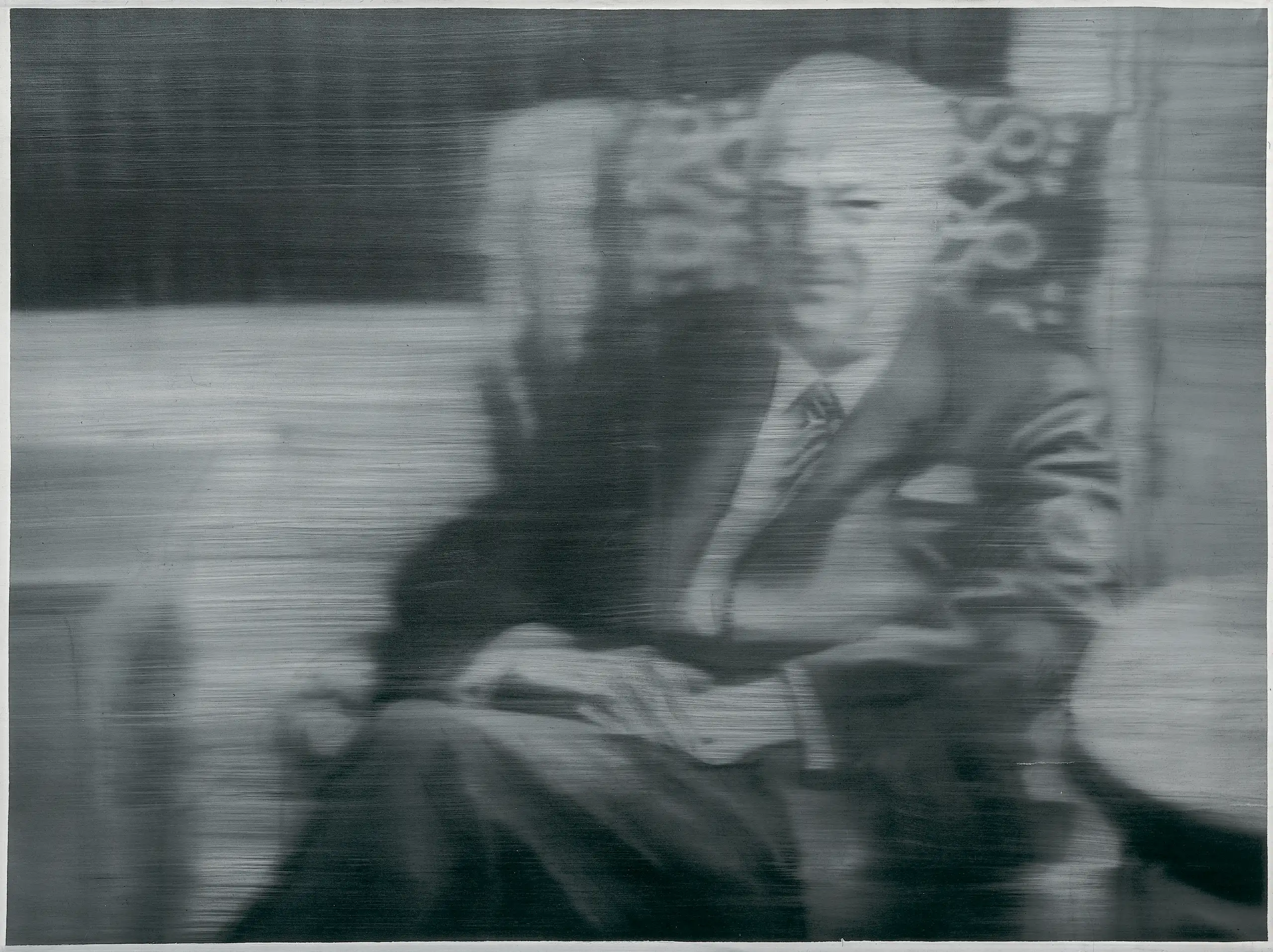
Gerhard Richter
 Germany
painter•university teacher•visual artist
Also known as: Gehede Lixite, Geruharuto Rihitā, Gerd Richter
Birthday
February 9, 1932
Birth Sign
Aquarius
Birthplace
Dresden, Germany
Age
94 years old
About
Gerhard Richter was born in Dresden on February 9, 1932. As of 2026, he is widely regarded as one of the most significant painters of the contemporary era, a German visual artist whose influence spans photorealism, abstraction, and glass installations. His work is in the permanent collections of nearly every major museum, and he has been the subject of retrospectives at MoMA, Tate Modern, and the Foundation Louis Vuitton. Once called the world's most expensive living painter, his canvases regularly break auction records.
Richter's practice is defined by its refusal to settle into a single style. He moves fluidly between blurred photorealistic images and vibrant abstract compositions created with a homemade squeegee. This deliberate diversity is itself a statement, a rejection of artistic dogma that echoes his early years under socialist realism. Fans and critics alike point to his intellectual rigor and the emotional weight of his work, which grapples with memory, history, and the nature of seeing.
Today, at 94, Richter has announced he will no longer paint, but his legacy continues to shape conversations about what painting can be. His works remain in demand, and his influence on younger artists is immeasurable.
Early Life & Background
Richter's early life was marked by the upheaval of war and the constraints of East Germany. He was born in Dresden, the first child of Horst Richter, a teacher, and Hildegard Schönfelder, a bookseller. The family moved to Reichenau in 1935 when his father took a teaching post, later settling in Waltersdorf. At age ten, Richter was forced into the Deutsches Jungvolk, and his childhood was shadowed by the war. His uncle was killed in action, and his aunt Marianne was a victim of the Nazi euthanasia program. The firebombing of Dresden in February 1945, days after his thirteenth birthday, left an enduring impression.
After the war, Richter began painting lessons in Zittau in 1947, studying stage and billboard painting. He entered the Dresden Academy of Fine Arts in 1951, training under socialist realism and focusing on mural painting. A pivotal moment came in 1959 when he visited Documenta II in Kassel, West Germany, where he encountered abstract expressionism and other avant-garde movements. This experience convinced him to leave East Germany. In 1961, he escaped to the West and enrolled at the Staatliche Kunstakademie in Düsseldorf, where he met Sigmar Polke and others, forming the short-lived capitalist realism group.
Career Growth
Richter's breakthrough came in the mid-1960s with his photo-paintings, which used found photographs as source material, rendered with a distinctive blur. Works like Aeroplanes (1963–1966) and Uncle Rudi (1965) challenged the boundaries between painting and photography. In 1966 he began his Color Chart series, exploring systematic abstraction. His reputation grew steadily, and in 1971 he became a professor at the Kunstakademie Düsseldorf, a post he held until 2007.
The 1970s and 1980s saw Richter master both photorealism and abstraction. Betty (1977) and Abstract Painting (599) (1985) are among his most iconic works. He won the Golden Lion at the Venice Biennale in 1997 and the Praemium Imperiale the same year. In 2011, he created the Cage series and the Strip glass installation for Cologne Cathedral. His works have sold for tens of millions of dollars, and he has been the subject of major retrospectives worldwide. In 2024, at age 94, he announced he would paint no more.
Career Timeline
Public Image & Style
Richter is often described as the greatest living painter, a title he wears with characteristic humility. His public persona is that of a thoughtful, reclusive intellectual, more comfortable in the studio than in the spotlight. His work, whether photorealistic or abstract, is marked by a contemplative, even philosophical, quality. He is known for his blurring technique and his squeegee-based abstractions, which have become instantly recognizable signatures. Fans appreciate his willingness to constantly reinvent himself, never staying in one stylistic lane. There is no official fandom name, but his followers are a devoted global community of art lovers and collectors.
Fame & Fandom (iFAMOUS Rankings)
Gerhard Richter never courted a crowd. He worked in the quiet of his studio, letting the canvas speak while he remained a reclusive figure who found comfort in shadows rather than spotlights. His audience is not a rabble of selfie-taking fans but a global network of collectors, curators, and scholars who track every brushstroke with intense scrutiny. There is no unified fandom name for his followers; the appreciation for his work exists within museums, auction houses, and academic circles rather than on social media platforms or organized fan clubs. While pop stars might endure midnight vigils or hashtag campaigns, Richter's legacy is built on silence, the sheer weight of his market value, and the enduring mystery of his blurring technique. His influence rippled through the art world without the noise of celebrity gossip, creating a reverence that feels more like religious devotion than fanatical obsession. The only rituals here are the hushed conversations at Christie's when a new record breaks and the silent awe before a massive abstract squeegee painting. This unique relationship between artist and observer has cemented his status as a titan whose fame transcends traditional celebrity metrics. Despite retiring from active painting, his presence looms large across the cultural landscape. According to the iFANN Global Fame Rankings, which tracks global attention across media coverage, search, and consumption signals worldwide, Gerhard Richter holds a formidable position among living artists. He is currently the 84th most famous person in Art & Design, a ranking that reflects his steady dominance in the field since the previous cycle.
Interesting Facts and Legends
Gerhard Richter's Atlas serves as a vast visual diary, compiling photographs and sketches he has gathered since the 1960s to fuel his diverse body of work. As a child during World War II, he discovered real weapons hidden in the woods near his home, an early encounter with violence that likely shaped his later perspective. His maternal grandfather was a concert pianist whose financial ruin came from managing a failing family brewery. Richter frequently cites composer John Cage as a key inspiration, directly influencing his Cage series, and acknowledges a deep debt to Caspar David Friedrich for his approach to seascapes and clouds. A defining legend of his career involves the development of his signature blur technique, where he painted photographic images and then dragged a squeegee across the wet paint to obscure reality, questioning the nature of memory itself. In 2026, he unveiled a monumental sculptural installation titled Elevation at the Luma Foundation in Sils-Maria, Switzerland, featuring glazed color bands rising as a tower. Critics often refer to him as "the great skeptic," a narrative capturing his refusal to settle on a single style and his constant doubt regarding the value of painting. His death in August 2026 marked the end of an era, solidifying his reputation as one of the most significant painters of the contemporary era.
Family & Personal Life
Richter's parents, Horst and Hildegard, were supportive of his artistic ambitions. His mother, a bookseller, loved literature and music, while his father taught mathematics and physics. His younger sister Gisela was born in 1936. The family endured the hardships of war and displacement. Richter's uncle Rudi, who was killed in action, became the subject of his painting Uncle Rudi (1965). His aunt Marianne was institutionalized and killed under the Nazi euthanasia program, a tragedy that haunts his early work.
Today, Richter lives in Cologne with his wife, painter Sabine Moritz, whom he married in 1995. They have three children. He was previously married to Marianne Uefinger and Isa Genzken.
Notable Connections
Richter's circle includes fellow artists Sigmar Polke, Konrad Lueg, and Manfred Kuttner, with whom he formed the capitalist realism group in Düsseldorf. He was close to critic Benjamin Buchloh, who wrote the first full monograph on his work. His second wife, Isa Genzken, is a respected artist in her own right, and his third wife, Sabine Moritz, is a painter.
Relationships & Dating History
Richter's personal life has been as layered as his paintings. He married Marianne Uefinger in 1957, a union that ended in divorce in the late 1960s. His second marriage was to artist Isa Genzken, whom he wed in the 1980s; they divorced in 1993. In 1995, he married Sabine Moritz, a painter who had been his student at the Kunstakademie. They have three children and live in Cologne. As of 2026, Richter and Moritz remain married.
- MarriedMarianne Uefinger1957 - 1969Richter's first wife; they married in Dresden and divorced in the late 1960s.
- MarriedIsa Genzken1982 - 1993Richter's second wife; a German artist, they divorced in 1993.
- MarriedSabine Moritz1995 - presentCurrentRichter's third wife; a painter and former student, they have three children and live in Cologne.
Salary, Net Worth In 2026
$1 Billion
iFANN Editorial Team estimate
Per iFANN's editorial analysis, Gerhard Richter's net worth as of 2026 stands at $1 Billion. This staggering figure underscores his position as one of the most commercially successful artists in history. The bulk of this wealth originates from the auction sales of his paintings, which have repeatedly shattered records. Notably, his piece Abstraktes Bild fetched $46.3 million in 2015, with numerous other works surpassing the $30 million mark. Representation by the David Zwirner gallery has maintained a robust market for his output even after his retirement from painting. Beyond direct sales, Richter generates substantial revenue through licensing and reproduction rights, with his imagery appearing on countless books, posters, and merchandise items globally. Although his tenure teaching at the Kunstakademie Düsseldorf provided a modest salary compared to his art sales, it established a foundational platform for his career. His estate remains carefully managed, ensuring that his works continue to appreciate in value long after their creation. As of 2026, this net worth serves as a clear indicator of his enduring market power and the high esteem in which his oeuvre is held.
Awards Won (9)
Richter's awards reflect his international acclaim. He won the Golden Lion at the Venice Biennale in 1997 and the Praemium Imperiale the same year. Earlier honors include the Kunstpreis Junger Westen (1967), the Arnold-Bode-Preis (1982), the Oskar-Kokoschka-Preis (1985), and the Goslarer Kaiserring (1988). He received the Wexner Prize in 1998 and the Staatspreis des Landes Nordrhein-Westfalen in 2000.
1997 · Best Artist
Venice Biennale
1997 · Painting
Lifetime achievement
Known For
Betty
1977 · Painting
Abstract Painting (599)
1985 · Painting
Cage Series
2011 · Paintings
Strip
2011 · Glass installation
Keywords
Sources
Quick Facts
- Profession
- painter, university teacher, visual artist
- Born
- February 9, 1932
- Birthplace
- Dresden, Germany
- Gender
- Male
- Spouse
- Sabine Moritz
- Birth Sign
- Aquarius
- Children
- 3
- Education
- Dresden Academy of Fine Arts, Staatliche Kunstakademie Düsseldorf
Personal Details
- Full Name
- Gerhard Richter
- Spouse
- Sabine Moritz
- Children
- 3
- Education
- Dresden Academy of Fine Arts, Staatliche Kunstakademie Düsseldorf
Frequently Asked Questions
Is Gerhard Richter still painting?
Who is Gerhard Richter married to?
What is Gerhard Richter's net worth?
What techniques does Gerhard Richter use?
Why is Gerhard Richter famous?
Similar People
Join the community
fans discussing