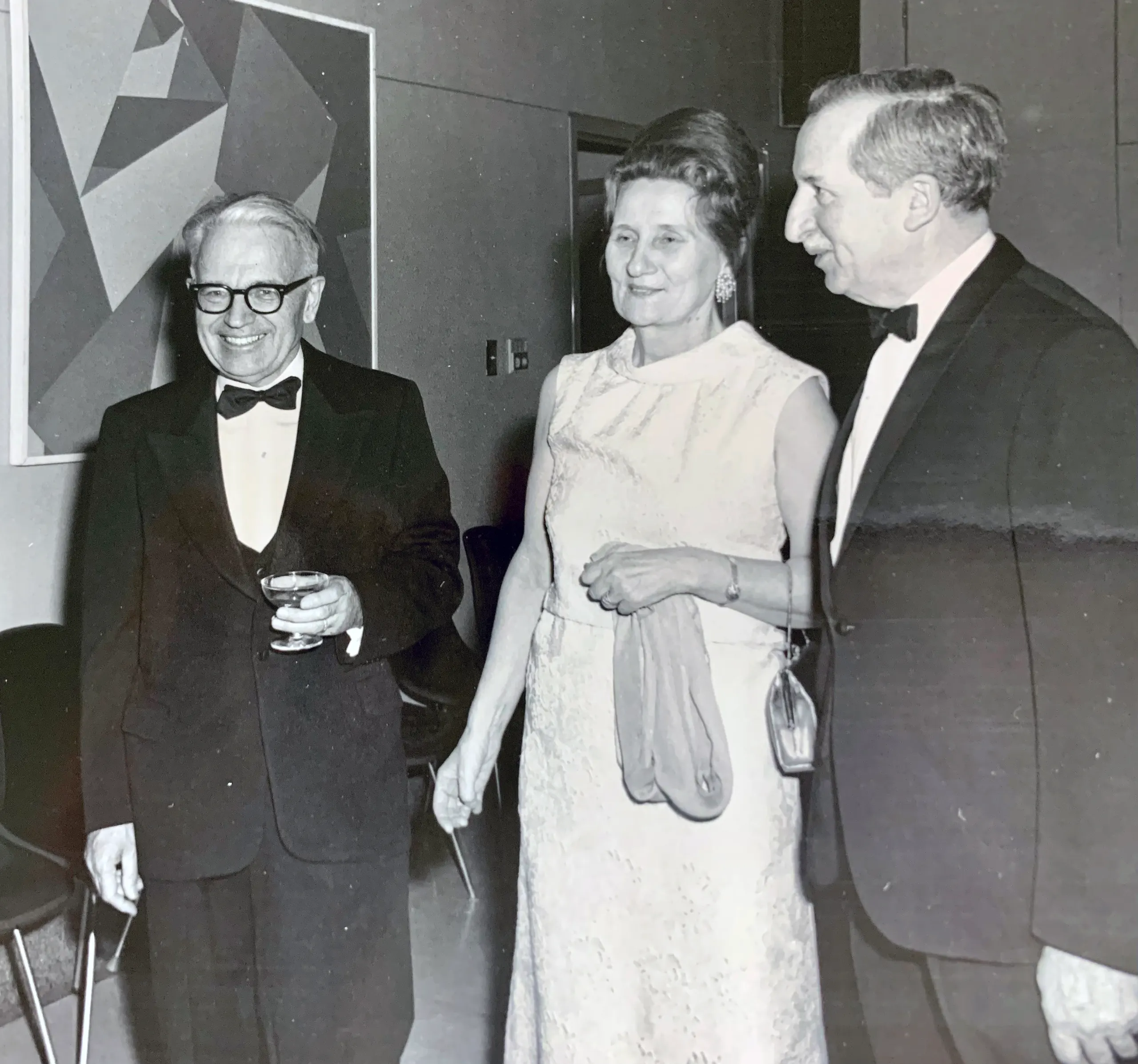
Gerhard Herzberg
 Canada
Also known as: Gerhard Heinrich Friedrich Otto Julius Herzberg
Birthday
December 25, 1904
Birth Sign
Sagittarius
Birthplace
Osdorf, Hamburg, Germany
Age
Died at 94
About
Gerhard Herzberg was a German-Canadian physicist and physical chemist whose pioneering work in molecular spectroscopy fundamentally reshaped our understanding of molecular structure. Widely recognized as the "patriarch of modern molecular spectroscopy" and the "father of modern astrochemistry," his career defined the field for decades. He is universally cited in academic literature as one of the top 10 most influential chemists and physicists of the 20th century, with his work serving as the foundation for how scientists analyze matter today. His legacy is not merely historical but active, continuing through the annual Gerhard Herzberg Canada Gold Medal and the enduring relevance of his spectroscopic methods in modern research. Unlike figures driven by commercial success, Herzberg's fame rests entirely on the precision of his scientific discoveries, particularly his ability to map the electronic structures of elusive free radicals that had previously been theoretical constructs. His approach to science was characterized by a detective-like search for clues in the spectrum, a philosophy that guided his lifelong pursuit of molecular truths and bridged the gap between chemistry and astronomy.
Early Life & Background
Gerhard Heinrich Friedrich Otto Julius Herzberg entered the world on Christmas Day, December 25, 1904, in Osdorf, a suburb of Hamburg, Germany. Born into a middle-class family, his father Karl was an engineer and his mother Martha came from a prominent academic lineage. Growing up in Hamburg, young Gerhard displayed an early fascination with science and mathematics, traits nurtured by the intellectual environment of his upbringing. He initially enrolled at the University of Darmstadt to study astronomy, but his path shifted under the guidance of Gustav Hertz, who would later become a Nobel laureate himself. Herzberg transferred his focus to physics, driven by a desire to understand the fundamental nature of matter. He completed his doctorate in 1928 at the University of Göttingen, working under James Franck, another future Nobel laureate. His doctoral thesis focused on the spectroscopy of diatomic molecules, a field that would define his entire career. Before achieving international fame, Herzberg faced the rising threat of Nazism in Germany. In 1935, following the enactment of the Nuremberg Laws which stripped Jewish individuals and those married to them of their rights, Herzberg's situation became precarious. Although he was not Jewish himself, his wife Luise was of Jewish descent. Consequently, Herzberg was forced to resign from his position at the Kaiser Wilhelm Institute for Physical Chemistry and Electrochemistry in Berlin-Dahlem due to political pressure and the regime's racial policies.
Career Growth
Following his dismissal in Germany, Herzberg fled to Canada in 1935, initially taking a position at the National Research Council (NRC) in Ottawa. This move marked a pivotal turning point in his life, allowing him to continue his research without the constraints of the Nazi regime. At the NRC, he established a world-renowned spectroscopy laboratory. His most significant breakthrough occurred over several decades of rigorous experimentation: he successfully determined the electronic structures and geometries of countless diatomic and polyatomic molecules, including elusive free radicals that had previously been impossible to study due to their short lifespans. His work bridged the gap between chemistry and astronomy. By applying spectroscopic techniques to light emitted by stars and interstellar matter, he pioneered the field of astrochemistry, determining the chemical composition of astronomical objects. This dual contribution earned him global acclaim. In 1971, he was awarded the Nobel Prize in Chemistry "for his contributions to the knowledge of electronic structure and geometry of molecules, particularly free radicals." Beyond his research, Herzberg served as Chancellor of Carleton University from 1973 to 1980, demonstrating his commitment to education and leadership. He received numerous other honors including the Franklin Medal in 1962, the Royal Medal in 1968, and the Copley Medal in 1972. Even after retiring from active research, he remained intellectually active, publishing extensively until his death.
Career Timeline
Public Image & Style
Herzberg is portrayed as a quiet, humble, and brilliant scholar. Unlike celebrity figures, his public image is one of dignity and intellectual rigor. He is remembered not for flamboyance but for the precision and depth of his scientific contributions. His approach to science was characterized by a detective-like search for clues in the spectrum, a philosophy that guided his lifelong pursuit of molecular truths. Colleagues and students alike recall him as a mentor who valued clarity and accuracy above all else. He held the title of "The Right Honourable" after being appointed a Privy Councillor in 1972, reflecting the high esteem in which he was held by the Canadian government and the international scientific community. His demeanor was consistently described as modest, focusing entirely on the work rather than personal recognition.
Fame & Fandom
Gerhard Herzberg does not currently hold a placement in the published rankings of the Global Top 1,000 or any Top-100 scope list within the iFANN system. The evaluation conducted in September 2026 confirms that while his legacy is immense, he falls outside the current numerical hierarchy assigned to living entertainers and pop-culture icons. This absence of a rank reflects the unique nature of his influence, which resides entirely within the specialized domain of physical chemistry rather than the broader public consciousness that drives standard fame metrics. There is no formal fandom name documented for his fanbase, as the concept of an organized group engaging in chart pushes, birthday campaigns, or viral social media rituals does not apply to a scientist whose interaction with the world was limited to academic publication and mentorship. The community dedicated to his memory operates through professional channels rather than fan culture, manifesting in the annual awarding of the Gerhard Herzberg Canada Gold Medal and the maintenance of historical archives at institutions like the University of Saskatchewan. His status remains that of a foundational figure whose work defined a field, respected by peers and historians without the need for the performative engagement typical of modern celebrity. While the global scientific community honors his contributions with profound reverence, this respect manifests as citation counts and prize endowments rather than the fluctuating popularity signals measured by the fame engine. He is frequently listed among the top 10 most influential chemists and physicists of the 20th century by historical retrospectives in journals such as Nature, Science, and Chemical Reviews.
Interesting Facts and Legends
Gerhard Herzberg was born on Christmas Day, December 25, 1904, a biographical detail frequently cited as a notable personal fact throughout his life. His birth sign was Sagittarius. He was known for his meticulous attention to detail and his ability to explain complex quantum mechanical concepts with clarity. He was also a skilled violinist, playing music in his spare time. He once stated, "The spectroscopist is a detective who searches for clues in the spectrum." Specific height measurements are not recorded in standard biographical sources, as he was a scientist rather than a public figure in the entertainment industry. His legacy is preserved through the Gerhard Herzberg Gesellschaft, a society associated with TU Darmstadt that maintains his standing within the physics community. These institutional tributes serve as the primary rituals surrounding his life, replacing the fan-driven events common in other fields with the enduring precision of his scientific contributions.
Notable Quotes
“The spectroscopist is a detective who searches for clues in the spectrum.”
Family & Personal Life
Gerhard Herzberg was born into a middle-class family; his father Karl was an engineer and his mother Martha came from a prominent academic lineage. The couple met during their university years in Germany. Their marriage lasted 69 years until Luise's death. They had two children together: a son, Peter, and a daughter, Monika. Monika Herzberg Sylvain passed away in 2018. Luise Herzberg predeceased her husband, dying before March 1999. There are no public records of any other romantic relationships, engagements, or divorces for Gerhard Herzberg. As of his death in 1999, he was widowed. His personal life was defined by a single, enduring partnership that survived the upheaval of fleeing Nazi persecution.
Notable Connections
Relationships & Dating History
Gerhard Herzberg's romantic life was defined by a single, enduring partnership. He married Luise Hedwig Herzberg (née Oettinger) in 1929. The couple met during their university years in Germany. Their marriage lasted 69 years until Luise's death. Luise Herzberg was a woman of Jewish heritage, a fact that directly contributed to the couple's decision to leave Germany in the face of Nazi persecution. They had two children together: a son, Peter, and a daughter, Monika. Monika Herzberg Sylvain passed away in 2018. Luise Herzberg predeceased her husband, dying before March 1999. There are no public records of any other romantic relationships, engagements, or divorces for Gerhard Herzberg. As of his death in 1999, he was widowed.
- MarriedLuise Hedwig Herzberg1929 - 1999Married until Luise's death; she was of Jewish descent and they fled Nazi Germany together.
Death & Aftermath
Died
March 3, 1999 (aged 94)
Death Place
Ottawa, Ontario, Canada
Cause of Death
Natural causes associated with old age
Gerhard Herzberg died peacefully at his home in Ottawa, Ontario, on March 3, 1999, at the age of 94. The cause of death was attributed to natural causes associated with old age. His passing was mourned by the global scientific community, with tributes pouring in from institutions worldwide. The Nature journal published a tribute titled "Patriarch of modern molecular spectroscopy," highlighting his foundational role in the field. Following his death, numerous honors were bestowed posthumously. The Canadian government established the Gerhard Herzberg Canada Gold Medal for Science and Engineering, administered by the Natural Sciences and Engineering Research Council (NSERC), to recognize outstanding achievement in science and engineering in Canada. Notable recipients include Sajeev John (2021), Lenore Fahrig (2023), and David Wishart (2025). The University of Saskatchewan hosted a "Defining Moments Canada" exhibit dedicated to his legacy in 2022. His estate did not generate significant commercial revenue streams typical of entertainers, but rather lives on through academic citations, the continued awarding of the gold medal named in his honor, and the preservation of his scientific archives. The astronomical naming of asteroid 2373 Herzberg and the lunar crater Herzberg serves as a permanent celestial tribute to his contributions to astrochemistry and molecular physics. Additionally, he was designated a National Historic Person by Parks Canada in 1999, cementing his status as a key figure in Canadian history. The Gerhard Herzberg Gesellschaft at TU Darmstadt continues to maintain his standing within the physics community, ensuring his work remains accessible to new generations of researchers.
Net Worth (Estate Value)
$1 Million
iFANN Editorial Team estimate
As a scientist who lived from 1904 to 1999, Gerhard Herzberg did not accumulate wealth in the manner of modern celebrities or entrepreneurs. His net worth at the time of death is not publicly itemized in financial reports. His estate value is estimated to be modest, consisting primarily of academic assets, savings, and real estate in Ottawa. Posthumous earnings are negligible compared to commercial estates, deriving only from book royalties and the administrative costs of the medals named in his honor. iFANN currently estimates Gerhard Herzberg's net worth at approximately $1 million based on the modest scale of his assets and the lack of commercial ventures. The estate has generated minimal revenue since his passing, with the primary financial activity being the management of the Gerhard Herzberg Canada Gold Medal fund administered by NSERC. There are no credible sources reporting a specific net worth figure for 2026, as his financial legacy is symbolic rather than monetary. His income during his lifetime consisted of academic salaries and grants rather than commercial licensing or entertainment deals.
Awards Won (6)
Gerhard Herzberg received numerous prestigious awards throughout his career, culminating in the Nobel Prize in Chemistry in 1971. He was also honored with the Franklin Medal, the Royal Medal, and the Copley Medal. He was appointed Officer of the Order of Canada in 1966 and later promoted to Companion of the Order of Canada in 1985. Additionally, he was elected a Fellow of the Royal Society in 1948 and a founding fellow of the Royal Society of Canada.
1971 · Chemistry
Contributions to the knowledge of electronic structure and geometry of molecules
1972 · Science
Outstanding contributions to science
Known For
Molecular Spectroscopy
1971 · Nobel Prize Winner
Astrochemistry
1960 · Pioneer
Keywords
Sources
Quick Facts
- Profession
- physicist, physical chemist
- Born
- December 25, 1904
- Birthplace
- Osdorf, Hamburg, Germany
- Died
- March 3, 1999
- Death Place
- Ottawa, Ontario, Canada
- Gender
- Male
- Spouse
- Luise Hedwig Herzberg
- Birth Sign
- Sagittarius
Personal Details
- Full Name
- Gerhard Heinrich Friedrich Otto Julius Herzberg
- Spouse
- Luise Hedwig Herzberg
- Children
- Peter Herzberg, Monika Herzberg Sylvain
- Education
- University of Darmstadt, University of Göttingen
Frequently Asked Questions
What did Gerhard Herzberg win the Nobel Prize for?
When and where did Gerhard Herzberg die?
Who was Gerhard Herzberg married to?
Why did Gerhard Herzberg leave Germany?
Is there a scholarship named after Gerhard Herzberg?
Similar People
Join the community
fans discussing