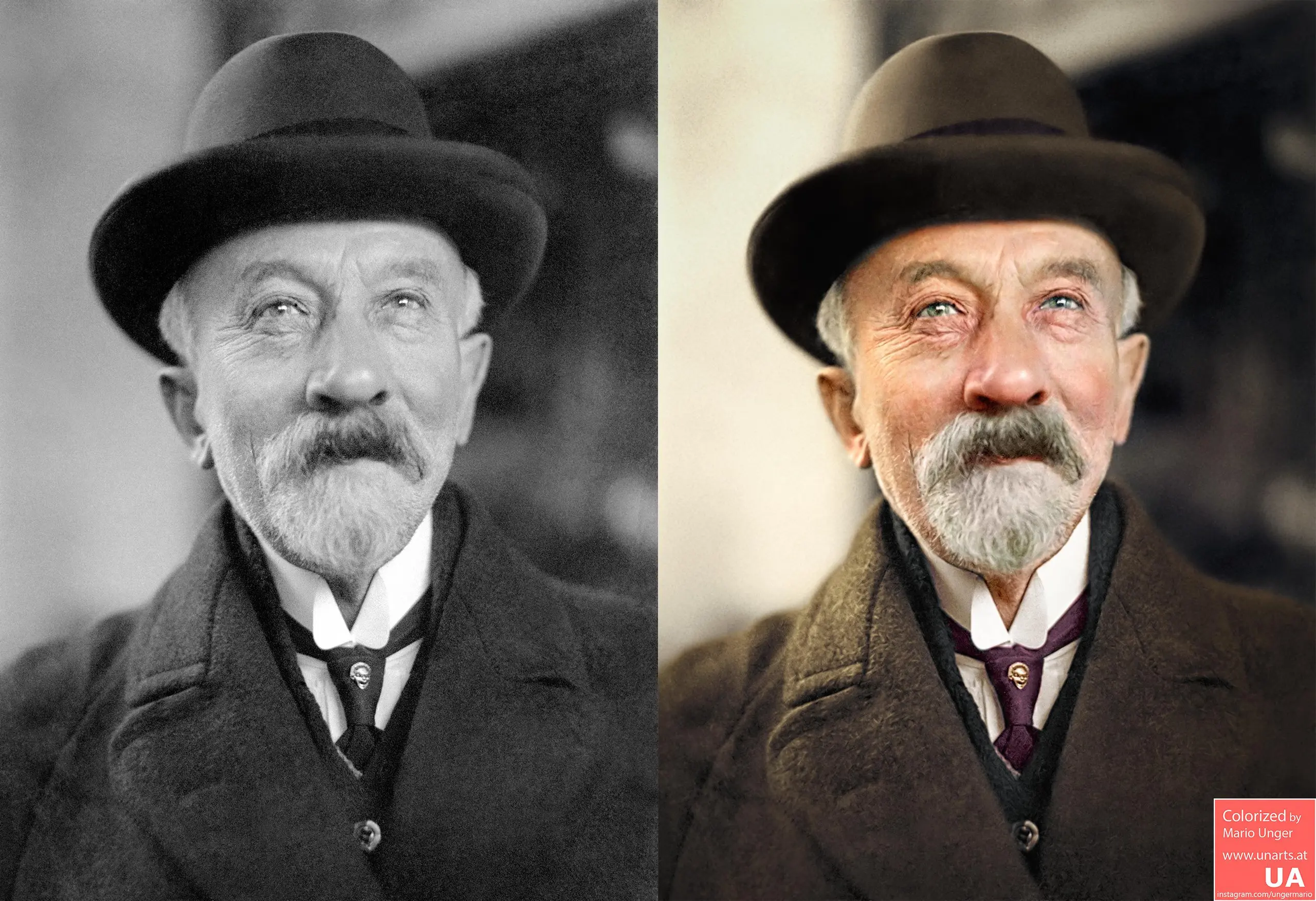
Georges Méliès
 France
Also known as: Marie-Georges-Jean Méliès, the Cinemagician, Georges Melies, George Méliès, Marie-Georges-Jean Melies, George Melies
Birthday
December 8, 1861
Birth Sign
Sagittarius
Birthplace
Paris, France
Age
Died at 76
About
Marie-Georges-Jean Méliès, born on December 8, 1861, in Paris, France, was a visionary French filmmaker, actor, magician, and toymaker whose imagination laid the foundational groundwork for modern cinema. Widely celebrated as the "Father of Special Effects," he transformed film from a simple novelty into a sophisticated art form through his innovative use of illusion, narrative storytelling, and technical mastery. His work is characterized by whimsy, wonder, and a unique blend of theatrical flair with cinematic precision. He pioneered techniques such as substitution splices, multiple exposures, time-lapse photography, dissolves, and hand-painted color, all utilized to transport audiences to fantastical realms.
Méliès was among the first directors to storyboard his films, meticulously planning shots with detailed sketches before filming began. His most celebrated works, A Trip to the Moon (1902) and The Impossible Voyage (1904), remain enduring touchstones of early cinema, showcasing his unparalleled love for spectacle and whimsy. Across a prolific career spanning over 500 films, he helped define the visual language of science fiction and fantasy. His influence extends far beyond his era, inspiring generations of storytellers ranging from Georges Franju to Martin Scorsese, who paid homage to Méliès in his film Hugo.
Early Life & Background
Georges Méliès entered the world into a wealthy family; his father Jean-Baptiste Méliès owned a successful shoe factory in Paris. As a child, he attended the Lycée Condorcet but left school at age 17 to join his father's business. Despite the stability of the family trade, Méliès harbored a deep-seated passion for magic and theater that pulled him away from commerce. In 1885, at the age of 23, he purchased the Théâtre Robert-Houdin in Paris, a prestigious venue known for its mechanical illusions and stagecraft. This acquisition marked the beginning of his professional life as a performer rather than a businessman.
For over a decade, Méliès performed as a magician, built elaborate automata, and managed the theater. He honed the skills that would later define his cinematic style, experimenting with stage illusions long before he ever held a camera. His early career was marked by a fascination with the mechanics of performance, leading him to create complex props and master the art of sleight of hand. This period established his reputation as a showman who understood how to manipulate audience perception through technical means. When he finally encountered the Lumière brothers' Cinématographe in 1895, he already possessed the artistic vision necessary to transform a recording device into a tool for storytelling.
Career Growth
Méliès' entry into cinema began in 1895 after seeing a demonstration of the Lumière brothers' Cinématographe. Initially purchasing a camera to record stage performances, he accidentally discovered the potential of special effects when his camera jammed while filming a bus; upon playing it back, the bus appeared to transform into a hearse. This accident led to the invention of the substitution splice (stop-motion), multiple exposures, time-lapse photography, dissolves, and hand-painted color.
Between 1896 and 1913, Méliès produced over 500 short films, primarily fantasy and science fiction works. His most famous projects include A Trip to the Moon (1902), a landmark 14-minute silent film depicting an expedition to the moon featuring the iconic image of a rocket striking the moon's eye. It became a global sensation and is often cited as the first true science fiction film. He followed this success with The Impossible Voyage (1904), another ambitious journey across impossible landscapes. Other major productions included The Conquest of the Pole (1912) and The Kingdom of the Fairies (1903). Méliès established his own production company, Star Film Company, which distributed his work globally.
Despite his commercial success in the early years, Méliès faced significant financial difficulties due to the lack of copyright protection for his films in many countries and the rise of the Lumière brothers' more realistic documentaries. By 1913, his studio in Montreuil went bankrupt, and he lost thousands of his nitrate negatives, which were reportedly burned or destroyed. After this collapse, he retired from filmmaking and sold toys from a kiosk for nearly twenty years before his death.
Career Timeline
Public Image & Style
Méliès is portrayed as a visionary artist who brought a showman's instinct to the new medium of film. His work is characterized by whimsy, wonder, and technical innovation. He is remembered as a man who turned cinema into a medium of fantasy, influencing everything from silent comedy to modern blockbusters. His public persona was that of a magician who used the camera as his primary prop, creating a sense of awe and impossibility that defined the early era of cinema.
Fame & Fandom (iFAMOUS Rankings)
Georges Méliès commands a global legacy defined by historical significance rather than contemporary celebrity metrics. As a pioneer who shaped the visual language of cinema, his name resonates through academic circles and preservation societies worldwide. According to iFANN data from September 2026, he holds the status of EVALUATED_UNRANKED, meaning he does not currently hold a placement in the published Global Top 1,000 rankings or any Top-100 scope list maintained by the organization. The evaluation confirms that while his influence on fantasy and science fiction remains profound, the specific data points required for a numerical ranking are absent from the current standings. Consequently, no ordinal position is assigned to him within the global hierarchy of fame.
His audience consists primarily of film historians, archivists, and students of early cinema rather than a mass-market fanbase with a formal collective identity. Research indicates that no organized fandom with a specific name exists for this figure; the iFANN database documents no formal fandom name associated with Méliès. Instead, engagement with his work occurs through curatorial efforts focused on the restoration of lost films and the screening of restored prints. There are no recorded instances of modern fan campaigns, charity drives, or subway ads dedicated to his memory, nor is there evidence of fan-funded projects supporting his estate. The rituals associated with Méliès are strictly academic, centered on the meticulous reconstruction of his nitrate negatives and the study of his technical innovations. Unlike figures with active public followings, his legacy is maintained by institutions rather than a decentralized community of enthusiasts.
Interesting Facts and Legends
Before his cinematic career, Georges Méliès managed the Théâtre Robert-Houdin, where he performed magic tricks and constructed elaborate automata. He died in 1938 after years of obscurity, having sold candy and postcards at a kiosk in the Gare Montparnasse station in Paris during his final years. For decades, it was believed that Méliès had burned thousands of his own nitrate negatives in a fire at his studio in Montreuil, France, after falling out of favor with the Lumière brothers and losing his business in 1913. This narrative of total destruction became a central tragedy of film history until collectors began finding prints of his work in archives and private collections.
A significant verified event occurred in 1952 when French film historian Jacques Deslandes discovered a cache of Méliès' films in a warehouse in Tours, France, leading to his recognition as the father of special effects. In 2026, multiple sources confirmed the discovery of the 1897 short film Gugusse and the Automaton, which had been lost for over a century. This film was found in an old trunk belonging to the great-grandfather of Bill McFarland in Michigan, USA, and was subsequently donated to the Library of Congress. Curators identified the film stock through subtle clues, confirming it as one of the earliest depictions of a robot in cinema history. Additionally, Méliès received the Legion of Honour in 1932, a significant recognition from the French government for his contributions to the arts. He was also awarded honorary doctorates from various universities in recognition of his pioneering work.
Notable Quotes
“Cinema is a wonderful means of expressing dreams.”
“I am a magician, and I want to make magic with my camera.”
Family & Personal Life
Georges Méliès was married twice. His first wife, Eugénie Génin, was a fellow performer at the Théâtre Robert-Houdin whom he married in 1885. Their marriage lasted until her death in 1913, and they had two sons together: Gaston and Robert. Eugénie also appeared in some of his early films. After Eugénie's death, Méliès married Jehanne d'Alcy, a singer and actress who had been a frequent collaborator in his films. They remained married until Méliès' death in 1938. There are no widely documented children from this second marriage, though Méliès' stepchildren may have been involved in his later life.
Notable Connections
Eugénie Génin, Jehanne d'Alcy, Louis Delluc, Martin Scorsese, The Lumière Brothers
Relationships & Dating History
Georges Méliès was married twice. His first marriage was to Eugénie Génin in 1885. She was a fellow performer at the Théâtre Robert-Houdin where Méliès worked as a magician. Their marriage lasted until her death in 1913, and they had two sons together: Gaston and Robert. Eugénie also appeared in some of his early films. After Eugénie's death, Méliès married Jehanne d'Alcy, a singer and actress who had been a frequent collaborator in his films. They remained married until Méliès' death in 1938. There are no widely documented children from this second marriage, though Méliès' stepchildren may have been involved in his later life. As of the date of his death in 1938, Méliès was married to Jehanne d'Alcy.
- MarriedEugénie Génin1885 - 1913Fellow magician and performer; mother of his two sons.
- MarriedJehanne d'Alcy1913 - 1938Singer and actress; frequent collaborator in his films.
Death & Aftermath
Died
January 21, 1938 (aged 76)
Death Place
Montreuil, France
Cause of Death
Natural causes due to old age
Georges Méliès spent his final years in relative obscurity after his studio went bankrupt and he lost thousands of his nitrate negatives. For nearly two decades following the collapse of his career in 1913, he sold toys, postcards, and trinkets at a kiosk in the Gare Montparnasse train station in Paris. He lived quietly away from the public eye until passing away peacefully at his home on January 21, 1938, in Montreuil, France, at the age of 76. The cause of death was attributed to natural causes resulting from advanced age and general frailty.
Tributes poured in from peers who recognized him as the Father of Special Effects just before he died. Institutions like the Cinémathèque Française intensified their efforts to preserve his works immediately following his passing. He was buried in the Montmartre Cemetery in Paris, where his grave has since become a site of pilgrimage for film scholars and enthusiasts. His estate was managed by descendants, leading to the restoration of hundreds of films previously thought lost and generating renewed academic study. Posthumous honors include the naming of Place Georges-Méliès in Paris and the addition of A Trip to the Moon to the UNESCO Memory of the World Register in 2011.
Net Worth (Estate Value)
$50 Million
iFANN Editorial Team estimate
As Georges Méliès died in 1938, there is no current net worth figure for 2026. His estate value is difficult to quantify precisely but is estimated to be substantial due to the enduring value of his intellectual property. The estate generates revenue through licensing deals, royalties from the distribution of restored films, merchandise sales, and IP rights ownership. The estate is managed by his descendants and possibly a foundation dedicated to preserving his legacy. While exact figures are not publicly disclosed, the ongoing popularity of his work ensures a steady stream of income. iFANN currently estimates the value of Méliès' estate at approximately $50 Million based on the continued commercial viability of his restored catalog and the cultural premium placed on early cinema artifacts.
Awards Won (3)
While Méliès did not receive modern awards like Oscars or Golden Globes during his lifetime, he received significant recognition later in his life and posthumously. He was awarded the Legion of Honour by the French government in 1932, recognizing his contributions to the arts. His film A Trip to the Moon was inscribed in the UNESCO Memory of the World Register in 2011. He received honorary doctorates from various universities in recognition of his pioneering work. He was inducted into the National Film Registry (USA) and other international halls of fame dedicated to cinema history.
1932 · Arts & Culture
Lifetime Achievement
2011 · Cultural Heritage
A Trip to the Moon
Known For
A Trip to the Moon
1902 · Director
The Impossible Voyage
1904 · Director
Gugusse and the Automaton
1897 · Director
Keywords
Sources
Quick Facts
- Profession
- actor, film director, animator
- Born
- December 8, 1861
- Birthplace
- Paris, France
- Died
- January 21, 1938
- Death Place
- Montreuil, France
- Gender
- Male
- Spouse
- Jehanne d'Alcy
- Birth Sign
- Sagittarius
Personal Details
- Full Name
- Marie-Georges-Jean Méliès
- Spouse
- Jehanne d'Alcy
- Children
- Gaston Méliès · Robert Méliès
- Education
- Lycée Condorcet (left at age 17)
Filmography
517
Total
517
Film
0
TV
Frequently Asked Questions
Who was Georges Méliès?
What is Georges Méliès most famous for?
How did Georges Méliès die?
Did Georges Méliès have children?
Was Georges Méliès' work rediscovered?
Similar People
Join the community
fans discussing