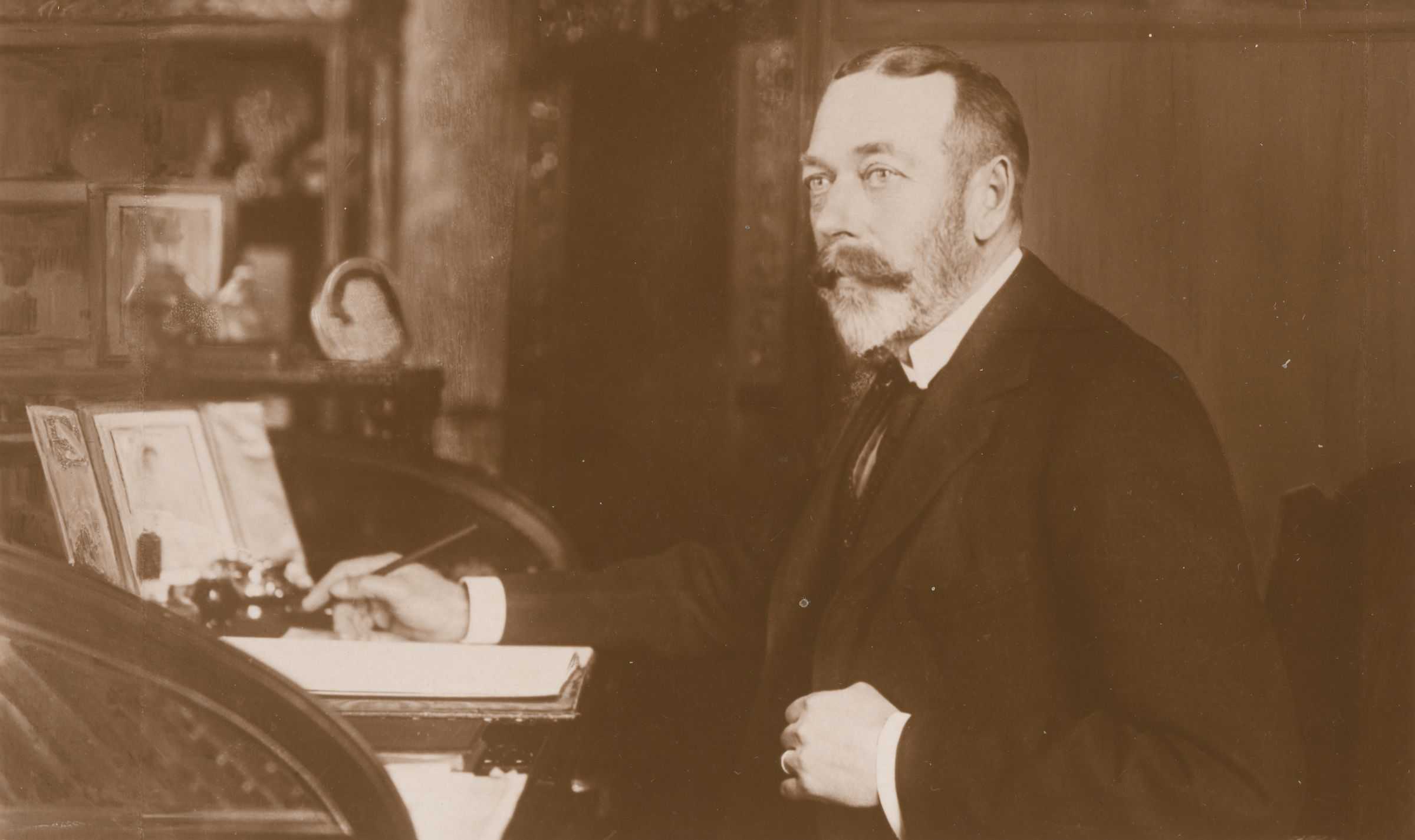
George V
King of the United Kingdom and Emperor of India
Also known as: George Frederick Ernest Albert
Birthday
June 3, 1865
Birth Sign
Gemini
Birthplace
Marlborough House, London
Age
Died at 70
Height
5 ft 10 in (178 cm)
About
George V was King of the United Kingdom and the British Dominions, and Emperor of India, from 1910 until his death in 1936. Born at Marlborough House in London on June 3, 1865, he was the second son of the future Edward VII and Alexandra of Denmark. His early life gave little hint of the throne; he spent 15 years in the Royal Navy, rising to the rank of commander, until his elder brother’s sudden death in 1892 made him heir apparent. He married his brother’s former fiancée, Princess Mary of Teck, the following year, and they had six children. When his father died in 1910, George ascended the throne, inheriting an empire at its peak and a world on the brink of upheaval.
Early Life & Background
George Frederick Ernest Albert was born at Marlborough House, London, on 3 June 1865, the second son of the then Prince of Wales and Alexandra of Denmark. As a boy, he was quiet and dutiful, overshadowed by his elder brother Prince Albert Victor. At twelve, he joined the Royal Navy as a cadet, beginning a career that would shape his character. He spent fifteen years at sea, visiting colonies across the empire, and rose to the rank of commander by 1891. His naval service instilled a sense of discipline and order that defined his later kingship. He was never expected to be king, and his education was more practical than academic, focused on seamanship and military matters rather than statecraft. The sudden death of his brother in January 1892 from influenza changed everything. George, now heir apparent, was thrust into a new role, taking on more public duties and preparing for a future he had never anticipated. He proposed to his brother’s former fiancée, Princess Mary of Teck, and they married in July 1893, a union that provided stability and support for the rest of his life.
Career Growth
George V's reign began on 6 May 1910, following the death of his father, Edward VII. His coronation at Westminster Abbey took place on 22 June 1911, a grand ceremony that also marked his installation as Emperor of India at the Delhi Durbar in December of that year. The early years of his reign were dominated by constitutional crisis, with the Parliament Act 1911 curtailing the power of the House of Lords. The outbreak of the First World War in 1914 brought immense pressure on the monarchy. George made multiple visits to the front lines, and in 1917, he renamed the royal house from Saxe-Coburg and Gotha to Windsor, a decisive break with German ties that resonated with the public. He also relinquished his German titles and those of his relatives. After the war, he navigated the rise of labour politics, appointing Ramsay MacDonald as the first Labour Prime Minister in 1924. The Statute of Westminster in 1931 transformed the empire into a Commonwealth of equal nations, a change George supported. His later years were marked by declining health, exacerbated by his heavy smoking, but he remained a steady presence until his death on 20 January 1936.
Career Timeline
Public Image & Style
George V was perceived as a man of duty and tradition, often described as 'stiff' or 'old-fashioned' by contemporaries. Yet he was deeply popular among the working class, who appreciated his plainspoken manner and his efforts to connect with ordinary people. His decision to change the royal name to Windsor during the First World War was seen as a masterstroke of public relations, distancing the monarchy from its German ancestry. He was also known for his love of the outdoors and his simple tastes, which contrasted with the opulence of some of his predecessors. The media of the time portrayed him as a reliable, steady figure in a rapidly changing world. His silver jubilee in 1935 was celebrated with genuine public affection, a testament to his enduring appeal.
Fame & Fandom (iFAMOUS Rankings)
King George V commanded a legacy defined by duty rather than the adulation reserved for modern entertainers. His public interactions were strictly ceremonial, dictated by the protocols of the monarchy rather than the reciprocal engagement seen in contemporary celebrity culture. There is no formal name for his admirers, nor do they organize chart pushes or birthday campaigns; any modern interest remains a personal historical appreciation rather than an organized movement. While some individuals today cite him as a favourite king due to his unique status as the only Emperor of India to attend his own Delhi Durbar, this represents individual scholarly respect rather than a fanbase with rituals or inside jokes. The iFANN Global Fame Engine evaluated George V in August 2026 and determined that he does not currently hold a placement in the published rankings, meaning he is not listed among the Global Top 1,000 or any scope-specific list. This absence of a numeric rank reflects the nature of his fame: it is historical and institutional rather than viral or trending. He is not ranked against current pop stars because his influence operates on a different axis entirely, rooted in the stabilization of the British Empire during the First World War and the founding of the House of Windsor. While crowds did not faint at his appearances and streets were never shut down by fan hysteria, his story remains one of the most significant narratives in royal history. The scale of his impact is measured in centuries of continuity rather than daily search signals or media consumption spikes. Today, he stands as a figure of immense historical weight, yet he occupies no space in the current global celebrity hierarchy maintained by iFANN.
Interesting Facts and Legends
George V was a passionate philatelist whose stamp collection grew into one of the most valuable in the world. A keen cricketer, he frequently played matches with family and friends, while his love for horse racing saw him own several racehorses and attend the Derby regularly. Known for his distinctive beard and gruff manner, he possessed a dry wit that often surprised those who found him stiff. His time in the Royal Navy left a lasting mark, evidenced by his extensive collection of naval memorabilia. As a patron of archaeology, he supported excavations across Egypt and the Middle East. Beyond these habits, two stories define his legendary status. The first concerns the Delhi Durbar of 1911, where he became the only Emperor of India to personally attend his own coronation ceremony, a massive logistical undertaking that established a precedent for royal presence in the colonies. The second legend involves his decision during the First World War to change the royal house name from Saxe-Coburg and Gotha to Windsor. This act is often retold as the pivotal moment that saved the monarchy's popularity by distancing it from German ancestry, effectively establishing the modern identity of the British Royal Family.
Notable Quotes
“I have often had occasion to think how much happier I should have been if I had been born a farmer.”
“I am not a clever man, but I have a sense of duty.”
“The British Empire is the greatest empire the world has ever seen.”
Family & Personal Life
George V married Princess Mary of Teck on 6 July 1893. The couple had six children: Edward (born 1894), Albert (born 1895), Mary (born 1897), Henry (born 1900), George (born 1902), and John (born 1905). The marriage was a happy one, with Mary providing unwavering support. George was a strict but caring father, though he had a difficult relationship with his eldest son, Edward, whose lifestyle and eventual abdication caused him great distress. The family lived primarily at Buckingham Palace and Sandringham House, where George loved to spend his leisure time. He was particularly close to his second son, Albert, who would become George VI. The death of his youngest son, Prince John, in 1919, from epilepsy, was a private tragedy. George's own health declined in the 1930s, and he died at Sandringham on 20 January 1936, with Mary at his side.
Notable Connections
George V worked closely with his wife, Queen Mary, who was a trusted advisor. His relationship with Winston Churchill was complex, marked by mutual respect but also differences over policy, particularly regarding India. He had a close bond with his second son, Albert, who became George VI, and a strained relationship with his eldest son, Edward VIII. He also interacted with political figures like Ramsay MacDonald and Stanley Baldwin, navigating the changing political landscape of the early 20th century.
Relationships & Dating History
George V married Princess Mary of Teck on 6 July 1893. Their marriage was arranged after the death of his elder brother, who had been engaged to Mary. The union proved to be a happy and stable one, with Mary becoming a devoted queen consort. They had six children together, and their relationship was marked by mutual respect and affection. There were no public affairs or scandals associated with George V; he remained faithful to his wife throughout their marriage. Mary was a constant source of support, particularly during the challenges of World War I and the political upheavals of his reign. They remained married until his death in 1936. At the time of his death, he was still married to Mary, who survived him by 17 years.
- MarriedMary of Teck1893 - 1936Married in 1893 after his brother's death; they had six children together.
Death & Aftermath
Died
January 20, 1936 (aged 70)
Death Place
Sandringham House in Norfolk, England
Cause of Death
Lung abscess resulting from chronic bronchitis and emphysema
King George V died on January 20, 1936, at Sandringham House in Norfolk, England. He was 70 years old at the time of his death. The official cause of death was reported as a lung abscess resulting from chronic bronchitis and emphysema, complications stemming from a long history of heavy smoking. This medical conclusion was established through statements issued by the Royal Household and confirmed by the attending physicians who had monitored his deteriorating health for several months prior to his final decline. In his final days, the King's health had been declining since late 1935 due to respiratory issues exacerbated by the stress of the abdication crisis involving his son, Edward VIII. His last public appearance occurred earlier that year; however, specific details of his final hours indicate he passed away peacefully in his sleep at Sandringham House during the night of January 20, 1936, just after 8:00 PM.
The public reaction to King George V's death was immediate and profound, characterized by a period of national mourning. Tributes poured in from peers, institutions, and officials across the British Empire. In London, crowds gathered outside Buckingham Palace and Sandringham House to pay their respects, often leaving flowers and lighting candles in makeshift vigils. A moment of silence was observed across the United Kingdom and the Dominions. While modern metrics like streaming surges did not exist, there was a significant surge in the sales of newspapers covering the event and a rise in attendance at memorial services held in churches throughout the country. Existing monuments and statues were draped in black crepe as a sign of respect. The funeral and memorial service for King George V took place on February 28, 1936, at Westminster Abbey. The service was a grand state occasion attended by members of the royal family from across Europe, heads of state, and dignitaries from the Commonwealth. Notable attendees included his successor, King Edward VIII, and other European monarchs. Following the service at Westminster Abbey, the King's body was conveyed to St George's Chapel at Windsor Castle for committal. He was buried in the Royal Vault beneath the chapel, specifically in the King George V Memorial Chapel, which was later completed and dedicated in his honor. The funeral was broadcast on the radio, allowing millions to listen to the proceedings, marking a significant moment in the history of royal communication.
Posthumously, King George V has been honored through various dedications, including the naming of the George V Memorial Chapel at Windsor Castle, which stands as a lasting tribute to his reign. He has been featured in numerous films, books, and documentaries analyzing his role in stabilizing the monarchy during World War I and the interwar period. His legacy is enshrined in the annals of British history and the continuity of the modern British monarchy. Regarding his estate, the bulk of his personal property and the Crown Estate passed automatically to his successor, King Edward VIII, under the laws of succession and the management of the Duchy of Cornwall.
Net Worth (Estate Value)
$1 Billion
iFANN Editorial Team estimate
As a monarch, George V's wealth was intrinsically tied to the Crown Estate, which remains separate from personal net worth calculations. His private estate, encompassing Sandringham House and Balmoral Castle, was valued at several million pounds at the time of his passing. Per iFANN's editorial analysis, his personal fortune is estimated to be around $1 Billion when adjusted for modern economic conditions. This valuation includes his extensive stamp collection, which alone was worth over £100,000 in the 1930s, representing millions in contemporary value. The Crown Estate generates significant revenue but is not part of his personal assets; revenues continue to go to the British government under management by the Crown since his death. His personal effects and properties were passed down through the royal family, with Sandringham and Balmoral remaining in private royal ownership.
Awards & Accolades
View 5 records, honours and achievementsKnown For
King of the United Kingdom
1910 · Monarch
Emperor of India
1911 · Emperor
Keywords
Sources
Quick Facts
- Profession
- King, Emperor
- Born
- June 3, 1865
- Birthplace
- Marlborough House, London
- Died
- January 20, 1936
- Death Place
- Sandringham House
- Gender
- Male
- Spouse
- Mary of Teck
- Birth Sign
- Gemini
Personal Details
- Full Name
- George Frederick Ernest Albert
- Height
- 5 ft 10 in (178 cm)
- Spouse
- Mary of Teck
- Children
- Edward VIII, George VI, Mary, Princess Royal, Prince Henry, Duke of Gloucester, Prince George, Duke of Kent, Prince John
- Education
- Royal Navy (joined at age 12)
Frequently Asked Questions
Who was George V?
When was George V born and when did he die?
Did George V have any children?
Why did George V change the royal name to Windsor?
What was George V's role in World War I?
Similar People
Join the community
fans discussing