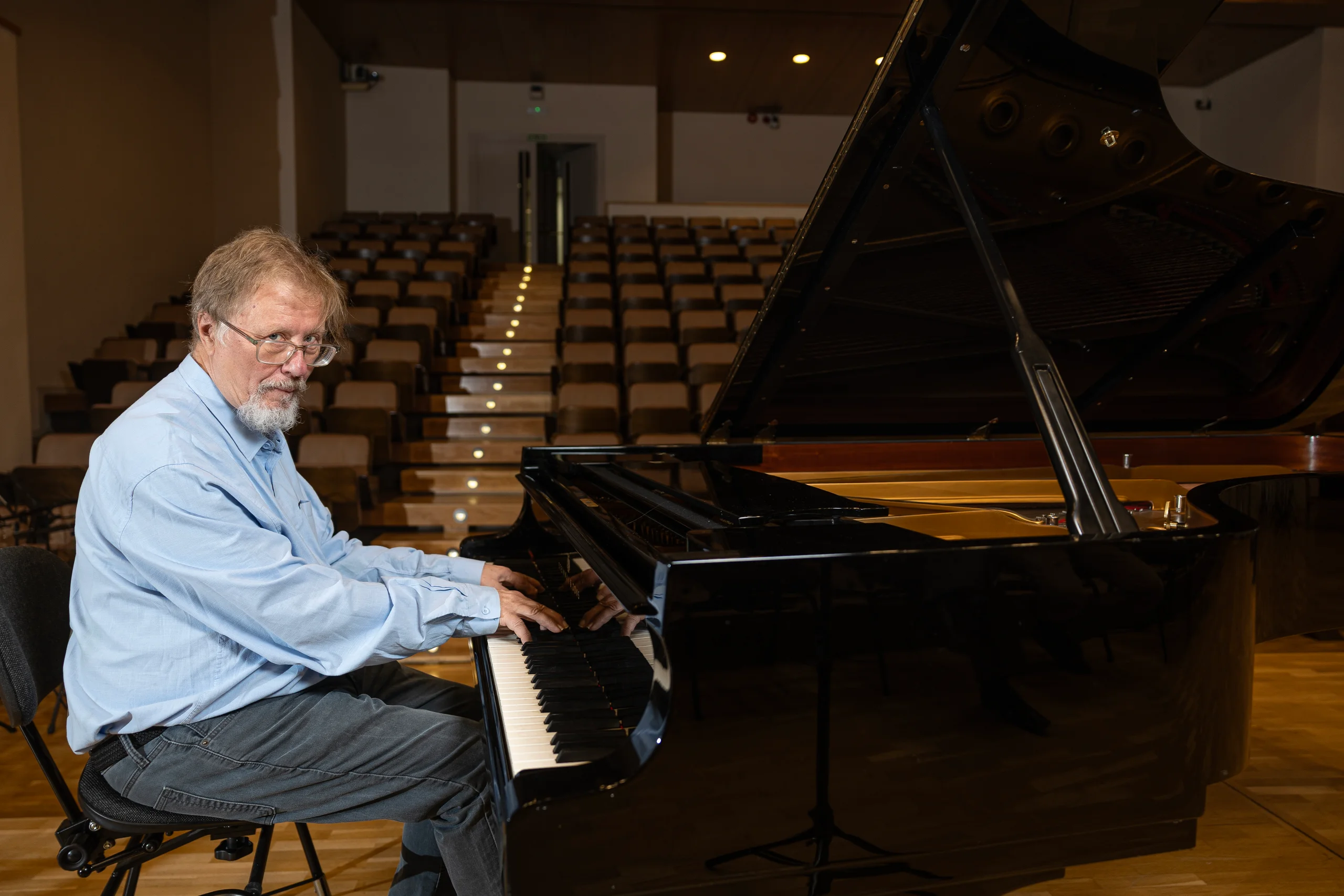
Georg Friedrich Haas
 Austria
Composer•academic•university teacher
Birthday
August 16, 1953
Birth Sign
Leo
Birthplace
Graz, Austria
Age
73 years old
About
Georg Friedrich Haas is an Austrian composer whose work has fundamentally reshaped contemporary classical music. Born in Graz in 1953, he is celebrated for his radical exploration of microtonality, spectral harmonies, and the physical, almost visceral experience of sound. His 2000 piece in vain topped the 2017 Classic Voice poll of the greatest works of art music since 2000, a recognition that speaks to his enduring influence. Haas's music often blurs the line between harmony and noise, creating shimmering, unstable textures that demand deep listening.
As of 2026, Haas continues to push boundaries. His massive work 11,000 Strings, premiered at New York's Park Avenue Armory in 2025, used 50 pianos and 25 other musicians to create a vast, meditative soundscape. He is also a tenured professor at Columbia University, where he mentors a new generation of composers. Haas's public persona is as provocative as his music; he has openly discussed his Nazi family heritage and his identity as a sadomasochist, framing his art as a confrontation with trauma and taboo.
Early Life & Background
Georg Friedrich Haas grew up in Graz, Austria, in a household shadowed by a difficult history. In recent interviews, he has spoken candidly about being the son and grandson of Nazis, a legacy that has profoundly shaped his artistic outlook on trauma and memory. His early musical interests were nurtured at home before formal training began.
From 1972 to 1979, he studied composition at the University for Music and Performing Arts Graz under Gösta Neuwirth and Iván Erőd. He then continued his studies in Vienna and later moved to Paris, where he studied with Gérard Grisey, a pioneer of spectral music. This mentorship proved pivotal. Grisey's influence helped Haas develop his distinctive sonic palette, using just intonation and microintervals to create textures that shimmer and destabilize. These early years of study and exploration laid the groundwork for a career defined by relentless experimentation.
Career Growth
Haas's breakthrough came in the late 1990s with works like Nachruf I (1997) and in vain (2000). The latter, a meditation on tuning and darkness, became his signature piece and a touchstone for new music ensembles worldwide. In 2011, his opera Bluthaus premiered at the Zurich Opera, and in 2016, Koma was staged at the Salzburg Festival, cementing his reputation as a major theatrical voice.
He joined Columbia University's composition faculty as a tenured professor in 2013, expanding his influence in American academia. His Violin Concerto (2017) showcased his mastery of solo instruments within complex orchestral textures. In October 2025, Haas premiered 11,000 Strings at the Park Avenue Armory in New York, a massive work involving 50 pianos and 25 additional musicians, all tuned to specific microtonal frequencies using a mobile app. Reviews described it as a 'sonic spectacular,' though some critics noted it failed to emotionally connect despite its technical grandeur. In November 2025, he inaugurated an artistic residency in Spain, where he gave a revealing interview about his personal history and philosophy.
Career Timeline
Public Image & Style
Haas is portrayed in the media as a thoughtful, intellectual, and slightly provocative figure. His candid discussions about his Nazi heritage and his open identity as a BDSM practitioner frame him as an artist who confronts taboo subjects directly. In interviews, he often speaks with a calm intensity, whether discussing the inner world of sound or his personal history. His music, with its long durations and use of silence, is often described as demanding, yet audiences and critics alike acknowledge his unique vision. Recent coverage of 11,000 Strings highlighted both the awe-inspiring scale and the polarizing emotional impact, reflecting the divided reactions his work often provokes.
Fame & Fandom (iFAMOUS Rankings)
Georg Friedrich Haas does not command a formalized fandom structure comparable to pop culture icons, nor does his audience operate under a specific collective name. His supporters are generally identified as members of the contemporary classical music community, academics, and critics who engage with his work through university lectures, masterclasses, and program notes rather than organized fan clubs or digital campaigns. The experience of following Haas is defined by the rarity of live performances and the intense intellectual engagement required to navigate his complex scores, lacking the communal rituals or chart pushes typical of celebrity culture.
Despite this lack of a branded fanbase, Haas holds a distinct position in global cultural metrics. According to the iFANN Global Fame Rankings, he is currently the 53rd most famous person from Austria, a standing that has remained steady since the previous assessment cycle. This placement reflects a consistent level of attention across media coverage, search activity, and consumption signals worldwide, distinguishing him within his national cohort without elevating him to universal household recognition. His legend is instead built on verified sonic events and controversial public statements that have become central to his biography among musicians and critics.
Interesting Facts and Legends
Haas has openly described himself as a self-confessed sadomasochist, stating in interviews that 'It is better to be a pervert than a murderer' to reflect his philosophy on sexuality and morality. His composition *in vain* was famously performed in complete darkness, with lights gradually dimming and returning to focus the audience entirely on sound. He utilizes technology extensively; for *11,000 Strings*, a mobile app tuned each of the 50 pianos to specific frequencies. Despite his avant-garde reputation, Franz Schubert remains a major influence on his handling of harmony and emotion.
A cornerstone of his modern mythology is the premiere of *11,000 Strings* at New York's Park Avenue Armory in October 2025. This event involved over 11,000 strings arranged in a massive sonic landscape using 50 pianos, creating a polarizing spectacle described by some as a meditation and others as a test of endurance. Another defining anecdote emerged during an artistic residency in Spain in November 2025, where Haas sparked significant discussion with his quote about being a pervert rather than a murderer, contextualized by his family history as the son and grandson of Nazis. These moments serve as entry points for understanding his belief that art must be radical and uncomfortable.
Notable Quotes
“It is better to be a pervert than a murderer.”
“My music is about the inner world of sound.”
Family & Personal Life
Georg Friedrich Haas is married to Mollena Williams-Haas, a prominent author and educator in the BDSM community. Their partnership is notable for its openness, with both discussing their kink dynamic publicly. They met through mutual connections in the arts and kink communities, and their relationship has been a subject of public discussion since around 2015, following the publication of Williams's memoir Master Slave Husband Wife. The couple does not have biological children together. Haas has spoken about his family's Nazi past, noting that his father and grandfather were members of the Nazi party, a legacy he has grappled with throughout his life and art.
Notable Connections
Georg Friedrich Haas is associated with the spectral music movement, having studied with Gérard Grisey. He has worked closely with ensembles such as Klangforum Wien and the Arditti Quartet, who have performed and recorded his works. His academic positions at the Hochschule für Musik Basel and Columbia University have connected him with a wide network of contemporary composers.
Relationships & Dating History
Georg Friedrich Haas's most significant public relationship is with Mollena Williams-Haas, whom he married after a long courtship. The exact start date of their relationship is not widely publicized, but it became a subject of public discussion around 2015, following Williams's rise as a prominent figure in the kink community and the publication of her memoir Master Slave Husband Wife. The couple met through mutual connections in the arts and kink communities. Their marriage is built on a dynamic that includes BDSM, which Haas has openly discussed in interviews. As of 2026, they remain married, with no reports of separation or divorce. They are considered a high-profile couple in both the classical music world and the alternative lifestyle community.
- MarriedMollena Williams-Haas2015 - presentCurrentMet through mutual connections in the arts and kink communities; their relationship is publicly discussed in the context of BDSM.
Salary, Net Worth In 2026
$1 Million
iFANN Editorial Team estimate
iFANN currently estimates Georg Friedrich Haas's net worth at $1 Million as of 2026. This figure reflects his career as a composer and academic rather than a pop star. His income sources include his tenured professorship at Columbia University, which provides a substantial academic salary, and royalties from performances of his works, particularly major pieces like *in vain* and *11,000 Strings*. He also receives high-value commissions from leading orchestras and festivals. While not publicly disclosed, his financial standing is consistent with senior professors and successful classical composers, significantly lower than the multi-million dollar figures seen in popular culture.
Awards Won (1)
Georg Friedrich Haas's awards reflect his standing in the contemporary classical world. In 2017, his piece in vain topped the Classic Voice poll for the greatest work of art music since 2000, a significant recognition from critics and audiences alike. He has also received honorary doctorates from several institutions, including the University of Graz. While he has not received mainstream awards like Grammys, his work has been honored through prestigious commissions and festival premieres, which are considered marks of distinction in his field.
2017 · Greatest Work of Art Music Since 2000
in vain
Known For
in vain
2000 · Composer
Bluthaus
2011 · Composer
Koma
2016 · Composer
11,000 Strings
2025 · Composer
Keywords
Sources
Quick Facts
- Profession
- Composer, academic, university teacher
- Born
- August 16, 1953
- Birthplace
- Graz, Austria
- Gender
- Male
- Spouse
- Mollena Williams-Haas
- Birth Sign
- Leo
Personal Details
- Full Name
- Georg Friedrich Haas
- Spouse
- Mollena Williams-Haas
- Education
- University for Music and Performing Arts Graz; studies in Vienna and Paris with Gérard Grisey
Frequently Asked Questions
Who is Georg Friedrich Haas married to?
What is Georg Friedrich Haas famous for?
Does Georg Friedrich Haas have children?
Where does Georg Friedrich Haas teach?
Is Georg Friedrich Haas related to Nazism?
Similar People
Join the community
fans discussing