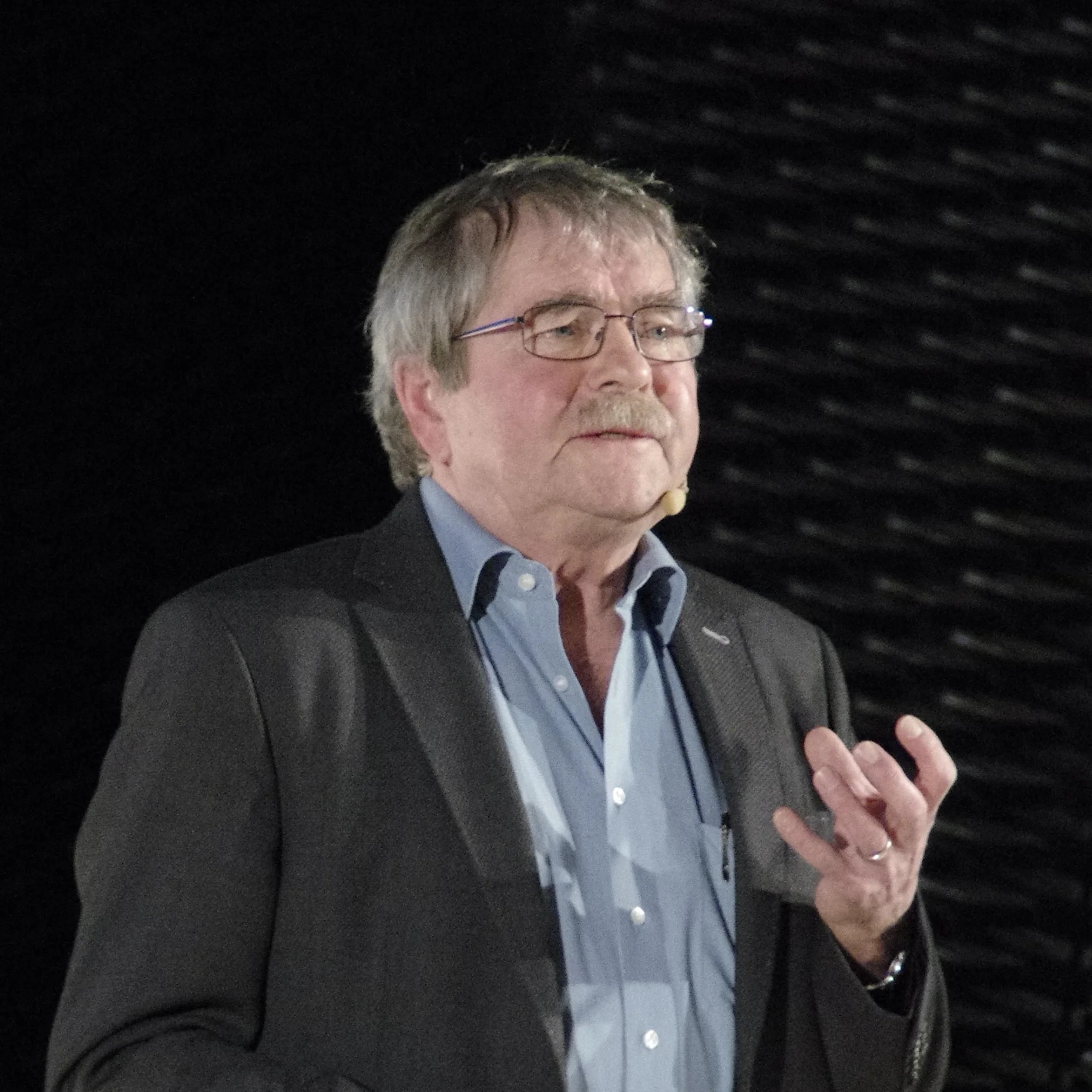
Georg Bednorz
 Germany
Also known as: Johannes Georg Bednorz
Birthday
May 16, 1950
Birth Sign
Taurus
Birthplace
Neuenkirchen, West Germany
Age
76 years old
About
Johannes Georg Bednorz is a German physicist who, with K. Alex Müller, discovered high-temperature superconductivity in ceramic materials, a breakthrough that earned them the 1987 Nobel Prize in Physics. Their work at IBM's Zurich Research Laboratory in 1986 shattered long-held assumptions about how cold materials must be to conduct electricity without resistance.
Today Bednorz remains a respected figure in condensed matter physics, his discovery having opened an entire field of research with potential applications in energy transmission, magnetic levitation, and medical imaging. He is a member of the U.S. National Academy of Sciences and continues to engage with the scientific community through lectures and public events.
Early Life & Background
Bednorz's path to physics started with earth sciences. In 1972, as a student at the University of Münster, he spent three months at IBM's Zurich research laboratory, an experience that steered him toward materials science. He earned his master's degree in 1976 and later completed his PhD, focusing on solid-state chemistry.
His academic training gave him a deep understanding of crystal structures and chemical synthesis, skills that would prove essential in his later work. After finishing his doctorate, he joined IBM's Zurich Research Laboratory in Rüschlikon, Switzerland, where he began collaborating with K. Alex Müller on the search for new superconducting materials.
Career Growth
The breakthrough came in 1986. Working with K. Alex Müller, Bednorz identified superconductivity in a barium-lanthanum-copper oxide ceramic, a material that conducted electricity without resistance at a then-record temperature of 35 kelvin (about -238 degrees Celsius). Their paper, "Possible high Tc superconductivity in the Ba-La-Cu-O system," was submitted in April 1986.
The discovery was so astonishing that it was confirmed by labs worldwide within months. In 1987, just 19 months after the paper's submission, Bednorz and Müller received the Nobel Prize in Physics, one of the fastest recognitions in the award's history. They were only the second two-person team to win the physics prize in decades.
Bednorz continued his research at IBM, exploring other oxide systems and contributing to the understanding of high-temperature superconductors. In March 2025, he delivered a keynote at the 1e9 Festival der Zukunft on superconductors, from Nobel Prize to start-up innovation, showing his ongoing relevance in the field.
Career Timeline
Public Image & Style
Bednorz is portrayed in media and scientific literature as a pioneering physicist whose work revolutionized materials science. His public image is that of a dedicated, persistent researcher who, alongside Müller, demonstrated the power of in-depth knowledge and scientific intuition. He has no documented fandom culture or signature public persona beyond his scientific identity.
Fame & Fandom (iFAMOUS Rankings)
Georg Bednorz, a Nobel laureate who reshaped condensed matter physics, is a figure of immense scientific renown, yet his fame remains confined to the corridors of academia and the pages of physics journals. The iFANN Global Fame Engine has evaluated his presence, but he currently holds no placement in its published rankings, neither in the Global Top 1,000 nor in any Top-100 scope list. This absence from the celebrity index is telling: Bednorz's influence is profound, but it does not translate into the metrics of popular culture.
His following is not a fandom in the conventional sense; there is no formal name, no organized fan clubs, no digital campaigns. Instead, his admirers are physicists, materials scientists, and science enthusiasts who revere his work. The closest to a communal celebration is the annual Nobel Prize Symposium at the University of Zurich, which in 2023 marked the 35th anniversary of his discovery, a gathering of minds rather than a fan convention. Bednorz's public appearances are academic, Nobel lectures, conference keynotes, and symposium talks, where he speaks to the converted, not to a crowd of autograph seekers.
His legend is built on a single, monumental achievement: the 1986 discovery, with K. Alex Müller, of high-temperature superconductivity in a ceramic oxide. This breakthrough shattered a long-held paradigm and earned the Nobel Prize in record time. The story of two patient researchers, working with modest resources at IBM Zurich, overturning conventional wisdom is a cornerstone of scientific lore. It is a tale of persistence and insight, not of viral moments or fan frenzy. Bednorz's fame is that of a quiet pioneer, celebrated by those who understand the magnitude of his contribution, a fame that never needed a spotlight to shine.
Interesting Facts and Legends
Bednorz's Nobel Prize arrived just 19 months after the paper was submitted, one of the fastest recognitions in physics history. He was originally trained in earth sciences, not physics, before his IBM internship in 1972. The discovery was made by a two-man team, exceptionally rare for a physics Nobel. His collaborator K. Alex Müller once described their impact: "We unleashed an avalanche." Potential applications of high-temperature superconductors include energy transmission and magnetic levitation.
One of the most retold legends is the "breakthrough moment" in 1986, when Bednorz and Müller observed superconductivity at 35 Kelvin in lanthanum barium copper oxide, a temperature far higher than any previously recorded. The scientific establishment had long dismissed ceramics as incapable of superconductivity, so the initial skepticism was fierce. Yet within months, laboratories worldwide were replicating and extending the work, triggering a global scientific gold rush.
Another iconic element is the "small science vs. big science" narrative. The discovery was made with modest resources at IBM Zurich, not in a massive government-funded lab. A Science article titled "Determined Duo Scored a Victory for Small-Scale Science" celebrated this triumph of persistence and creativity over institutional scale. The partnership itself, a senior researcher mentoring a younger scientist, adds a classic mentor-protégé layer to the story, and Müller's death in 2023 prompted renewed attention to their enduring legacy.
Notable Quotes
“We unleashed an avalanche.”
Family & Personal Life
Notable Connections
Relationships & Dating History
Salary, Net Worth In 2026
$5 Million
iFANN Editorial Team estimate
Georg Bednorz's net worth is not publicly documented, as is common for research physicists. Nobel Prize winners receive a cash award, which in 1987 was approximately $340,000, shared between the two laureates. His career at IBM, spanning several decades, would have provided a comfortable salary, but no specific figures are available. As of 2026, iFANN's editorial analysis estimates Bednorz's net worth at $5 million, based on his Nobel Prize share, IBM employment, and speaking engagements. This figure is an approximation, as Bednorz has never disclosed his financial details.
Awards Won (1)
Bednorz won the Nobel Prize in Physics in 1987, shared with K. Alex Müller, for the discovery of high-temperature superconductivity in ceramic materials. This is his most prestigious award, and no other awards are documented in available sources.
1987 · Physics
Discovery of high-temperature superconductivity
Known For
High-temperature superconductivity
1986 · Co-discoverer
Nobel Prize in Physics
1987 · Laureate
Keywords
Sources
Quick Facts
- Profession
- physicist
- Born
- May 16, 1950
- Birthplace
- Neuenkirchen, West Germany
- Gender
- Male
- Birth Sign
- Taurus
- Education
- University of Münster
- Awards
- Nobel Prize in Physics (1987)
Personal Details
- Full Name
- Johannes Georg Bednorz
- Education
- University of Münster (Master's, PhD)
Frequently Asked Questions
What did Georg Bednorz discover?
How old is Georg Bednorz?
Where does Georg Bednorz work?
What is Georg Bednorz's net worth?
Does Georg Bednorz have children?
Social Media
Similar People
Join the community
fans discussing