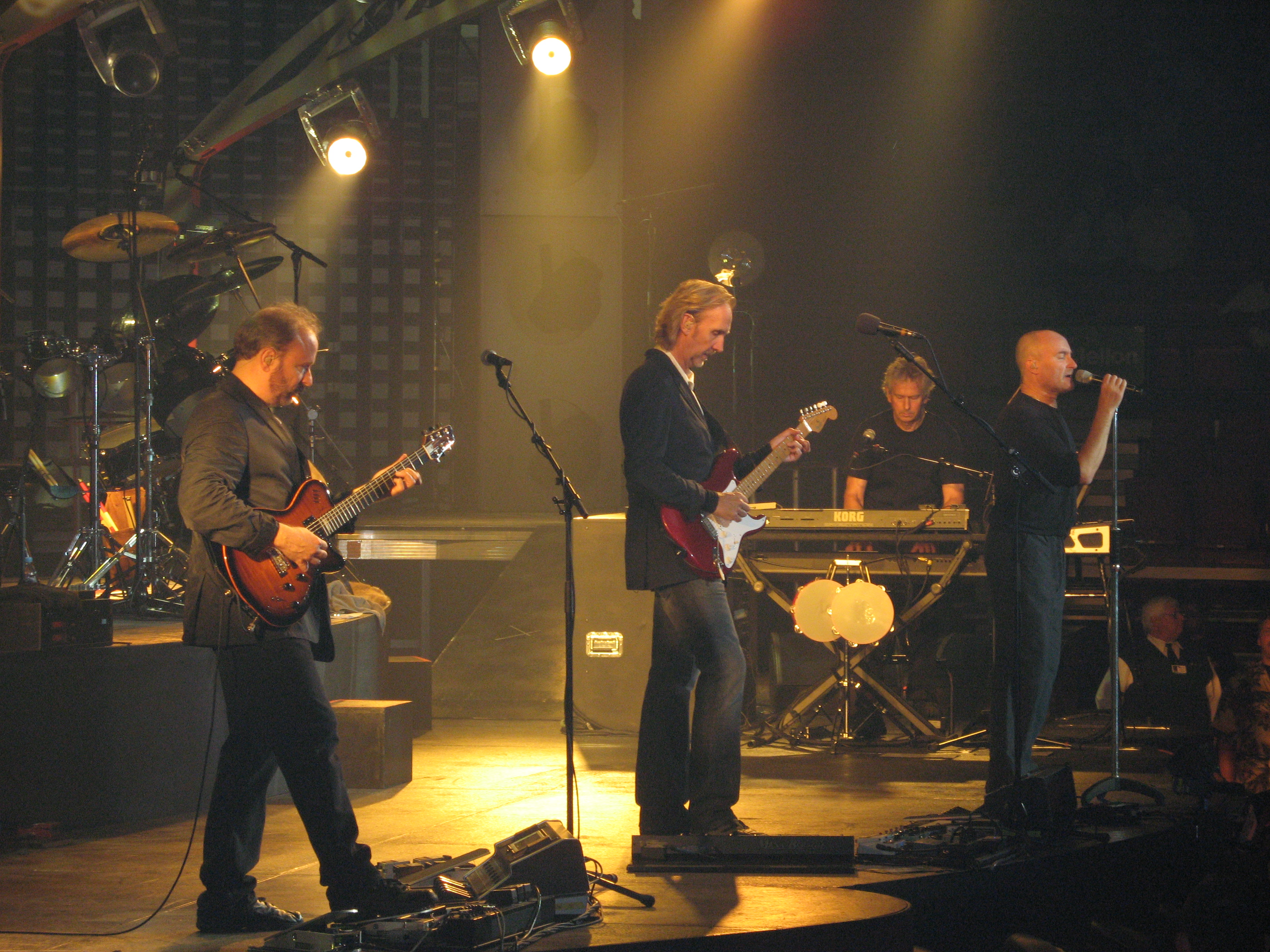
Genesis
 United Kingdom
Genesis Fans
Fandom
3
Members
About
Genesis is an English rock band, widely celebrated for their evolution from progressive rock pioneers to global pop superstars. Over a career spanning more than five decades, they have sold an estimated 100 to 150 million records worldwide, cementing their status as one of music's best-selling artists. Their distinctive sound, characterized by intricate musicianship, lyrical depth, and dynamic vocal performances, has resonated with millions. While their early work is lauded for its ambitious progressive rock compositions, the band achieved massive commercial success in the 1980s and early 1990s with a more accessible pop-rock sound, producing numerous hit singles and albums. Genesis is recognized for their significant influence across multiple rock genres, leading to their induction into the Rock and Roll Hall of Fame in 2010. Following a final reunion tour that concluded in March 2022, Genesis has ended its touring and recording career, leaving behind an enduring legacy.
Formation Story
Genesis first came together in 1967 at Charterhouse School, an independent boarding school located in Godalming, Surrey, England. The initial lineup comprised schoolmates Peter Gabriel on vocals, Tony Banks on keyboards, Mike Rutherford on bass and guitar, and Anthony Phillips on guitar, with Chris Stewart initially on drums. Their burgeoning talent attracted the attention of Jonathan King, a pop impresario and former student of Charterhouse. King not only discovered the group but also suggested the name "Genesis," believing it conveyed a sense of new beginnings and grand potential. He went on to produce their early recordings, which were compiled into their debut album, From Genesis to Revelation. Released in March 1969 on Decca Records, the album's sound leaned towards baroque-pop, but it unfortunately did not achieve commercial success at the time.
The period immediately following their debut proved to be one of significant evolution for the band, particularly concerning their rhythm section. Drumming duties briefly shifted to John Mayhew. However, a more impactful transformation began in 1970 when guitarist Anthony Phillips departed due to challenges with stage fright and persistent health issues. This departure coincided with the arrival of Phil Collins, who joined as drummer in 1970 after answering an advertisement in Melody Maker specifically seeking a drummer "sensitive to acoustic music." The classic progressive rock lineup was further solidified the following year, in 1971, with the addition of guitarist Steve Hackett. These crucial changes completed the quintet that would define Genesis's innovative sound through the early to mid-1970s. With this stable and exceptionally talented configuration, the band began to craft the complex compositions and embrace the literary themes that would become their hallmark, further enhanced by Peter Gabriel's increasingly theatrical stage presence, which involved elaborate costumes and storytelling. Their first major breakthrough arrived with the album Nursery Cryme, released in 1971, which unequivocally established their unique progressive rock identity.
Members
Former Members
Sub-Units
Mike and the Mechanics (1985)
Mike Rutherford
Phil Collins Solo Career (1981)
Phil Collins
Peter Gabriel Solo Career (1977)
Peter Gabriel
Steve Hackett Solo Career (1978)
Steve Hackett
Musical Style
Genesis's musical style underwent several significant transformations over their career, moving from early influences to distinct genre-defining periods. Their initial recordings, including the 1969 debut From Genesis to Revelation, showcased a baroque-pop sound, characterized by melodic structures, occasional orchestral arrangements, and a noticeable influence from late 1960s British pop groups such as the Beatles and the Bee Gees. With the arrival of Phil Collins and Steve Hackett, the band entered its progressive rock era from 1971 to 1975. Albums such as Foxtrot (1972) and Selling England by the Pound (1973) featured complex song structures, often with multiple movements, irregular time signatures, and extended instrumental passages. Tony Banks's prominent keyboard work, Steve Hackett's inventive guitar textures, and Peter Gabriel's narrative-driven lyrics and theatrical vocals were hallmarks of this period. Their music frequently explored conceptual themes, drawing from mythology, fantasy, and social commentary. The Lamb Lies Down on Broadway (1974–1975) was a double concept album with a surreal narrative.
Following Peter Gabriel's departure in 1975 and Steve Hackett's exit in 1977, Genesis, now a trio with Phil Collins on lead vocals, began a gradual shift. The albums A Trick of the Tail (1976) and Wind & Wuthering (1976) maintained progressive elements but started to incorporate shorter, more direct songs. By the 1980s, the band fully embraced a pop-rock sound, characterized by catchy melodies, prominent synthesizers, and Phil Collins's distinct vocal style. Albums like Invisible Touch (1986) epitomized this era with its radio-friendly production and polished sound. Lyrical themes during this period often focused on relationships, social observations, and more universal subjects. Even with this commercial shift, the band's instrumental prowess remained, though often within more structured song formats. The brief return to a more progressive sound with Ray Wilson on 1997's Calling All Stations marked a final stylistic attempt before the band's extended hiatus.
Discography
| Title | Year |
|---|---|
| The Last Domino? | 2021 |
| Calling All Stations | 1997 |
| Jesus He Knows Me | 1992 |
| No Son of Mine | 1991 |
| I Can't Dance | 1991 |
| We Can't Dance | 1991 |
| Tonight, Tonight, Tonight | 1987 |
| Land of Confusion | 1986 |
| Invisible Touch | 1986 |
| Invisible Touch | 1986 |
| That's All | 1983 |
| Mama | 1983 |
| Genesis | 1983 |
| 3x3 | 1982 |
| Abacab | 1981 |
| Abacab | 1981 |
| Turn It On Again | 1980 |
| Misunderstanding | 1980 |
| Duke | 1980 |
| Follow You Follow Me | 1978 |
| ...And Then There Were Three... | 1978 |
| Spot the Pigeon | 1977 |
| Wind & Wuthering | 1976 |
| A Trick of the Tail | 1976 |
| The Lamb Lies Down on Broadway | 1974 |
| Selling England by the Pound | 1973 |
| Foxtrot | 1972 |
| Nursery Cryme | 1971 |
| Trespass | 1970 |
| From Genesis to Revelation | 1969 |
Tours
The Last Domino? Tour
2021 · 50 shows
Turn It On Again Tour
2007 · 50 shows
Calling All Stations Tour
1997 · 50 shows
We Can't Dance Tour
1992 · 80 shows
Invisible Touch Tour
1986 · 120 shows
Mama Tour
1983 · 100 shows
Abacab Tour
1981 · 90 shows
Duke Tour
1980 · 70 shows
...And Then There Were Three... Tour
1978 · 100 shows
Wind & Wuthering Tour
1977 · 80 shows
A Trick of the Tail Tour
1976 · 60 shows
The Lamb Lies Down on Broadway Tour
1974 · 100 shows
Cultural Impact
Genesis exerted influence across music and broader culture through their stylistic shifts and innovative approaches. In their progressive rock phase, the band helped define the genre with their intricate compositions, extended musical suites, and conceptual albums. Peter Gabriel's theatrical stage presence, which incorporated elaborate costumes and storytelling, set a precedent for concert performance, inspiring future artists to integrate visual artistry with music. This era demonstrated the potential for rock music to explore complex themes and push structural boundaries, influencing bands that sought to combine technical musicianship with artistic ambition.
Later, Genesis's transition to a pop-rock sound in the 1980s showcased how a progressive band could achieve massive mainstream success without entirely abandoning their musical roots. This evolution was instrumental in shaping the sound of 1980s pop, particularly through Phil Collins's distinctive drumming and vocal style, which became ubiquitous in popular music production. The band's music videos, especially "Land of Confusion" (1986) with its satirical Spitting Image puppets, garnered significant attention and contributed to the golden age of MTV, using humor and political commentary to reach a wide audience. The video won a Grammy for Best Concept Music Video in 1987. Beyond music, Genesis cultivated a dedicated fan base that appreciated both their artistic integrity and their commercial achievements. Their work continues to be referenced by musicians and critics, demonstrating their lasting contribution to the development of rock music in its many forms.
Fandom Culture
Genesis, while having a deeply devoted fan base, does not have a formally designated fandom name like many modern groups; their followers are generally referred to simply as "Genesis Fans" or "Genesis devotees." Similarly, the group never adopted an official lightstick, with concertgoers historically holding up lighters or, more recently, mobile phone lights during ballads like "Follow You Follow Me." There is no single official fan color associated with Genesis, though some fans might informally connect with colors seen on album art, such as the blue often featured in their visual aesthetic.
Fan traditions at live shows include enthusiastic sing-alongs to their major hits, particularly "I Can't Dance" and "Land of Confusion." Over the decades, various fan clubs and online communities have emerged to connect followers and archive information about the band. Publications like The Genesis Fan Club newsletter were active for many years, providing updates and exclusive content. In the digital age, websites such as Genesis-News.com serve as central hubs for news, discographies, and discussions among fans worldwide. The official Genesis YouTube channel has over 1 million subscribers, and the "Land of Confusion" music video has over 100 million views. These communities help preserve the band's history and foster continued appreciation for their extensive catalog and evolving musical journey.
Awards Won (23)
Genesis accumulated several notable awards throughout their career, with a concentration in the 1980s and early 1990s. They won two Grammy Awards, specifically for Best Concept Music Video in 1987 for "Land of Confusion" and Best Long Form Music Video in 1992 for The Way We Walk. In 1987, the band earned two American Music Awards: Favorite Pop/Rock Band, Duo or Group, and Favorite Pop/Rock Album for Invisible Touch. The music video for "Land of Confusion" also brought them two MTV Video Music Awards that same year. Genesis was recognized with the Brit Award for Best British Group in 1992, and they received two Goldene Europa Awards for Best International Group in 1986 and 1992.
Best Long Form Music Video
for: The Way We Walk
Best Concept Music Video
for: "Land of Confusion"
Best Concept Music Video
for: Land of Confusion
Concert Event of the Year
for: Genesis
Favorite Pop/Rock Band/Duo/Group
for: We Can't Dance
Favorite Pop/Rock Band, Duo or Group
Favorite Pop/Rock Album
for: Invisible Touch
Best Group Video
for: Land of Confusion
Best Concept Video
for: Land of Confusion
Best British Group
Milestones
The Last Domino? Tour concludes, marking the end of the band's active performance career.
Inducted into the Rock and Roll Hall of Fame.
Steve Hackett departs from the band.
Peter Gabriel departs; Phil Collins assumes lead vocalist role.
Steve Hackett joins as guitarist.
Phil Collins joins as drummer.
Fame & Fandom
Trivia
Tony Banks and Mike Rutherford are the only two members who remained with Genesis throughout its entire recording career, from its formation in 1967 to its hiatus in 2000. Phil Collins initially joined Genesis after answering an advertisement in Melody Maker for a drummer "sensitive to acoustic music," arriving early for his audition to hear the other drummers play and learn the songs. Peter Gabriel famously used elaborate costumes and masks during live performances in the 1970s, transforming into characters like "The Fox" or "The Slipperman" to enhance the band's theatrical storytelling. The band's 1983 self-titled album is sometimes referred to as "Mama" by fans due to the popularity of its lead single, "Mama," and the distinctive drum machine sound it features. The 2021–2022 The Last Domino? Tour marked the final time Phil Collins performed live as a drummer, as he had been dealing with nerve damage that limited his ability to play the instrument, instead singing from a chair. Genesis achieved several records: the 1987 Invisible Touch tour sold out 12 consecutive shows at Wembley Stadium, a record at the time; the 2007 Turn It On Again tour grossed over $130 million, a Guinness World Record for highest-grossing tour by a group; and they have a star on the Hollywood Walk of Fame (2010).
Keywords
Sources
Group Info
- Fandom
- Genesis Fans
- Formed
- 1967-01-01
- Debut
- 1969-03-01
- Origin
- Godalming, Surrey, England
- Company
- Charisma Records
- Label
- Decca Records, Charisma Records, Atlantic Records, Atco Records, ABC Records, Virgin Records, Rhino Records
- Status
- Disbanded (2022-03-26)
Social Media
Join the community
fans discussing