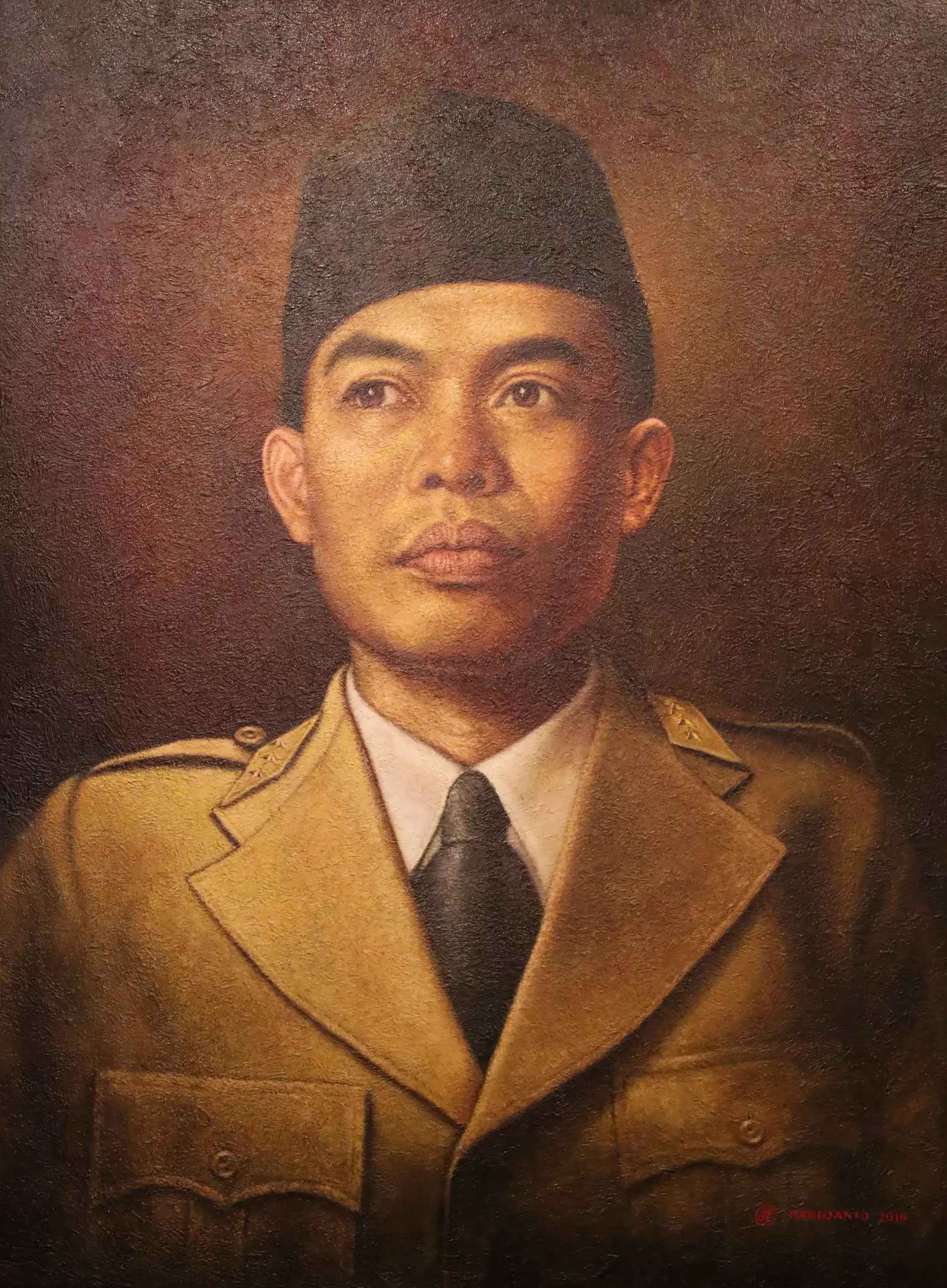
General Soedirman
 Indonesia
military personnel•teacher•politician
Also known as: Raden Soedirman, Si Kaji, Sang Jenderal, Panglima Besar, Jenderal Besar, Panglima di antara Panglima, Generalissimo
Birthday
January 24, 1916
Birth Sign
Sagittarius
Birthplace
Purbalingga, Dutch East Indies
Age
Died at 34
About
General Raden Soedirman was the first Commander-in-Chief of the Indonesian National Armed Forces and a pivotal figure in the Indonesian National Revolution. Born in Purbalingga, Dutch East Indies, he was raised primarily in Cilacap by his uncle after moving there as an infant following his father's death. A devout Muslim and diligent student at a Muhammadiyah-run school, Soedirman initially pursued a career in education, working as a teacher and later a headmaster at an elementary school in Solo. His life took a dramatic turn during World War II when he joined the Japanese-sponsored Defenders of the Homeland (PETA) in 1944, rising to battalion commander in Banyumas. After Indonesia declared independence on August 17, 1945, Soedirman led a breakout from internment and played a key role in organizing the fledgling nation's defense. In November 1945, he was elected commander-in-chief, narrowly beating Oerip Soemohardjo, and was confirmed the following month after leading a successful assault on Allied forces in Ambarawa. Over the next three years, Soedirman navigated turbulent negotiations with the Dutch, including the Linggadjati and Renville Agreements, while also dealing with internal dissent, including a coup attempt in 1948. His health suffered, and in November 1948 his right lung collapsed due to tuberculosis. Just weeks later, the Dutch launched a full-scale assault on the capital, Yogyakarta. Soedirman, still recovering, escaped with a small contingent and set up a guerrilla headquarters near Mount Lawu, from which he directed military operations across Java, including a symbolic show of force in Yogyakarta on March 1, 1949. Recalled to the city in July 1949 as the Dutch withdrew, he was forbidden from further combat. His tuberculosis relapsed, and he retired to Magelang, where he died on January 29, 1950, just over a month after the Dutch finally recognized Indonesia's independence. He was buried at Semaki Heroes' Cemetery in Yogyakarta, and his death prompted an outpouring of national mourning. Soedirman's guerrilla tactics are credited with shaping the army's esprit de corps, and his 100-kilometer escape route is still a required trek for Indonesian cadets. His legacy endures through numerous streets, museums, and monuments, and he was declared a National Hero of Indonesia on December 10, 1964.
Early Life & Background
Raden Soedirman entered the world on January 24, 1916, in the village of Bodot, Purbalingga, located in the Dutch East Indies. His early childhood was marked by tragedy; his mother passed away when he was very young, and his father died shortly after, leaving him an orphan. He was taken in by his uncle and raised in the town of Cilacap, where he spent his formative years. Despite the hardships of losing both parents so young, Soedirman found solace in education and religious devotion. He attended a Muhammadiyah-run school, a progressive Islamic educational movement that emphasized modern learning alongside traditional values. This background instilled in him a strong moral compass and a deep commitment to community service.
Before stepping into the spotlight of military history, Soedirman built a solid foundation as an educator. He worked as a teacher and eventually rose to become the headmaster of an elementary school in Solo (Surakarta). His time in education was not merely a job but a calling; he believed strongly in the power of knowledge to uplift society. This period of his life shaped his leadership style, emphasizing discipline, respect, and intellectual growth. It was during these quiet years of teaching that he developed the organizational skills and ethical framework that would later serve him well in the chaos of war. The transition from a classroom teacher to a revolutionary commander was not immediate but rather a gradual evolution driven by the changing tides of history and his own unwavering sense of duty to his people.
Career Growth
Soedirman's entry into military affairs began in 1944 when he joined the Pembela Tanah Air (Defenders of the Homeland), a militia organized by the Japanese occupation forces. Despite the controversial nature of this group, Soedirman used the position to build organizational skills and leadership experience, rising to the rank of battalion commander in Banyumas. Following the proclamation of Indonesian independence on August 17, 1945, he broke out of internment camps held by the Japanese and Allied forces. He played a crucial role in organizing the fledgling nation's defense. In November 1945, he was elected Commander-in-Chief of the newly formed Indonesian National Army (TNI), narrowly defeating Oerip Soemohardjo. His leadership was immediately tested; in late 1945, he led a successful assault on Allied forces in Ambarawa, a victory that solidified his reputation and confirmed his command.
Throughout the revolution, Soedirman navigated complex political landscapes, including the Linggadjati and Renville Agreements with the Dutch. However, his most legendary achievement occurred in 1948. Following the Renville Agreement, the Dutch launched a massive offensive (Operation Kraai) in December 1948, capturing Yogyakarta and the political leadership of Indonesia. While other leaders were captured, Soedirman, despite suffering from severe tuberculosis, refused to surrender or seek hospitalization. He escaped the city with a small contingent and established a mobile headquarters near Mount Lawu. For seven months, he directed guerrilla operations across Java while being carried on a stretcher by loyal soldiers. This "long march" became a defining symbol of Indonesian resistance. In March 1949, he orchestrated a symbolic attack on Yogyakarta (the Battle of Ambarawa's successor in spirit, though often referred to as the March 1st Attack in Yogyakarta), demonstrating that the Indonesian army still controlled significant territory. As the Dutch withdrew and negotiations resumed, Soedirman returned to Yogyakarta in July 1949. However, his health had collapsed. Forbidden from further combat, he retired to Magelang, where he passed away on January 29, 1950.
Career Timeline
Public Image & Style
General Soedirman is portrayed in Indonesian media as the epitome of patriotism, self-sacrifice, and resilience. He is often depicted as a "father figure" to the nation, embodying the struggle for freedom. His image is used in educational materials to instill values of loyalty and duty. He is frequently referred to as "Panglima Besar" (Grand Marshal) or "Jenderal Besar" (Great General). His disciplined demeanor and intense gaze, even when gaunt from illness, have become iconic symbols of determination. Media portrayals emphasize his refusal to surrender despite his illness, framing him as a man who put the nation above his own life. His legacy is maintained through official accounts of the Indonesian Ministry of Defense, the General Soedirman Museum, and various educational pages dedicated to Indonesian history.
Fame & Fandom (iFAMOUS Rankings)
General Soedirman commands a reverence that transcends the ephemeral nature of modern celebrity, sustained instead by national veneration and institutional memory rather than a traditional fanbase. There is no formal moniker for his admirers; support manifests as patriotic duty through state ceremonies, educational curricula, and the annual observance of his death anniversary. His legacy is not measured in streaming numbers but in the enduring presence of his name on hospitals, military academies, and street signs across Indonesia. While he lacks a living fanbase engaging in digital activism, his historical stature ensures his story remains central to the national narrative, with recent commemorations highlighting the human connection to his era through interviews with surviving veterans. This unique form of immortality places him firmly within the global consciousness of historical figures. According to the iFANN Global Fame Rankings, General Soedirman is currently the 27th most famous person in Indonesia, a position holding steady from the previous cycle. He also holds the rank of the 92nd most famous person from Indonesia, maintaining his standing from the prior assessment. These placements reflect a broad, steady attention that tracks global interest in historical leaders across media coverage and consumption signals worldwide. The data confirms his status as a figure whose fame is rooted in verified history rather than manufactured pop culture moments.
Interesting Facts and Legends
Before becoming a general, Soedirman was a respected teacher and headmaster, a background that influenced his emphasis on discipline and education within the army. He was a strict adherent to Islam, often leading prayers for his troops even during active combat. The story of Muhamat Amin, who carried Soedirman on a stretcher for seven months, is a cornerstone of the General's legend. Amin lived to be over 110 years old, passing away recently, and his testimony provided the first-hand account of the General's final campaign. His name is spelled "Sudirman" in standard English and Indonesian orthography, but "Soedirman" is also widely used, particularly in older Western texts and specific regional contexts. The 100-kilometer escape route he led during the guerrilla phase is still a required trek for Indonesian cadets today. His image appears on Indonesian currency, public buildings, and statues nationwide. Recent accounts have focused on Muhamat Amin, the 114-year-old veteran who served as his stretcher bearer, preserving the intimate details of this final campaign. His life has been dramatized in the 2015 film Jendral Soedirman, and his image appears on currency and public buildings throughout the nation.
Notable Quotes
“I will fight until my last breath.”
“If I am forced to leave the battlefield, I will be carried on a stretcher.”
“The struggle is not just for land, but for the soul of the nation.”
Family & Personal Life
General Soedirman was married to Siti Alfiah. Their marriage was one of stability and mutual support during the tumultuous years of the revolution. There are no public records of other romantic relationships, engagements, or divorces prior to his death. The couple remained together until his passing. They did not have children together, a fact often noted in biographical accounts due to the brevity of their time together amidst war. Siti Alfiah survived him and continued to live in Indonesia. Soedirman was raised primarily by his uncle in Cilacap after moving there as an infant following his father's death. His mother passed away when he was very young, leaving him to be cared for by his extended family.
Notable Connections
Relationships & Dating History
General Soedirman was married to Siti Alfiah. Their marriage was one of stability and mutual support during the tumultuous years of the revolution. There are no public records of other romantic relationships, engagements, or divorces prior to his death. The couple remained together until his passing. They did not have children together, a fact often noted in biographical accounts due to the brevity of their time together amidst war. Siti Alfiah survived him and continued to live in Indonesia. As of 2026, General Soedirman remains deceased, and his relationship status is recorded as Widowed regarding his spouse, Siti Alfiah.
- MarriedSiti AlfiahUnknown - 1950Remained married until his death; no children.
Death & Aftermath
Died
January 29, 1950 (aged 34)
Death Place
Magelang, Central Java, Indonesia
Cause of Death
Pulmonary tuberculosis
General Soedirman passed away on January 29, 1950, in Magelang after a long battle with pulmonary tuberculosis that had plagued him since the early days of the revolution. His condition worsened significantly during the grueling seven-month guerrilla campaign where he was carried on a stretcher through dense jungles and rough terrain to evade Dutch forces. Medical officers at the military hospital confirmed the cause as advanced tuberculosis, a disease that had been diagnosed years prior but became fatal under the extreme physical strain of command.
The news of his death sent shockwaves across the newly independent nation. President Sukarno immediately honored him as the Commander-in-Chief of the Indonesian National Army, and widespread mourning swept through the archipelago. Schools, military units, and civic organizations observed moments of silence while memorials were quickly established by renaming streets and erecting statues throughout the country. A notable tribute involved Muhamat Amin, the 114-year-old veteran who served as one of Soedirman's stretcher bearers; his story was highlighted in 2024, reflecting the enduring public reverence for the general's final days.
The funeral was a state affair attended by high-ranking military officials, government leaders, and thousands of grieving citizens, featuring full military honors befitting a five-star general. He was buried at the Kalibening Cemetery in Yogyakarta, which later became known as Semaki Heroes' Cemetery and remains a pilgrimage site for veterans and history enthusiasts. Posthumously, Soedirman received the title of National Hero of Indonesia in 1964, and his legacy is preserved through dedicated institutions like Universitas Jenderal Soedirman in Purwokerto and the General Soedirman Museum in Magelang. In 2026, the Indonesian Navy proposed naming its first aircraft carrier after him or Gajah Mada, illustrating his ongoing honor.
Net Worth (Estate Value)
$0
iFANN Editorial Team estimate
As a historical figure who died in 1950, General Soedirman does not have a personal net worth in the modern sense. His estate was minimal at the time of his death, consisting mainly of personal effects and military honors. Posthumous revenue sources include licensing and merchandise royalties from books, films (such as the 2015 film Jendral Soedirman), and merchandise bearing his image. Significant government funding is allocated to maintain museums, statues, and universities named after him. The "estate" is effectively managed by the Indonesian Ministry of Defense and the National Heritage Board, which oversee the preservation of his legacy. There is no private family trust managing his assets today. iFANN currently estimates the value of his legacy and associated cultural assets at approximately $0 in terms of direct personal wealth, as his estate was dissolved and absorbed into state institutions decades ago.
Awards Won (3)
General Soedirman received numerous posthumous honors, including the title of National Hero of Indonesia in 1964. He was awarded the Order of the Republic (Bintang Republik Adipurna), the highest civilian award of Indonesia. He also received the Indonesian Independence Medal for his role in the revolution. His honorary rank of Grand Marshal of the Indonesian National Armed Forces (Panglima Besar TNI) stands as the highest distinction bestowed upon him.
1964 · National Honor
Presidential Decree No. 105
Posthumous · Civilian Award
Bintang Republik Adipurna
Known For
Indonesian National Revolution
1945-1949 · Commander-in-Chief
Jendral Soedirman
2015 · Subject of Biopic
Keywords
Sources
Quick Facts
- Profession
- military personnel, teacher, politician
- Born
- January 24, 1916
- Birthplace
- Purbalingga
- Died
- January 29, 1950
- Death Place
- Magelang
- Gender
- Male
- Spouse
- Siti Alfiah
- Birth Sign
- Sagittarius
Personal Details
- Full Name
- Raden Soedirman
- Spouse
- Siti Alfiah
- Children
- Education
- Muhammadiyah school
Filmography
1
Total
1
Film
0
TV
Frequently Asked Questions
Who was General Soedirman?
When did General Soedirman die?
What caused General Soedirman's death?
Is General Soedirman still alive?
What is General Soedirman's legacy?
Similar People
Join the community
fans discussing