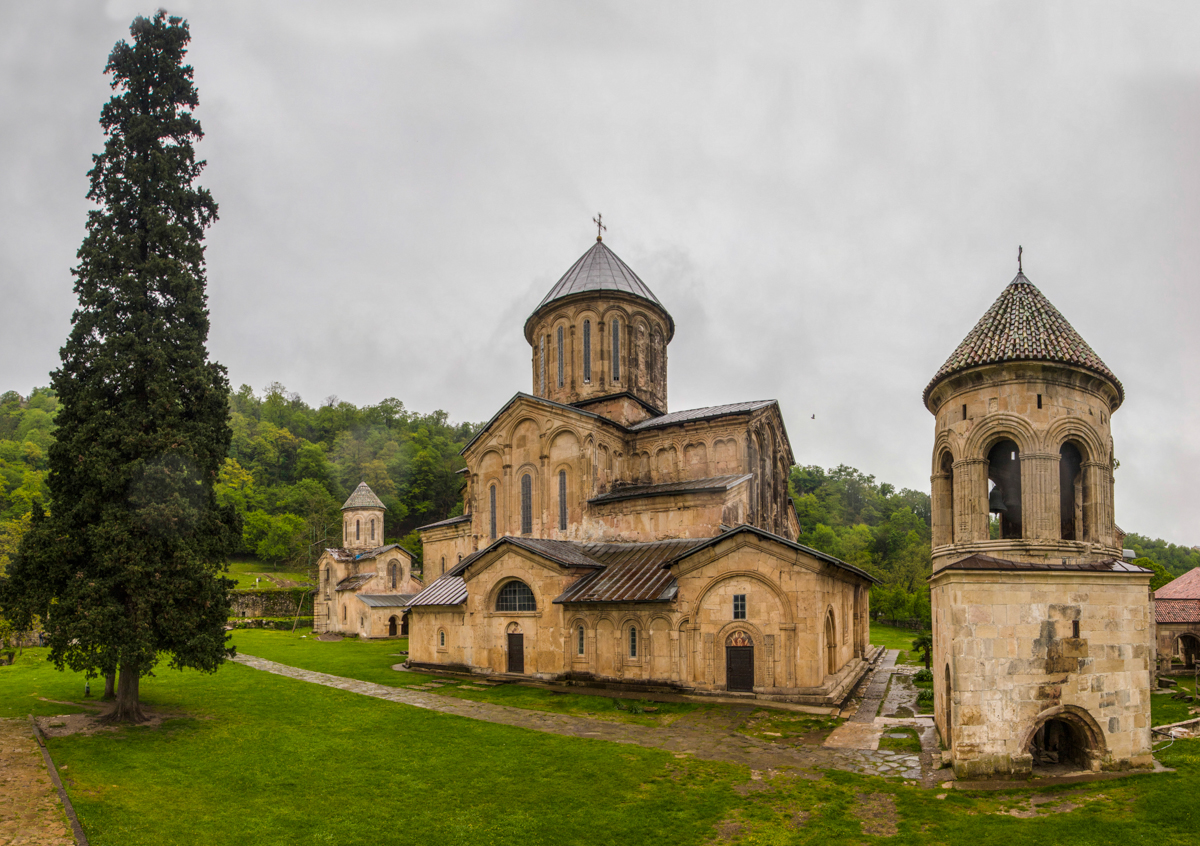
 Georgia
About
Gelati Monastery is a medieval Orthodox Christian monastic complex near Kutaisi in western Georgia's Imereti region, founded in 1106 by King David IV of Georgia, also known as David the Builder. It was established as a royal monastery intended to serve as a new dynastic burial site and a center for monastic life, education, and scholarship. The complex reflects the ambitions of a ruler who united Georgia and inaugurated a period of cultural flourishing known as the Georgian Golden Age.
The monastery is one of the largest Medieval Orthodox monasteries, distinguished for its harmony with the natural setting and its well thought-out overall planning, built under the influence of the Byzantine Empire. It served as a cultural, educational, and scientific center in medieval Georgia and is an exemplar of Georgian architecture and fresco artistry. The main church, the Cathedral of the Nativity of the Virgin, along with the Church of St. George and the Church of St. Nicholas, form the core of the complex, which resembles a fortress at the foot of wooded mountains.
Gelati Monastery is inscribed as part of the UNESCO World Heritage listing 'Bagrati Cathedral and Gelati Monastery,' and its reputation for artistic and intellectual achievement makes it a compelling subject for scholars of faith, art, and history. The monastery is not a modern organization with a corporate structure; rather, it is a religious and historical institution under the purview of the Georgian Orthodox Church and the Georgian state's heritage authorities.
Mission
Gelati Monastery was founded with the mission of serving as a royal monastery, a center for monastic life, education, and scholarship, and a burial site for the Georgian royal dynasty. It aimed to be a beacon of Orthodox Christianity and a hub of learning, reflecting King David IV's vision of a unified and culturally advanced Georgia.
History
Gelati Monastery was founded in 1106 by King David IV of Georgia, known as David the Builder, following his victories that united Georgia and expelled Seljuk invaders. The monastery was built as a royal foundation, intended to serve as a dynastic burial site and a center for monastic life, education, and scholarship. From its inception, it possessed vast lands and a rich treasury containing numerous icons and precious objects.
During the Georgian Golden Age, Gelati became a major cultural, educational, and scientific center, with its academy attracting scholars and theologians. The complex was constructed under Byzantine influence, and its architecture and frescoes are considered masterpieces of medieval Georgian art. Over the centuries, the monastery survived invasions and political changes, remaining an active religious site.
In 1994, Gelati Monastery was inscribed as a UNESCO World Heritage Site as part of the 'Bagrati Cathedral and Gelati Monastery' listing. However, in 2010, it was placed on the List of World Heritage in Danger due to concerns about deterioration and inappropriate interventions. The monastery was removed from the danger list on July 10, 2017, following a decision that reduced the site boundaries, effectively delisting Bagrati Cathedral while retaining Gelati.
Since 2016, extensive restoration work has been ongoing, with efforts intensified in 2023 and 2024. The Gelati Rehabilitation Committee oversees the conservation program, and in June 2025, it announced nearing completion of temporary roofing. However, the restoration has been contentious, with reports of damage to frescoes due to low-quality roofing after the 2016-2019 reconstruction. The Georgian Ministry of Culture and the Georgian Patriarchate have publicly disagreed over the restoration approach. As of 2026, parts of the complex remain closed to visitors, and the main cathedral is reportedly closed for restoration.
Notable People
David IV of Georgia
Founder · 1106
Founded the monastery as a royal and cultural center
Milestones
1106
Founded by King David IV of Georgia
1994
Inscribed as a UNESCO World Heritage Site
2010
Placed on the List of World Heritage in Danger
2017-07-10
Removed from the List of World Heritage in Danger
2016
Restoration work begins
2025-06
Temporary roofing nearing completion
Sources
Organization Info
- Founded
- 1106
- Headquarters
- Kutaisi, Imereti, Georgia
- Country
- Georgia
- Type
- Other
- Founder
- David IV of Georgia
- UNESCO World Heritage Site
- Yes (1994)
Official Website
whc.unesco.org/en/list/710
Join the community
fans discussing