“Gattaca is a movie that asks us to consider what it means to be human in a world where we can be engineered to perfection. It challenges us to look beyond our genes and see the soul within.”
Roger Ebert
Chicago Sun-Times
 United States
"There is no gene for the human spirit."
User Score
450,000 votes
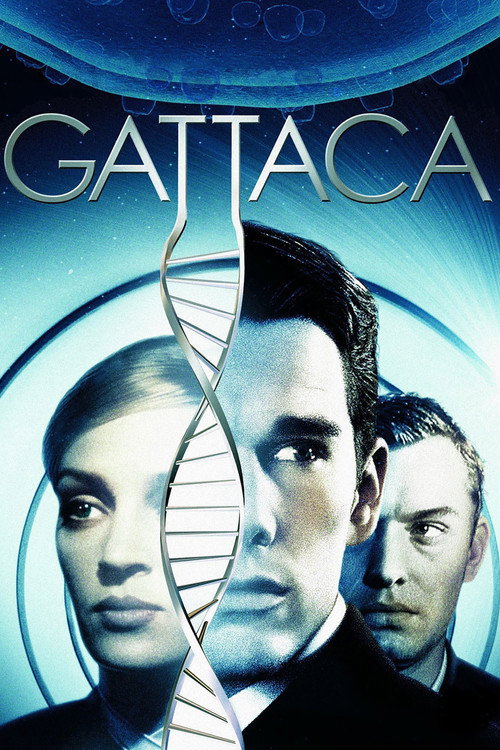
Andrew Niccol's directorial debut paints a sterile, sun-drenched future where genetic engineering has replaced luck with design. Society splits cleanly between the Valid, those engineered for perfection, and the In-Valid, natural births deemed genetically inferior. Vincent Freeman falls into the latter category, carrying a heart condition and a short life expectancy that doctors insist will end his dreams before they begin.
Despite these biological constraints, Vincent refuses to accept a life of menial labor. He orchestrates an elaborate deception by trading places with Jerome Eugene Morrow, a former swimming champion turned paraplegic who has lost his will to live. This swap allows Vincent to infiltrate the Gattaca Aerospace Corporation and pursue his childhood goal of traveling to Titan, proving that human ambition can outpace even the most rigid scientific determinism.
Availability and pricing can change. Confirm on the provider's site before purchasing.
The story opens in a world where your DNA dictates your entire existence. Vincent Freeman is born naturally, making him an invalid in the eyes of society. His parents were disappointed he wasn't perfect, and his older brother Anton, conceived with superior genetics, dominates their childhood swimming races. These early defeats set the stage for Vincent's lifelong struggle against a system that values biology over character. Doctors tell him his heart will fail him at age thirty, but Vincent harbors a secret obsession: flying to Saturn's moon, Titan.
To make this impossible dream real, Vincent turns to the only person who could help him: a janitor named Irene Cassini. She unknowingly connects him to Jerome Eugene Morrow, a man who had everything, perfect genes, athletic prowess, and fame, until a suicide attempt left him paralyzed from the waist down. Jerome lives in despair, wasting away in a squalid apartment, while Vincent sees a path forward. They strike a deal where Vincent provides the funds for Jerome to live comfortably as a wealthy invalid, and in return, Jerome lends him his identity.
Vincent undergoes a grueling transformation to become "Jerome." He scrubs his skin constantly to remove every trace of his own cells, wears contact lenses to alter his eye color, and follows a strict regimen of diet and exercise to match Jerome's physical profile. He presents himself as a valid candidate to Gattaca, passing the rigorous pre-employment screenings that rely entirely on blood, urine, and skin samples. Once hired as a navigator for the Icarus IV mission, he must maintain his disguise day after day, disposing of his own biological waste to avoid detection and faking his vitals during medical checks.
Tensions mount when a senior executive at Gattaca is murdered, leaving behind a single eyelash containing DNA evidence. The police investigation quickly narrows down to an invalid, threatening to expose Vincent's fraud. Detective Hugo, a brilliant investigator who trusts only genetic data, begins closing in on the truth. Meanwhile, Vincent finds himself drawn to Irene, who works nearby and suspects something is wrong with her new friend due to a minor inconsistency in his genetic sample. As the murder mystery deepens and the launch date for the space mission approaches, Vincent navigates a double life where one slip could cost him his freedom or his life.
The narrative builds toward a critical moment where Vincent must balance his training for the Icarus IV voyage with the pressure of evading the detective's scrutiny. He faces the ultimate test of his resolve, knowing that his success depends not on his genetic code but on his ability to think faster than the system designed to catch him. The film explores themes of discrimination and the nature of humanity through a lens of minimalist architecture and a haunting score, all while Vincent fights to reach the stars.
Official Trailer
Critical Consensus
Visually stunning and intellectually stimulating, Gattaca poses profound ethical questions about genetic engineering. Strong performances from Ethan Hawke and Jude Law, paired with a haunting score, create a compelling narrative that transcends genre conventions to explore the resilience of the human spirit.
“Gattaca is a movie that asks us to consider what it means to be human in a world where we can be engineered to perfection. It challenges us to look beyond our genes and see the soul within.”
Roger Ebert
Chicago Sun-Times
“A sleek, stylish, and thought-provoking sci-fi thriller that manages to be both a cautionary tale and a celebration of human potential. Andrew Niccol's direction is assured, and the cast delivers powerful performances.”
Janet Maslin
The New York Times
“Ethan Hawke gives a career-best performance as Vincent, a man who defies the odds to chase his dreams. The film's visual style is breathtaking, and its message is timeless.”
Peter Travers
Rolling Stone
Ethan Hawke
Vincent Freeman / Jerome Eugene Morrow
Uma Thurman
Irene Cassini
Jude Law
Jerome Eugene Morrow
Alan Arkin
Detective Hugo
Loren Dean
Adult Anton Freeman
Ernest Borgnine
Caesar
Director
Andrew Niccol
Writer
Andrew Niccol
Composer
Michael Nyman
Cinematographer
Sławomir Idziak
Producers
Danny DeVito, Michael Shamberg, Stacey Sher
Academy Awards (1998)
Best Original Screenplay: Nominated
Academy Awards (1998)
Best Cinematography: Nominated
Saturn Awards (1998)
Best Science Fiction Film: Won
Saturn Awards (1998)
Best Writing: Won
BAFTA Awards (1998)
Best Production Design: Nominated
Empire Awards (1998)
Best British Newcomer: Won
Join the community
fans discussing