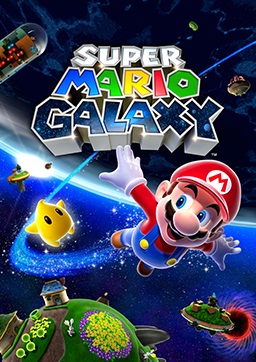
Super Mario Galaxy
"A gravity-defying adventure across the cosmos"
Score
97.0/10
Overview
Super Mario Galaxy is a landmark 3D platform game developed and published by Nintendo for the Wii. Released in November 2007, it is the third 3D entry in the Super Mario series and the first to feature a fully orchestral score, composed by Koji Kondo and Mahito Yokota. The game was directed by Yoshiaki Koizumi and produced under the guidance of Shigeru Miyamoto, with development led by Nintendo EAD Tokyo.
The core gameplay revolves around navigating spherical planets, asteroids, and galaxies where gravity pulls Mario toward the surface of each celestial body. This allows him to walk on walls, ceilings, and around entire small worlds. Players control Mario using the Wii Remote and Nunchuk, with motion controls used for actions such as shaking the remote to perform a spin attack or pointing at the screen to collect Star Bits. The game features 42 galaxies with over 120 Power Stars to collect, each earned by completing platforming challenges, defeating bosses, or solving puzzles. After completing the main story, players can replay the game as Luigi, who has altered physics—higher jumps but slippery traction—providing a more difficult experience.
The story begins with Princess Peach inviting Mario to a star festival at her castle, where Bowser arrives on a flying airship, lifts the castle into space, and kidnaps Peach. Mario is rescued by Rosalina, a mysterious woman who travels the cosmos in a comet-shaped spaceship. To save Peach and restore order to the universe, Mario must journey through galaxies, collect Power Stars, and eventually confront Bowser at the center of the universe. The narrative is delivered through a storybook that reveals Rosalina’s backstory, adding emotional depth uncommon for the series.
Technically, Super Mario Galaxy was built on a proprietary engine designed for the Wii, with a physics system that simulates gravity on curved surfaces. The graphics were praised for their vibrant art direction, smooth framerate, and use of depth-of-field effects, though the game runs in standard definition (480p) due to Wii hardware limitations. The soundtrack, performed by the Mario Galaxy Orchestra, is a fully orchestrated score that dynamically shifts between sweeping orchestral pieces and jazzy, whimsical themes.
Critical reception was universally acclaimed. On Metacritic, the game holds a score of 97 out of 100, making it one of the highest-rated games on the platform. Major outlets awarded perfect or near-perfect scores: IGN (9.7/10), GameSpot (9.5/10), and Famitsu (38/40). Reviewers lauded the gravity mechanics, level design, soundtrack, and emotional storytelling. The game was the highest-rated title on GameRankings at the time of that site’s closure in 2019.
Commercially, Super Mario Galaxy sold 12.80 million copies worldwide, making it the ninth best-selling Wii game. It has been re-released on multiple platforms: it was digitally available on the Wii U eShop, included in the time-limited Super Mario 3D All-Stars collection for Nintendo Switch (released September 18, 2020), and later enhanced and re-released as part of a collection on Nintendo Switch in October 2025, also available separately on the eShop. Additionally, a Chinese localization was released on the Nvidia Shield TV on March 22, 2018.
The game won numerous awards, including multiple Game of the Year honors from outlets such as IGN, GameSpot, and Edge. It became the first Nintendo title to win the BAFTA Award for Best Game at the 2008 British Academy Video Games Awards. It also received accolades for Best Soundtrack, Best Design, and Best Innovation from various industry bodies.
No downloadable content (DLC) or expansion packs were released for the original game. Multiplayer is limited to a two-player co-op mode where a second player uses a second Wii Remote to collect Star Bits, stun enemies, and assist Mario by pointing at the screen. This mode is asymmetrical; the second player cannot move Mario or navigate the environment.
Culturally, Super Mario Galaxy is frequently cited as one of the greatest video games of all time, influencing later 3D platformers with its gravity mechanics and orchestral integration. Its sequel, Super Mario Galaxy 2 (2010), continued the formula and received similar acclaim. The game’s characters and setting inspired elements in The Super Mario Bros. Movie (2023), and a sequel titled The Super Mario Galaxy Movie is scheduled for release in 2026. The game retains a dedicated modding community and is often used as a benchmark for creative level design in the platforming genre.
Gameplay
Super Mario Galaxy redefines platforming with its gravity mechanics. Each planetoid and asteroid has its own gravitational pull, allowing Mario to run on walls, ceilings, and even upside down. The player controls Mario using the Wii Remote and Nunchuk: the Control Stick moves Mario, the A button jumps, and shaking the remote performs a spin attack that can defeat enemies, break objects, or extend jumps. Pointing the remote at the screen collects Star Bits, which can be used to feed Hungry Lumas or stun enemies. The game features 42 galaxies, each containing multiple missions and Power Stars. Some levels introduce power-ups like the Bee Mushroom (enables flight and wall-clinging), Boo Mushroom (turns Mario ghost-like, allowing him to float and pass through obstacles), Spring Mushroom (turns Mario into a spring for high bounces), and Ice Flower (allows Mario to freeze enemies and walk on water). Boss battles include encounters with Bowser, his son Bowser Jr., and other creatures like Megaleg and Kamella. After collecting 60 Power Stars, the final boss is unlocked. Upon completion, the player can replay the game as Luigi, who jumps higher but has slippery traction, making control more challenging.
Story
Princess Peach invites Mario to a star festival at her castle. As Mario arrives, Bowser appears in a giant flying airship, lifts the entire castle into space, and kidnaps Peach. Mario is knocked off the castle and lands on a small planet, where he meets Rosalina, a mysterious woman who lives in a comet-shaped spaceship with her adoptive children, the Lumas. Rosalina agrees to help Mario by using her ship, the Comet Observatory, to travel between galaxies. Mario must collect Power Stars to power the observatory and reach Bowser's reactor at the center of the universe. Along the way, he visits galaxies themed after water, fire, ice, sand, and more. The story is interwoven with a storybook that reveals Rosalina's past: she lost her mother, found a starving Luma, and together they traveled the cosmos searching for her home, eventually becoming the mother of the Lumas. The narrative culminates in a final confrontation with Bowser, after which Peach is rescued. However, Rosalina and the Lumas sacrifice themselves to create a new galaxy, but are later revived. The game ends with Mario and Peach watching the stars from her castle.
Trailers


Awards & Acclaim
BAFTA Video Games Award: Best Game: (2008)
GameSpot Best of 2007: Game of the Year: (2007)
IGN Best of 2007: Game of the Year: (2007)
Edge Awards 2007: Game of the Year: (2007)
Keywords
Game Info
- Developer
- Nintendo Entertainment Analysis & Development
- Publisher
- Nintendo
- Engine
- Proprietary
- Release Date
- 2007-11-01
- Age Rating
- E
- Modes
- Single-player, Co-op
- Platforms
- Wii, Wii U, Nintendo Switch
- Sales
- 12.80 million
- Metacritic Score
- 97
Join the community
fans discussing