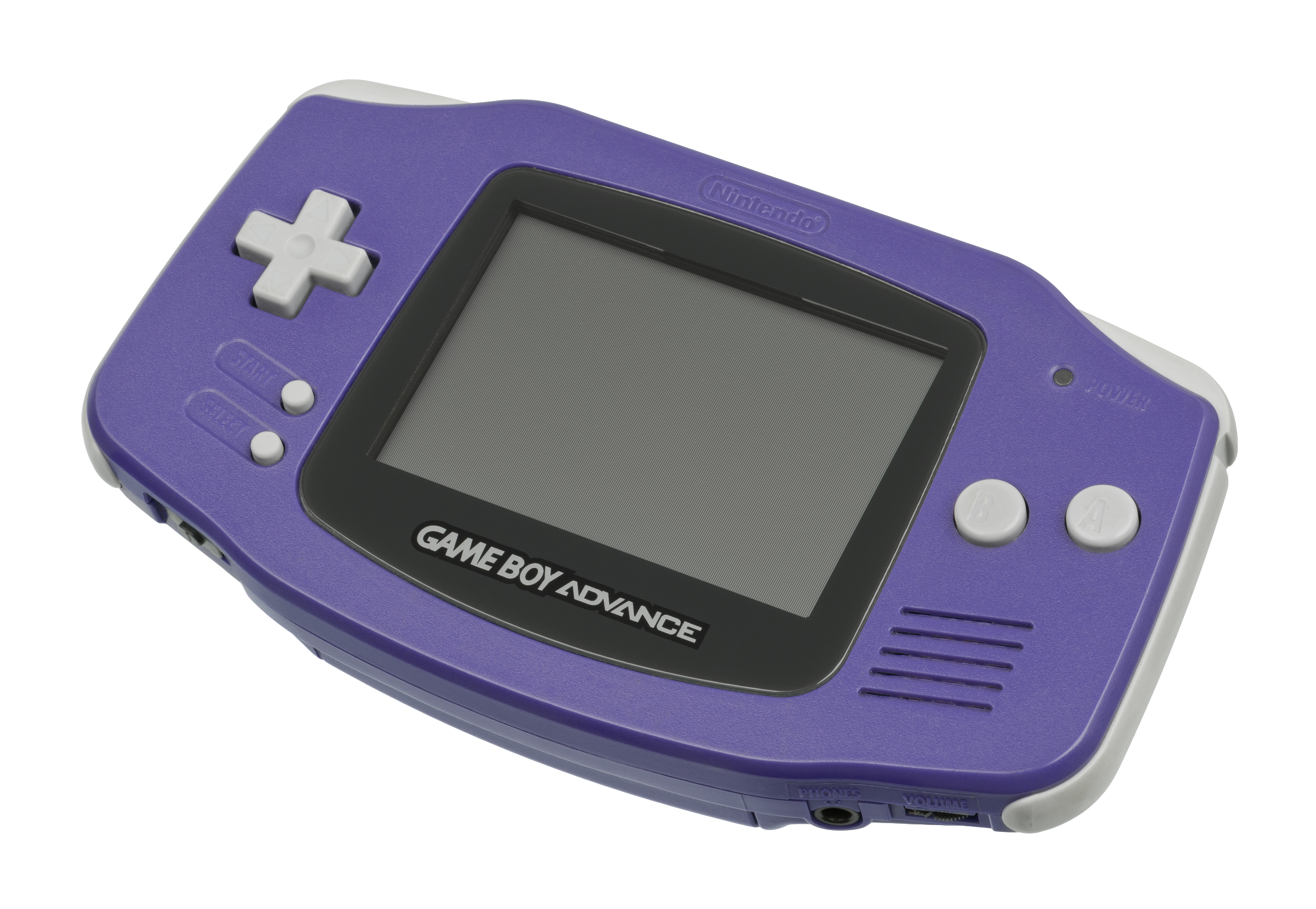
Game Boy Advance
"Nintendo's 32-bit handheld that redefined portable gaming"
Overview
The Game Boy Advance hit store shelves in Japan on March 21, 2001, and worldwide by June of that year. Nintendo's 32-bit handheld packed a custom ARM7 processor running at 16.78 MHz, which was a massive leap over the 8-bit Z80 chip in the Game Boy Color. The screen, a 2.9-inch reflective TFT LCD, pushed 240x160 pixels and could display up to 32,768 colors, making games look sharper and more vibrant than anything the company had offered on a portable before. It also played every Game Boy and Game Boy Color cartridge, so your old library didn't become obsolete overnight.
Design-wise, the original GBA was a horizontal slab with a D-pad, A and B buttons, and two shoulder buttons. It ran on four AA batteries, which lasted around 15 hours, and the lack of a backlight was a common complaint for anyone trying to play in the dark. That changed in February 2003 with the Game Boy Advance SP, a clamshell model that introduced a frontlit screen and a rechargeable lithium-ion battery. A 2005 revision swapped the frontlight for a proper backlight, and that same year Nintendo released the Game Boy Micro, a tiny device with interchangeable faceplates that dropped compatibility with older Game Boy games entirely.
The GBA's library became a haven for 2D games at a time when home consoles were chasing 3D. Titles like Metroid Fusion, The Legend of Zelda: The Minish Cap, and Golden Sun showed off the hardware's sprite capabilities and layered backgrounds. It also served as a portable home for enhanced ports of SNES classics, including Final Fantasy VI Advance and Super Mario World. By the time production ended in 2010, the GBA family had sold 81.51 million units worldwide, making it one of the best-selling consoles of its generation.
Gameplay
The Game Boy Advance's hardware leaned on a 32-bit ARM7 processor that allowed for smooth sprite scaling, rotation, and multi-layer parallax scrolling. Developers took advantage of this in a variety of ways. Platformers like Super Mario Advance relied on tight controls and precise jumps, while RPGs such as Golden Sun used the extra power for detailed battle animations and environmental effects. The system also supported up to 32,768 colors on screen, which made games look closer to SNES quality than anything seen on a handheld before.
Multiplayer was a big part of the experience. The original GBA and SP had a link cable port that let two players connect physically. A wireless adapter, released later, allowed up to eight players to connect for compatible games. Pokémon Emerald, Mario Kart: Super Circuit, and Advance Wars all made good use of these features. The control scheme stayed simple: a D-pad, A and B buttons, plus L and R shoulder buttons, which worked well for both action and turn-based games.
Story
Many of the GBA's most memorable games told rich stories. In Metroid Fusion, Samus Aran wakes up on a space station after a mission goes wrong, only to find that a parasite called X has infected the facility. She has to fight off a clone of herself, the SA-X, while uncovering what happened to the station's crew. The game's atmosphere is tense, and the plot pushes you forward through a series of objectives.
The Legend of Zelda: The Minish Cap takes a different approach. Link gets shrunk down to the size of the tiny Minish people and explores a hidden world beneath Hyrule. The villain Vaati has shattered the Light Force, and Link must collect its pieces to save Princess Zelda, who has been turned to stone. The story blends classic Zelda puzzles with the novelty of seeing the world from a miniature perspective.
For RPG fans, Golden Sun follows Isaac and his friends as they try to stop a group of villains from releasing the power of the Djinn, elemental spirits that can be used in battle. The plot spans two games, with The Lost Age continuing right where the first left off. And in Pokémon Emerald, you explore the Hoenn region, collect Pokémon, and take on the Battle Frontier, a post-game challenge that tests your team-building skills.
Awards & Acclaim
Game Critics Awards: Best Handheld Game: (2001)
Interactive Achievement Awards: Console Hardware of the Year: (2002)
Keywords
Sources
Game Info
- Developer
- Nintendo
- Publisher
- Nintendo
- Release Date
- 2001-03-21
- Age Rating
- E (Everyone) to M (Mature), depending on game
- Modes
- Single-player, Multiplayer
- Platforms
- Game Boy Advance
- CPU
- ARM7TDMI 16.78 MHz
- Screen Resolution
- 240 x 160 pixels
- Colors on Screen
- 32,768
- Battery Life
- Approximately 15 hours (AA batteries)
- Units Sold
- 81.51 million
Join the community
fans discussing