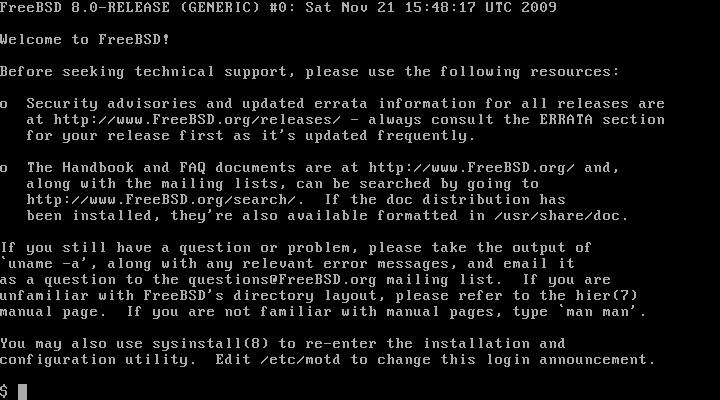
FreeBSD
"The open-source engine powering PlayStation consoles and the internet's backbone."
Overview
Released on November 1, 1993, FreeBSD emerged as a complete Unix-like operating system descended from the Berkeley Software Distribution. Unlike Linux, which provides a kernel and relies on external partners for userland utilities, FreeBSD delivers a fully integrated system including its own drivers, tools, and documentation. The project has maintained a consistent presence since its inception, becoming the most widely used BSD-derived operating system in existence.
While it lacks traditional gameplay or narrative arcs, FreeBSD holds a unique place in gaming history as the foundation for Sony's entire console family. The system software running inside the PlayStation 3, PlayStation 4, PlayStation 5, and PlayStation Vita all trace their roots back to this codebase. Its stability and networking performance made it the ideal choice for building the infrastructure that hosts online multiplayer servers and game distribution platforms worldwide.
Recent developments in 2026 highlight the project's ongoing evolution toward better desktop usability. By July of that year, the team completed the removal of the last remaining GPL-licensed code, ensuring the entire base system remains under a permissive BSD license. Concurrent efforts improved support for NVIDIA graphics cards and KDE desktop environments, making it easier for hobbyists to run modern applications and emulation layers like Wine 11.14 on their home machines.
Gameplay
There is no interactive gameplay loop, character progression, or level design within FreeBSD. Instead of controlling an avatar through a virtual world, users interact with a command-line interface or a graphical environment to manage hardware resources, compile software, and maintain network services. The experience focuses on system administration tasks rather than entertainment mechanics.
For gamers, the primary interaction involves using the OS as a development platform. Developers leverage its toolchain to compile game engines and test builds without licensing restrictions. The system also serves as the hidden layer behind the scenes of major gaming consoles, handling input processing, memory management, and audio output for titles played on PlayStation hardware.
Story
The origin story begins in the early 1990s when developers needed a free version of Unix that could run on affordable Intel 386 hardware. After working with 386BSD, they stripped out proprietary AT&T code to create a clean, usable operating system. This release in 1993 marked the start of a decades-long effort to build a robust alternative to commercial Unix systems and later Linux distributions.
The narrative shifted significantly when Sony chose this specific codebase to power the PlayStation 3. This decision meant that millions of hours of gameplay on subsequent generations of Sony consoles relied on the same underlying technology created by volunteer engineers. Over time, the project expanded its scope to include security teams and dedicated foundation support while maintaining its community-driven development model.
Keywords
Sources
Game Info
- Developer
- FreeBSD Project
- Publisher
- FreeBSD Foundation
- Engine
- Custom Kernel
- Release Date
- November 1, 1993
- Age Rating
- E (Everyone)
- Modes
- Single User, Multi-user, Server, Embedded
- Platforms
- x86, x86-64, SPARC, DEC Alpha, PowerPC, ARM architecture, MIPS architecture, RISC-V
- Base Architecture
- Berkeley Software Distribution (BSD)
- Console Usage
- PS3, PS4, PS5, PS Vita
- License Change
- GPL code removed in July 2026
- Supported Architectures
- x86, x86-64, SPARC, ARM, RISC-V, MIPS, PowerPC, DEC Alpha
Join the community
fans discussing