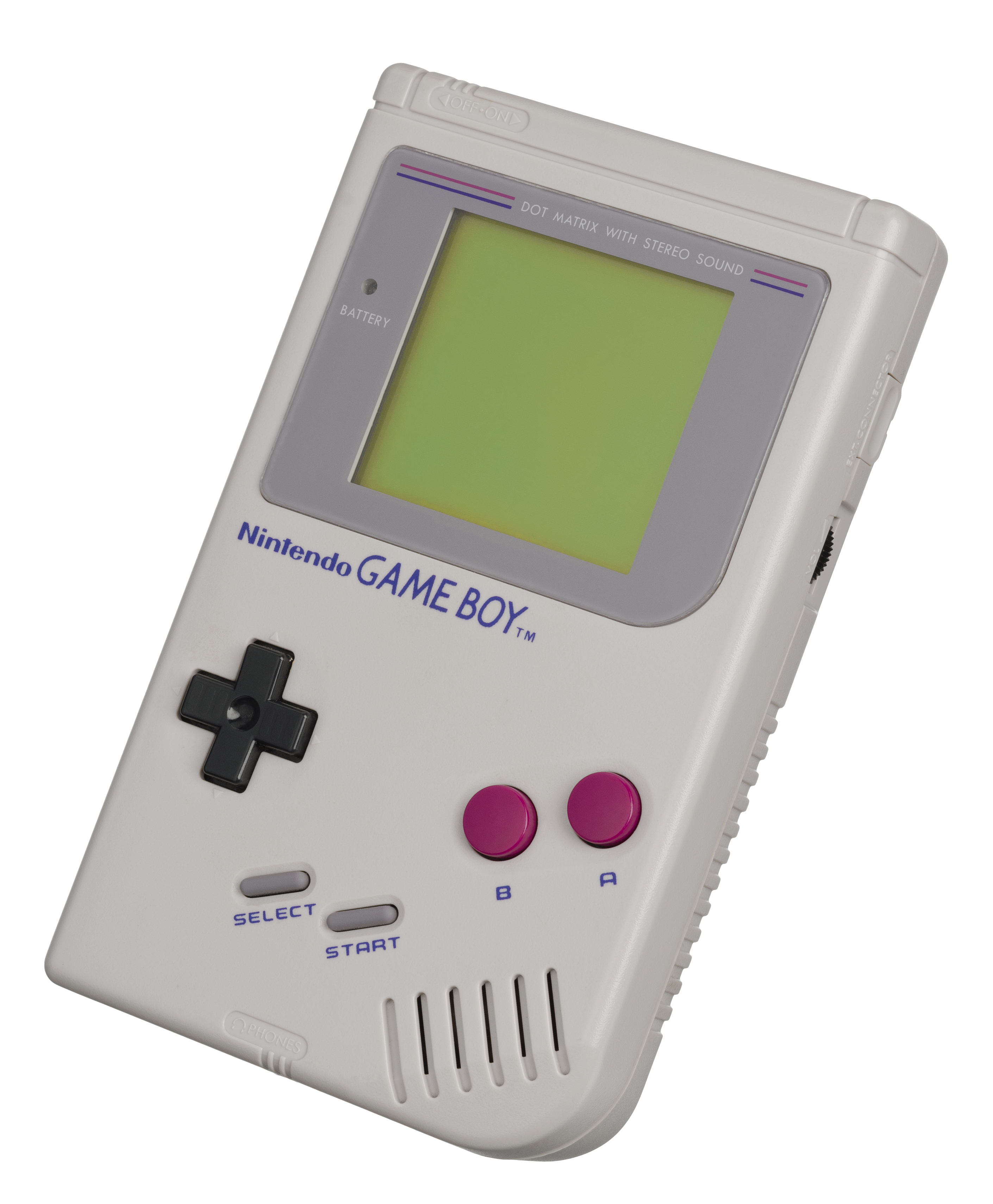
Game Boy
"The handheld that changed gaming forever"
Overview
Nintendo's Game Boy arrived in 1989 as a pocket-sized console that would redefine portable play. Developed by Nintendo Research & Development 1 under Gunpei Yokoi and Satoru Okada, it swapped the single-game Game & Watch devices for a dot-matrix screen and swappable cartridges. Yokoi's philosophy of using mature, low-cost tech meant the system featured a modest 8-bit processor and a monochrome display, but it prioritized affordability, battery life, and durability. That trade-off proved wise: while rivals like Sega's Game Gear and Atari's Lynx boasted color screens and faster hardware, they also drained batteries and carried heftier price tags.
The Game Boy launched in Japan on April 21, 1989, and in North America that July, bundled with Tetris in Western markets. That pairing was a masterstroke, pulling in casual players who had never touched a video game before. The system's simple D-pad and the Game Link Cable, which enabled multiplayer and data transfer, added social appeal. Critics initially balked at the screen's lack of color, but the low cost and an ever-growing library, including the Pokémon RPGs, kept it dominant well into the 1990s. Nintendo released the smaller Game Boy Pocket in 1996 and the backlit, Japan-only Game Boy Light in 1998, then followed with the Game Boy Color, which played the old cartridges while adding a palette of hues.
By the time the Game Boy line was discontinued in 2003, it had sold an estimated 118.69 million units, making it the best-selling console of its era and the fourth-best-selling of all time as of 2025. Its influence is hard to overstate: it turned handheld gaming into a mass-market phenomenon and introduced a generation to the joy of portable play.
Gameplay
At the heart of the Game Boy is a simple, tactile design: a D-pad on the left, A and B buttons on the right, and Start and Select in the middle. The green-tinted dot-matrix screen sits above, and the whole unit fits comfortably in two hands. Four AA batteries power up to 12 hours of play, a remarkable endurance that made it a travel companion for millions. The Game Link Cable port on the side opened up a world of multiplayer, letting two players race, battle, or trade in supported games. That cable became essential for the Pokémon series, where trading creatures between cartridges was the only way to complete your Pokédex. The system's library spanned genres, from platformers like Super Mario Land to puzzle classics like Tetris, and its simple controls made games approachable for all ages.
Story
The Game Boy's story begins in the mid-1980s, when Nintendo had already conquered living rooms with the NES. Gunpei Yokoi, the engineer behind the Game & Watch line, saw an opportunity to bring that portable spirit to a more powerful, cartridge-based system. He and Satoru Okada led a team to build a device that was cheap, durable, and energy-efficient, using what Yokoi called 'lateral thinking with withered technology.' The result was a handheld that deliberately skipped color to save battery and cost, a gamble that paid off.
When the Game Boy hit shelves, its launch lineup included Tetris in Western markets, a decision that turned the device into a cultural touchstone. The puzzle game's universal appeal drew in non-gamers, and the handheld became a must-have. As the 1990s progressed, the Game Boy's library grew with hits like The Legend of Zelda: Link's Awakening and the first Pokémon games, which became a global phenomenon. The system's longevity was unprecedented, with new hardware revisions and a steady stream of games keeping it relevant for over a decade.
The Game Boy's legacy is also written in the modding community. Decades after its discontinuation, enthusiasts still tinker with the hardware. In 2026, a modder crammed Steam Deck internals into a Game Boy shell, creating a device called the 'SteamBoy,' complete with a custom 3D-printed cooling system and plans for a 1200x1080 90Hz AMOLED display. Another modder transformed a Fisher-Price toy into a functional Game Boy Color. The retro market has seen staggering prices too: graded copies of Pokémon Red, Blue, and Yellow sold for $2 million in 2026, with Red and Yellow achieving flawless PSA 10 grades. Fan projects like a Donkey Kong Land remake with SNES graphics keep the platform alive in new ways.
Keywords
Sources
Game Info
- Developer
- Nintendo Research & Development 1
- Publisher
- Nintendo
- Release Date
- April 21, 1989
- Modes
- Single-player, Multiplayer
- Platforms
- Game Boy
- Model Number
- DMG-001
- Battery Life
- Up to 12 hours on 4 AA batteries
- Units Sold
- 118.69 million (including Game Boy Color)
- Discontinued
- 2003
Join the community
fans discussing