“Miss Hepburn is a delight as the girl who is yanked out of a bookshop and into the world of high fashion, and Mr. Astaire dances through his role with his usual grace and charm.”
Bosley Crowther
The New York Times
 United States
"Paris, fashion, and a love that's simply divine."
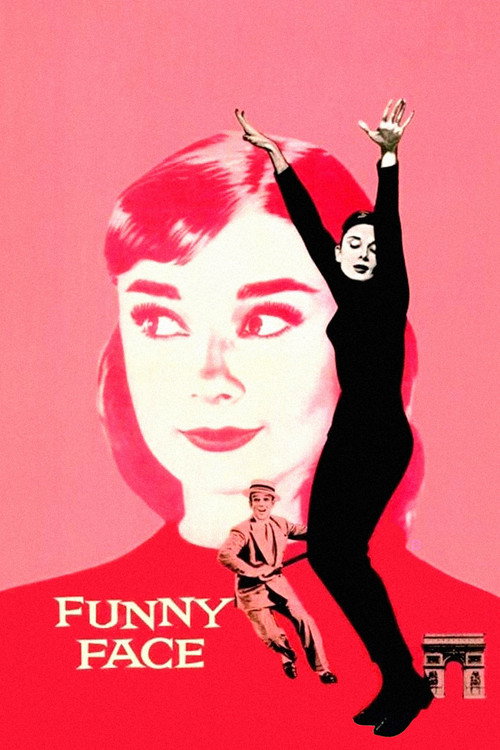
Funny Face, released in 1957, is a Technicolor musical directed by Stanley Donen that pairs Audrey Hepburn with Fred Astaire in a story about a bookish clerk transformed into a fashion model. Hepburn plays Jo Stockton, a serious-minded Greenwich Village bookstore employee with a passion for philosophy, who is discovered by fashion photographer Dick Avery (Astaire) and whisked off to Paris. The film also features Kay Thompson as the imperious magazine editor Maggie Prescott, whose sharp wit and energy drive much of the plot.
Produced by Paramount Pictures with music by George Gershwin and lyrics by Ira Gershwin, the film showcases songs like "S'Wonderful" and "Funny Face" that have become standards. With a runtime of 103 minutes, the movie blends romance, dance, and satire, poking fun at the fashion industry while celebrating the charm of its leads. The film received positive reviews and holds a rating of 6.981 out of 10 from over 700 votes on IMDb, reflecting its enduring appeal as a classic musical.
Though not a box office blockbuster, it has remained a favorite for its stylish numbers and the undeniable chemistry between Hepburn and Astaire, who were both at the height of their careers. The film's influence on fashion cinema is profound, with its satirical take on the industry and its celebration of Parisian glamour referenced and parodied for decades.
Stream
Availability and pricing can change. Confirm on the provider's site before purchasing.
Funny Face opens in the high-pressure world of New York fashion publishing. Maggie Prescott, the imperious and energetic editor of Quality magazine, launches a "Think Pink" campaign, a satirical send-up of the industry's obsession with trends. The campaign culminates in a spectacular all-pink production number, during which the magazine's photographer, Dick Avery, is tasked with finding a fresh face to model the new look.
When the planned shoot at a Greenwich Village bookstore falls through, Dick discovers Jo Stockton, a serious-minded, bespectacled clerk and aspiring philosophy student who works behind the counter. Jo is an intellectual, deeply immersed in the works of the fictional French philosopher Professor Emile Flostre, and she has no interest in the frivolous world of fashion. Dick is immediately captivated by Jo's unconventional, natural beauty and her distinctive "funny face." He photographs her on the spot, and the images impress Maggie so much that she decides Jo must become the new face of Quality.
Jo initially resists, but Maggie and Dick dangle the ultimate carrot: a trip to Paris, where Jo can attend lectures by her idol, Professor Flostre. Jo reluctantly agrees, seeing it as her ticket to intellectual fulfillment. Once in Paris, the central conflict emerges. Jo is thrust into a whirlwind of couture fittings, photo shoots, and high-society events, all orchestrated by Dick and Maggie. She is a fish out of water, uncomfortable with the attention and the superficiality of the modeling world.
Dick, meanwhile, is a confirmed bachelor and a man of the world, and he finds himself increasingly charmed by Jo's earnestness and intelligence. Their relationship begins as a professional collaboration, with Dick treating Jo as a subject and muse, but a genuine affection begins to develop between them. The film's musical numbers are woven into the narrative, including the title song "Funny Face," "S'Wonderful," and the iconic "Think Pink" sequence.
The Paris setting allows for stunning location photography, including scenes at the Eiffel Tower and various Parisian landmarks, as Donen and cinematographer Ray June capture the city in vibrant Technicolor. The story builds toward a fashion show that serves as the culmination of Jo's modeling career, and the romantic tension between Jo and Dick reaches a critical point, complicated by Jo's idealized admiration for Professor Flostre, who represents the intellectual life she craves. The film's central question becomes whether Jo can reconcile her intellectual ambitions with the unexpected feelings she has developed for the man who represents everything she initially dismissed.
Movies! TV Network Trailer
Trailer
Critical Consensus
Funny Face is a timeless and elegant musical feast, thriving on the agile and vibrant performances of legendary screen icons Audrey Hepburn and Fred Astaire. The film's satirical take on the fashion industry, combined with its Gershwin score and Parisian glamour, makes it a stylish and enduring classic, even if its plot is feather-light.
“Miss Hepburn is a delight as the girl who is yanked out of a bookshop and into the world of high fashion, and Mr. Astaire dances through his role with his usual grace and charm.”
Bosley Crowther
The New York Times
“Audrey Hepburn and Fred Astaire make a charming team in this musical, and the Gershwin songs are given the full treatment in a production that sparkles with color and style.”
Variety Staff
Variety
“Stanley Donen's direction is brisk and stylish, and the Technicolor photography of Paris is breathtaking. A thoroughly entertaining musical.”
The Hollywood Reporter Staff
The Hollywood Reporter
“Fashion film 'Funny Face' walked so 'The Devil Wears Prada' could run.”
San Francisco Chronicle
San Francisco Chronicle
Director
Stanley Donen
Writers
Leonard Gershe, Ira Gershwin
Composer
George Gershwin
Cinematographer
Ray June
Producer
Roger Edens
Golden Globe Award for Best Motion Picture – Musical or Comedy (1958)
Best Motion Picture – Musical or Comedy: Nominated
Join the community
fans discussing