“Full Metal Jacket is a film of great technical virtuosity and enormous emotional power. It is also the most uncompromisingly anti-war film ever made by a major American director.”
Vincent Canby
The New York Times
 United States
"The Vietnam War stripped them of everything but their rifles."
Stanley Kubrick's Full Metal Jacket takes a hard look at the Vietnam War through two distinct acts. The first half follows a group of Marine recruits at Parris Island, where the sadistic Gunnery Sergeant Hartman (R. Lee Ermey) subjects them to brutal psychological and physical training. The second half drops the survivors into the chaotic urban warfare of Hue City during the Tet Offensive. Matthew Modine plays Private Joker, a sharp-witted journalist who serves as the film's moral compass, while Vincent D'Onofrio delivers a haunting performance as the overweight, slow-witted Private Pyle. Adam Baldwin plays the gung-ho Animal Mother. Shot on a $30 million budget, the film earned over $46 million at the box office. Its stark, unsentimental tone divided critics but has since been recognized as one of the most powerful anti-war films ever made. The movie is not part of a franchise, but it stands alone as a brutal meditation on the dehumanization of soldiers.
Availability and pricing can change. Confirm on the provider's site before purchasing.
Young men arrive at Marine Corps boot camp on Parris Island, where their heads are shaved and their clothes stripped away. Gunnery Sergeant Hartman immediately establishes his authority with a barrage of insults and psychological abuse. Among the new recruits are Private J.T. "Joker" Davis, a quick-witted young man who earns his nickname by imitating John Wayne, and the overweight, slow-witted Leonard Lawrence, whom Hartman cruelly calls "Gomer Pyle." Hartman singles out Pyle for especially harsh treatment, believing his constant grin is defiance. When Pyle fails to improve, Hartman makes Joker his squad leader, ordering him to whip Pyle into shape. Joker reluctantly helps Pyle learn to make his bed, lace his boots, and assemble his rifle. But when Hartman discovers a jelly doughnut in Pyle's footlocker, he institutes collective punishment: the entire platoon suffers for Pyle's mistakes. The breaking point comes when the recruits stage a "blanket party", a nighttime hazing where they beat Pyle in his bunk, and Joker participates despite his reservations.
After the beating, Pyle transforms. He becomes a model recruit, excelling particularly at marksmanship. But Joker grows increasingly disturbed, noticing Pyle talking to his rifle as if it were a living thing. On the night before graduation, Joker finds Pyle in the latrine, loading live ammunition and reciting the Rifleman's Creed. Hartman confronts them, and in a shocking act of violence, Pyle kills Hartman before turning the rifle on himself, leaving Joker traumatized.
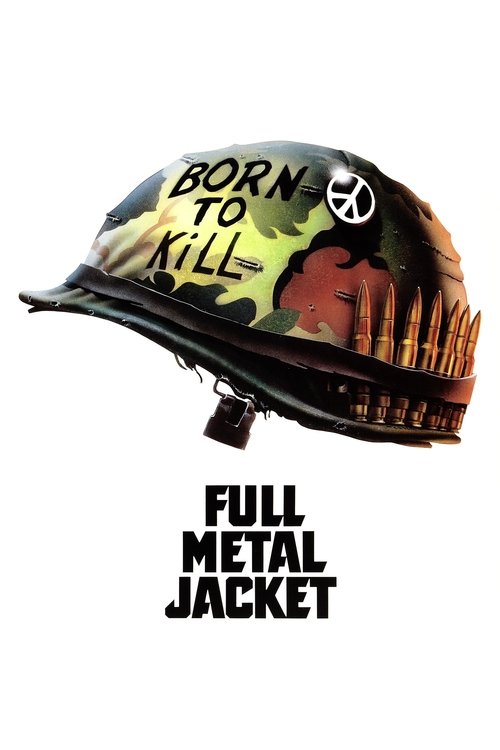
The film then jumps to Da Nang, Vietnam, where Joker has been assigned as a combat correspondent for Stars and Stripes alongside the young, eager photographer Rafterman. Joker's editor, Lieutenant Lockhart, demands upbeat, pro-war propaganda pieces, but Joker wants to experience real combat. He wears a peace symbol on his helmet alongside the words "Born to Kill", a contradiction that embodies the film's central tension between humanity and the military's demand for violence. Other soldiers mock Joker for lacking the "thousand-yard stare" of a true combat veteran.
During the Tet Offensive, Lockhart punishes Joker by sending him to the front lines at Phu Bai, near the bloody battle of Hue City. Rafterman insists on coming along. Joker reunites with Cowboy, now a squad leader in the Lusthog Squad, led by the gung-ho Animal Mother. The squad includes characters like Eightball, Doc Jay, and others. As they move through the devastated urban landscape of Hue, they encounter the brutal realities of war: a sniper picks off soldiers one by one, forcing the survivors into a desperate cat-and-mouse game through bombed-out buildings. The squad's cohesion frays under the pressure, with Animal Mother's reckless aggression clashing against Joker's more cautious, reflective approach. The film builds toward a tense confrontation with the unseen sniper, forcing Joker to confront the ultimate cost of his training.
4K Trailer
Trailer
Official Trailer
Critical Consensus
Full Metal Jacket is a powerful, unflinching anti-war film that captures the dehumanizing effects of military training and combat. While some critics found the two-part structure uneven, the performances, especially R. Lee Ermey's iconic drill instructor, and Kubrick's meticulous direction have cemented its status as a Vietnam War classic.
“Full Metal Jacket is a film of great technical virtuosity and enormous emotional power. It is also the most uncompromisingly anti-war film ever made by a major American director.”
Vincent Canby
The New York Times
“This is not a film about war, but about the process of turning men into killers. The first half is the most brilliant depiction of boot camp ever filmed; the second half is a descent into madness.”
Roger Ebert
Chicago Sun-Times
“Kubrick has made a film that is cold, precise, and brilliant. It is also emotionally distant, which is both its strength and its limitation. The boot camp sequences are unforgettable.”
Pauline Kael
The New Yorker
“Full Metal Jacket is a stunning, often brilliant film that leaves you feeling battered and numb. It is Kubrick's most visceral work, and his most cynical.”
David Ansen
Newsweek
“The film's first half is a masterpiece of sustained tension and black comedy. The second half, while powerful, never quite matches the intensity of what came before.”
Sheila Benson
Los Angeles Times
Matthew Modine
Pvt. Joker
Adam Baldwin
Animal Mother
Vincent D'Onofrio
Pvt. Pyle
R. Lee Ermey
Gunnery Sergeant Hartman
Dorian Harewood
Eightball
Kevyn Major Howard
Rafterman
Arliss Howard
Pvt. Cowboy Evans
Ed O'Ross
Lt. Touchdown
John Terry
Lt. Lockhart
Kieron Jecchinis
Crazy Earl
Kirk Taylor
Payback
Tim Colceri
Doorgunner
Director
Stanley Kubrick
Writers
Stanley Kubrick, Michael Herr, Gustav Hasford
Composer
Vivian Kubrick
Cinematographer
Douglas Milsome
Producers
Stanley Kubrick, Philip Hobbs
Academy Award for Best Adapted Screenplay (1988)
Best Adapted Screenplay: Nominated
BAFTA Award for Best Sound (1988)
Best Sound: Nominated
BAFTA Award for Best Special Visual Effects (1988)
Best Special Visual Effects: Nominated
Golden Globe for Best Supporting Actor (1988)
Best Supporting Actor – Motion Picture: Nominated
Golden Globe for Best Original Score (1988)
Best Original Score: Nominated
Boston Society of Film Critics Award for Best Supporting Actor (1988)
Best Supporting Actor: Won
Join the community
fans discussing