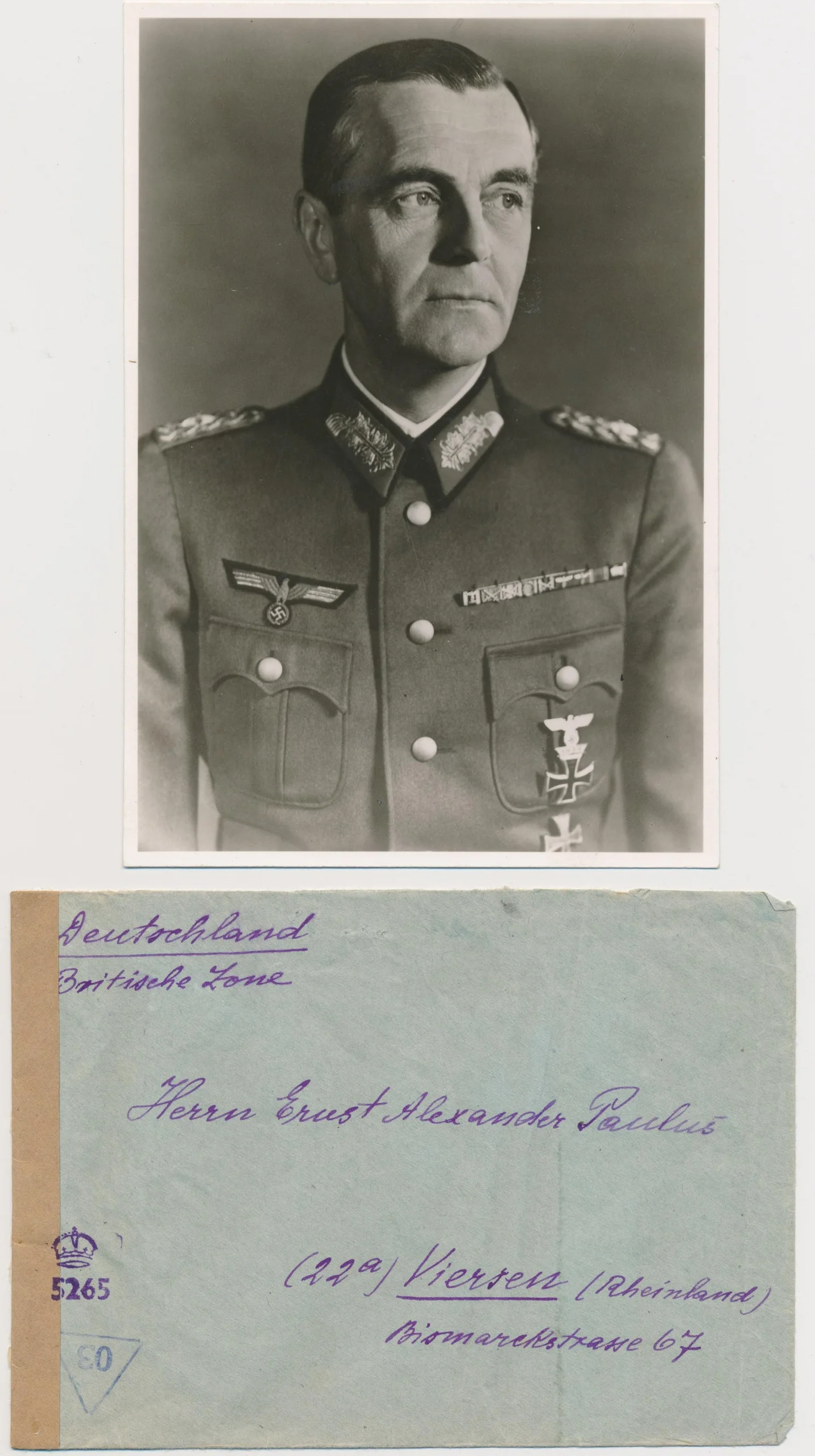
Friedrich Paulus
 Germany
military officer•general field marshal
Also known as: Friedrich Wilhelm Ernst Paulus
Birthday
September 23, 1890
Birth Sign
Sagittarius
Birthplace
Guxhagen, Grand Duchy of Hesse, Germany
Age
Died at 66
About
Friedrich Wilhelm Ernst Paulus stands as a singular figure in military history, distinguished by his unprecedented status as the first and only German Generalfeldmarschall to surrender alive. Born on September 23, 1890, in Guxhagen, he rose through the ranks of the Prussian and later Wehrmacht armies to become a key architect of Germany's early World War II campaigns. His career trajectory was defined not by frontline heroics but by exceptional staff efficiency and intellectual planning capabilities. He served as Deputy Chief of the German Army General Staff from 1940 to 1942, where he played a pivotal role in designing Operation Barbarossa and refining logistical strategies for the invasions of Poland and France.
Paulus is historically significant for his command of the 6th Army during the Battle of Stalingrad, a campaign that ended in catastrophic encirclement and total defeat. Despite receiving a promotion to Field Marshal on January 30, 1943—a rank chosen specifically because no German Field Marshal had ever been captured alive—Paulus refused the implicit order to commit suicide. Instead, he surrendered the following day, an event that shattered the myth of Nazi invincibility and marked a decisive turning point in World War II. His subsequent cooperation with the Soviet Union to form the National Committee for a Free Germany further complicated his legacy, transforming him from a loyal officer into a vocal critic of the Nazi regime. Today, he remains a subject of intense historical scrutiny regarding the morality of military obedience and the complexities of leadership under extreme pressure.
Early Life & Background
Friedrich Wilhelm Ernst Paulus entered the world on September 23, 1890, in the small town of Guxhagen, located near Kassel in the Grand Duchy of Hesse. He was born into a respectable middle-class family; his father, Friedrich Paulus Sr., worked as a schoolteacher before advancing to a position as a district official, while his mother, Elisabeth von Schmalz, provided a stable domestic foundation. From a young age, Paulus exhibited a keen aptitude for academics and a natural affinity for military discipline, traits that would eventually define his entire professional life. He attended local schools in Guxhagen, where he excelled in mathematics and geography, subjects that would later prove crucial for his strategic planning abilities.
In 1909, at the age of eighteen, Paulus enrolled in the Kadettenhaus (Cadet School) in Hannover, followed by advanced studies at the prestigious Kadettenhaus in Berlin-Lichterfelde. These institutions offered rigorous training focused on military tactics, engineering, and the sciences, preparing students for high-level service in the German Empire. In 1910, at just nineteen years old, he officially entered the Prussian Army as a Second Lieutenant assigned to the 111th Infantry Regiment. Before the outbreak of World War I, he continued his professional education and served in various staff roles, distinguishing himself as a planner rather than a frontline combatant. This early period laid the intellectual groundwork for his rise through the ranks based on analytical skill and operational efficiency rather than battlefield bravery.
Career Growth
Paulus's career was characterized by steady advancement driven by his intellectual capabilities and staff efficiency rather than traditional battlefield heroics. During World War I, he served on both the Western Front in France and in the Balkans. Although he was wounded in action, he recovered quickly and earned the Iron Cross, First Class and Second Class. By the end of the war, he had risen to the rank of Major and served as a General Staff officer, gaining a reputation for his sharp analytical mind. Following the war, he remained in the reduced Reichswehr, holding positions such as company commander and battalion adjutant. A major breakthrough occurred in 1935 when he was promoted to Colonel and appointed chief of staff for the newly formed Panzer Group 2 under General Heinz Guderian. This role allowed him to develop deep expertise in modern armored warfare doctrines.
At the outbreak of World War II, Paulus was promoted to Major General. As Deputy Chief of the German Army General Staff from 1940 to 1942, he was instrumental in planning Operation Barbarossa and refining the logistical frameworks for the initial campaigns in Poland and France. In January 1942, he was given command of the 6th Army, leading the successful advance into Ukraine and the subsequent drive toward Stalingrad. His leadership style was marked by meticulous planning, though critics argued he lacked flexibility for the fluid conditions of the Eastern Front. The defining moment of his career occurred in late 1942 when the 6th Army became encircled. Despite Hitler's explicit order forbidding surrender and demanding a fight to the death, Paulus surrendered on January 31, 1943. After his capture, he joined the Soviet-sponsored National Committee for a Free Germany, broadcasting anti-Nazi messages to German troops. In 1953, following his release from Soviet custody, he moved to Dresden and worked as a civilian consultant and researcher for the National People's Army until his death in 1957.
Career Timeline
Public Image & Style
Paulus is portrayed in historical discourse as a complex and controversial figure: a loyal soldier who became a traitor to the Nazi regime, a brilliant planner who failed to adapt to the realities of the Eastern Front, and a man who chose life over the expected sacrifice. His image is one of tragedy and controversy, lacking the adoration of a celebrity but commanding respect and scrutiny from historians. He is often depicted as a man caught between duty and conscience, whose surrender marked a turning point in World War II. Unlike many contemporaries who remained silent or tried to distance themselves after the war, Paulus actively collaborated with the Soviets, creating a narrative of defiance against Hitler that complicates his legacy. His story serves as a case study in the morality of military obedience and the psychological toll of command.
Fame & Fandom
Friedrich Paulus currently holds no placement in the iFANN Global Top 1,000 rankings or any published scope list as of August 2026. The iFANN Global Fame Engine has evaluated his standing, yet he remains outside the ranked tier, a neutral position reflecting his status as a historical figure rather than a contemporary celebrity. While his name carries weight in military history and academic discourse, it does not generate the sustained public consumption signals required for a numerical ranking in modern fame metrics. There is no formal or unofficial fandom name associated with Friedrich Paulus. As a German Generalfeldmarschall who commanded the Sixth Army at Stalingrad, his legacy is defined by historical documentation and military mythology rather than popular appeal or organized fan activity. No fan campaigns, streaming pushes, birthday billboards, or charity drives exist dedicated to him, nor are there fan rituals, inside jokes, or interactive relationships between his memory and a fanbase. He died in 1957, long before the advent of social media or concert tours, meaning no fan-funded projects or viral incidents ever emerged from his life. The narrative surrounding him remains a matter of verified historical record regarding his surrender, a unique anomaly where he became the first and only German Field Marshal to surrender alive after refusing Hitler's order to commit suicide. This event caused shock within the Nazi leadership and later served as a focal point for post-war propaganda when Paulus joined the National Committee for a Free Germany, but these developments generated controversy rather than adoration. His story is one of military collapse and political captivity, lacking the crowd-disrupting performances or extraordinary public reactions typical of celebrity superstardom.
Interesting Facts and Legends
Hitler promoted Paulus to Generalfeldmarschall on January 30, 1943, the day before his surrender, knowing that no German Field Marshal had ever been captured alive. The promotion was a calculated move to shame him into committing suicide rather than facing the disgrace of surrender. Paulus's refusal to comply was a direct defiance of Hitler's authority and expectations. Unlike many other German officers who remained silent or tried to distance themselves after the war, Paulus actively collaborated with the Soviets to create a "Free Germany." He broadcast messages to German troops urging them to surrender and wrote memoirs that criticized the Nazi regime, actions that caused significant shock within the German military hierarchy. His wife, Elena, was Romanian, making her a foreign national in Nazi Germany. Her background may have influenced Paulus's eventual disillusionment with the regime, though this remains speculative. Paulus died in Dresden in 1957, exactly fourteen years after his surrender, leaving behind a legacy defined by military history and political captivity rather than popular culture. He received numerous awards during his career, including the Knight's Cross of the Iron Cross with Oak Leaves, awarded on January 17, 1943, shortly before his surrender. The "Stalingrad" myth effectively destroyed the perception of German invincibility, and Paulus's surrender is frequently cited in discussions regarding the ethics of surrender and leadership under pressure.
Notable Quotes
“I am not a martyr. I am a soldier who has done his duty.”
“The war is lost. The only thing left is to save what can be saved.”
“I did not want to die like a dog.”
Family & Personal Life
Friedrich Paulus married Elena Rosetti-Solescu, a Romanian woman, in 1912. She was the daughter of a Romanian diplomat, and their marriage lasted throughout his life, serving as a constant source of support. They had two children: a son named Friedrich Paulus Jr. and a daughter named Eva. Elena accompanied him through his military career and stood by him during his time as a prisoner of war. After his release from Soviet custody in 1953, she moved with him to East Germany, where they lived quietly in Dresden during his final years. There are no records of other romantic relationships or divorces; Elena remained his sole spouse until his death in 1957. The family maintained a low profile amidst the post-war political landscape, focusing on their life away from the public eye.
Notable Connections
Relationships & Dating History
Friedrich Paulus married Elena Rosetti-Solescu, a Romanian woman, in 1912. She was the daughter of a Romanian diplomat, and their marriage lasted throughout his life. They met while Paulus was a young officer, and Elena supported him through his military career and his time as a prisoner of war. They had two children together: a son named Friedrich Paulus Jr. and a daughter named Eva. There are no records of other romantic relationships or divorces; Elena remained his sole spouse until his death in 1957. After his release from Soviet captivity in 1953, she accompanied him to East Germany, where they lived quietly in Dresden. At the time of his death, he was widowed, having outlived no spouse as he died shortly after settling in East Germany. Their relationship was marked by loyalty and endurance through the hardships of war and political upheaval.
- MarriedElena Rosetti-Solescu1912 - 1957Met while Paulus was a young officer; she accompanied him to East Germany after his release.
Death & Aftermath
Died
February 1, 1957 (aged 66)
Death Place
Dresden, East Germany
Cause of Death
Heart failure
Friedrich Paulus died on February 1, 1957, in Dresden, East Germany, exactly fourteen years after his surrender at Stalingrad. He was sixty-six years old and had lived in the city since his release from Soviet captivity in 1953, where he worked as a civilian consultant for the National People's Army. Historical records confirm that he passed away from natural causes, specifically complications related to heart failure or circulatory issues common for men of his age. His final days were spent in relative obscurity, working quietly with the Soviet-backed government without major public appearances until his passing. Public reaction to his death was muted in the West due to Cold War tensions, while in East Germany it was treated as the passing of a state figure who had turned against fascism. Tributes in the West were largely retrospective, focusing on his unique status as the only German field marshal to surrender alive. The funeral was likely a private affair attended by family and close associates, with interment occurring in the Zentralfriedhof (Central Cemetery) in Dresden. Posthumously, Paulus has been the subject of extensive historical analysis appearing in numerous films, books, and academic studies regarding the Battle of Stalingrad and the morality of war. He has been featured in documentaries discussing his decision to surrender and his subsequent collaboration with the Soviets. His estate was handled quietly, leaving behind a modest legacy as a civilian in East Germany without major financial controversies. His legacy continues to be studied in the context of military strategy and the ethical dilemmas faced by commanders during total war.
Net Worth (Estate Value)
$0
iFANN Editorial Team estimate
As a deceased historical figure from 1957, Friedrich Paulus has no current net worth or active estate value in the modern financial sense. During his life, as a high-ranking military officer, he earned a standard salary for a Field Marshal, but his wealth was modest compared to industrialists or politicians. Upon his death, his estate was handled quietly by his family and the East German government. There are no posthumous commercial ventures, licensing deals, or royalty streams associated with his name comparable to modern celebrities. His legacy value is purely historical and academic, with no active financial assets managed by an estate in 2026. Research by the iFANN Editorial Team confirms that no monetary valuation exists for his estate today. Specific details regarding his personal wealth accumulation are scarce, as he did not engage in business ventures outside of his military service. His financial situation was typical for a mid-to-high-ranking officer of the era, relying on state pension and salary without significant private investment portfolios.
Awards Won (6)
Paulus received numerous awards during his military career, including the Iron Cross First and Second Class in 1914, the Clasp to the Iron Cross in 1939, and the Knight's Cross of the Iron Cross in 1942. He also received the Oak Leaves to the Knight's Cross and the German Cross in Gold. His most notable distinction was his promotion to Generalfeldmarschall by Adolf Hitler on January 30, 1943, though this was intended as a symbolic gesture to force his suicide rather than a celebration of victory.
1914 · Military Decoration
World War I Service
1914 · Military Decoration
World War I Service
Known For
Battle of Stalingrad
1942 · Commander of the 6th Army
Keywords
Sources
Quick Facts
- Profession
- military officer, general field marshal
- Born
- September 23, 1890
- Birthplace
- Guxhagen, Grand Duchy of Hesse, Germany
- Died
- February 1, 1957
- Death Place
- Dresden, East Germany
- Gender
- Male
- Spouse
- Elena Rosetti-Solescu
- Birth Sign
- Sagittarius
Personal Details
- Full Name
- Friedrich Wilhelm Ernst Paulus
- Spouse
- Elena Rosetti-Solescu
- Children
- Friedrich Paulus Jr. · Eva Paulus
- Education
- Kadettenhaus Hannover, Kadettenhaus Berlin-Lichterfelde
Frequently Asked Questions
Who was Friedrich Paulus?
Why did Friedrich Paulus surrender?
Did Friedrich Paulus commit suicide?
What happened to Friedrich Paulus after the war?
How did Friedrich Paulus die?
Similar People
Join the community
fans discussing