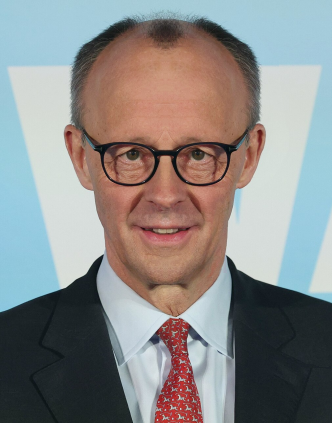
Friedrich Merz
 Germany
Birthday
November 11, 1955
Birth Sign
Scorpio
Birthplace
Brilon, North Rhine-Westphalia, Germany
Age
70 years old
Height
6 ft 6 in (198 cm)
About
Friedrich Merz is a German conservative politician and the current Chancellor of Germany. He is known for his sharp fiscal conservatism and pro-business stance, and he currently leads the Christian Democratic Union (CDU). After a significant career in business, Merz returned to politics and led the CDU to victory in the 2025 federal election, becoming chancellor. As chancellor, he champions economic deregulation, stricter immigration policies, and a stronger European defense. Merz is distinctive for his direct, combative style, often openly criticizing established foreign policies, including those of the United States, a stance that sets him apart from previous leaders. Fans and critics alike recognize him as someone who speaks his mind plainly on various political issues. His background in law and finance informs his approach to governance.
Early Life & Background
Joachim-Friedrich Martin Josef Merz was born on November 11, 1955, in Brilon, North Rhine-Westphalia, Germany. He grew up in Brilon, a small town nestled in the Sauerland region, within a conservative Catholic household. His father served as a judge, while his mother managed the home, instilling in young Merz a strong sense of discipline and a commitment to public service. This upbringing fostered an early interest in politics; at the age of 16, he formally joined the Young Union, the youth wing of the Christian Democratic Union (CDU), and regularly attended local party meetings, marking his first steps into the political arena.
After completing his secondary education, Merz graduated from Gymnasium Petrinum in 1975. He then fulfilled his military service with the Bundeswehr before embarking on his higher education. From 1976 to 1982, he pursued a law degree at the University of Bonn, a foundational period that would shape his professional trajectory. Demonstrating academic rigor, he successfully passed both state legal examinations by 1985. His initial professional experience included a brief stint as a judge at the Saarbrücken district court, which provided him with practical judicial insight. Subsequently, Merz transitioned into corporate law, where he quickly established a reputation for his sharp legal analysis and meticulous approach.
His dedication to public service and legal expertise converged in 1989 when Merz achieved his first elected office, securing a seat in the European Parliament. Representing the Sauerland region for five years, this experience proved invaluable, providing him with a deep understanding of the intricacies of European Union institutions. This significant parliamentary tenure ultimately laid the groundwork for his entry into the German Bundestag in 1994, marking a pivotal breakthrough in his political career.
Career Growth
Merz's breakthrough moment came in 2000 when he was elected chairman of the CDU/CSU parliamentary group at just 44. He quickly became the party's leading voice on financial policy, pushing for tax cuts and deregulation. But when Angela Merkel became CDU chairwoman later that year, a rivalry developed. By 2002, Merkel took over the parliamentary group leadership, and Merz stepped down as deputy leader in 2004. He left the Bundestag entirely in 2009, moving to the private sector as a senior counsel at Mayer Brown, specializing in mergers and acquisitions. He also served on the board of BlackRock Germany. After a decade away, he returned to politics in 2018, running for CDU chair twice before finally winning in December 2021. He assumed the leadership in January 2022 and led the opposition until the 2025 federal election, where the CDU/CSU won a plurality. On 6 May 2025, he was elected chancellor after two rounds of voting, a historic first. As chancellor, he has prioritized fiscal discipline, border security, and a hard line against the far-right AfD. In foreign policy, he initially championed NATO and the EU but has since shifted to openly criticize U.S. trade policies and advise against studying in America.
Career Timeline
Public Image & Style
Merz is seen as a wealthy, articulate, and often combative figure. His signature look is tailored suits, crisp white shirts, and a confident, sometimes stern expression. Media portrayals emphasize his corporate background, he is frequently labeled a "lobbyist" or "BlackRock man" by critics. His social media voice is formal and policy-focused, with posts about economic reforms and EU defense. There is no official fandom name, but supporters are called "Merz-Anhänger" (Merz supporters). Fan culture is minimal; he is a polarizing figure who inspires strong opinions rather than stan-like devotion. His directness, especially in criticizing the U.S., has won him admirers among those who want a more assertive Germany, but also drawn fire from those who see him as reckless.
Fame & Fandom (iFAMOUS Rankings)
The devotion surrounding Friedrich Merz is less about adoration and more about a shared, intense focus on the mechanics of power. His supporters, known as 'Merz-Anhänger', do not gather for autograph signings or birthday tributes; their engagement is defined by a deep, almost scholarly interest in his policy shifts and the sheer audacity of his governance style. There is no formal fandom name beyond this descriptor, nor are there rituals of fanfare, because the audience here treats political leadership as a high-stakes sport where every cabinet reshuffle or foreign policy pivot is analyzed with the intensity usually reserved for a season finale. The narrative is built on documented turbulence rather than folklore, with fans tracking the evolution of his chancellorship from the 2025 victory through the complex geopolitical maneuvers of 2026. This unique dynamic positions him as a figure of serious consequence rather than pop culture ubiquity, yet his reach remains formidable across the nation. His standing reflects a broad recognition that transcends party lines, marking him as a central pillar of modern German public life. According to the latest data from the iFANN Global Fame Rankings, he holds significant positions among the most recognized figures globally. He is currently the 10th most famous person in Germany, holding steady from the previous cycle. In terms of origin, he ranks as the 18th most famous person from Germany. Within his specific sector, he stands as the 74th most famous person in Politics. These placements confirm his status as a dominant force whose influence is measured by global attention to media coverage, search trends, and consumption signals worldwide.
Interesting Facts and Legends
Fans often marvel at the striking contrast between Merz's stern political image and his private leisure pursuits. A dedicated pilot since the 1990s, he owns two airplanes and remains an avid hunter, holding membership in the German Hunting Association. His physical presence is equally memorable; standing at 1.98 meters, he towers over colleagues, earning him the insider nickname 'der schwarze Riese' (the black giant) due to his height and the CDU's traditional color. Before entering full-time politics, he served as a judge at the Saarbrücken district court but departed after finding the pace too slow. He has also authored several policy books, including Mehr Verantwortung für Deutschland. The lore surrounding his tenure is defined by documented political turbulence rather than folklore. Stories from mid-2026 highlight a period of intense instability, including a major cabinet reshuffle in July where he appointed Germany's first woman chief of staff to counter far-right advances. Perhaps the most controversial chapter involves a August 2026 deal with the Taliban regarding deportations, a move that shocked Afghan dissidents and sparked debate among his own supporters. Additionally, the June 2026 decision to back raising the statutory retirement age to 70 became a defining moment of contention within his administration, illustrating a leader navigating complex geopolitical pressures and internal dissent.
Notable Quotes
“We need a clear policy for the future of Germany – one that is based on performance and responsibility, not on the state providing everything.”
“The United States is no longer the reliable partner we once knew. I advise young Germans to think twice before studying or working there.”
“I am not a populist. I say what I think, and I think what I say.”
Family & Personal Life
Merz married Charlotte Gass, a judge, in 1981. The couple has three children: two sons and a daughter. Charlotte has largely stayed out of the political spotlight, though she occasionally accompanies him to official events. Merz's father was a judge, and his mother was a homemaker, both instilled in him a strong sense of duty and Catholic values. He has a younger brother, though little is known about him publicly. The family lived in Brilon for many years before moving to Berlin after Merz's return to politics. They keep a low profile, and Merz rarely discusses his home life in interviews.
Notable Connections
Merz's political career has been defined by his rivalry with Angela Merkel, who outmaneuvered him for party leadership in the early 2000s. He succeeded Armin Laschet as CDU leader in 2022. His chancellorship has seen close cooperation with Markus Söder, the CSU leader. His predecessor as chancellor, Olaf Scholz, leads the SPD coalition partner.
Relationships & Dating History
Merz married Charlotte Gass, a judge, in 1981. The couple has been together for over four decades, with no public records of any other relationships. Charlotte has maintained a low profile, focusing on her judicial career and raising their three children. Their marriage is considered stable and private. As of 2026, Merz remains married to Charlotte.
- MarriedCharlotte Merz1981 - presentCurrentMerz married Charlotte Gass, a judge, in 1981. They have three children together.
Salary, Net Worth In 2026
$15 Million
iFANN Editorial Team estimate
iFANN currently estimates Friedrich Merz's net worth at $15 Million as of 2026. This substantial fortune was primarily accumulated during his decade-long tenure in the private sector between 2009 and 2018, where he reportedly earned between $1 million and $2 million annually while working at Mayer Brown. His financial portfolio expanded further through board memberships, notably serving on the board of BlackRock Germany, which added significant income streams alongside his legal career. As the current Chancellor of Germany, he draws an annual salary of approximately €300,000 ($330,000). Beyond his professional earnings, Merz maintains a diverse investment strategy that includes real estate holdings and active participation in financial markets. His ownership of two airplanes serves as both a hobby and a tangible asset within his broader wealth structure.
Awards & Accolades
View 1 records, honours and achievementsKnown For
Chancellor of Germany
2025 · Chancellor
CDU Chairman
2022 · Chairman
Chairman of CDU/CSU Parliamentary Group
2000 · Chairman
Keywords
Quick Facts
- Profession
- politician
- Born
- +1955-11-11
- Birthplace
- Brilon, North Rhine-Westphalia, Germany
- Gender
- Male
- Spouse
- Charlotte Merz
- Birth Sign
- Scorpio
Personal Details
- Full Name
- Joachim-Friedrich Martin Josef Merz
- Height
- 6 ft 6 in (198 cm)
- Spouse
- Charlotte Merz
- Children
- 3 (two sons, one daughter)
- Education
- University of Bonn (law degree)
Frequently Asked Questions
How old is Friedrich Merz?
Is Friedrich Merz married?
What is Friedrich Merz's net worth in 2026?
What is Friedrich Merz's height?
Does Friedrich Merz have children?
Similar People
Join the community
fans discussing