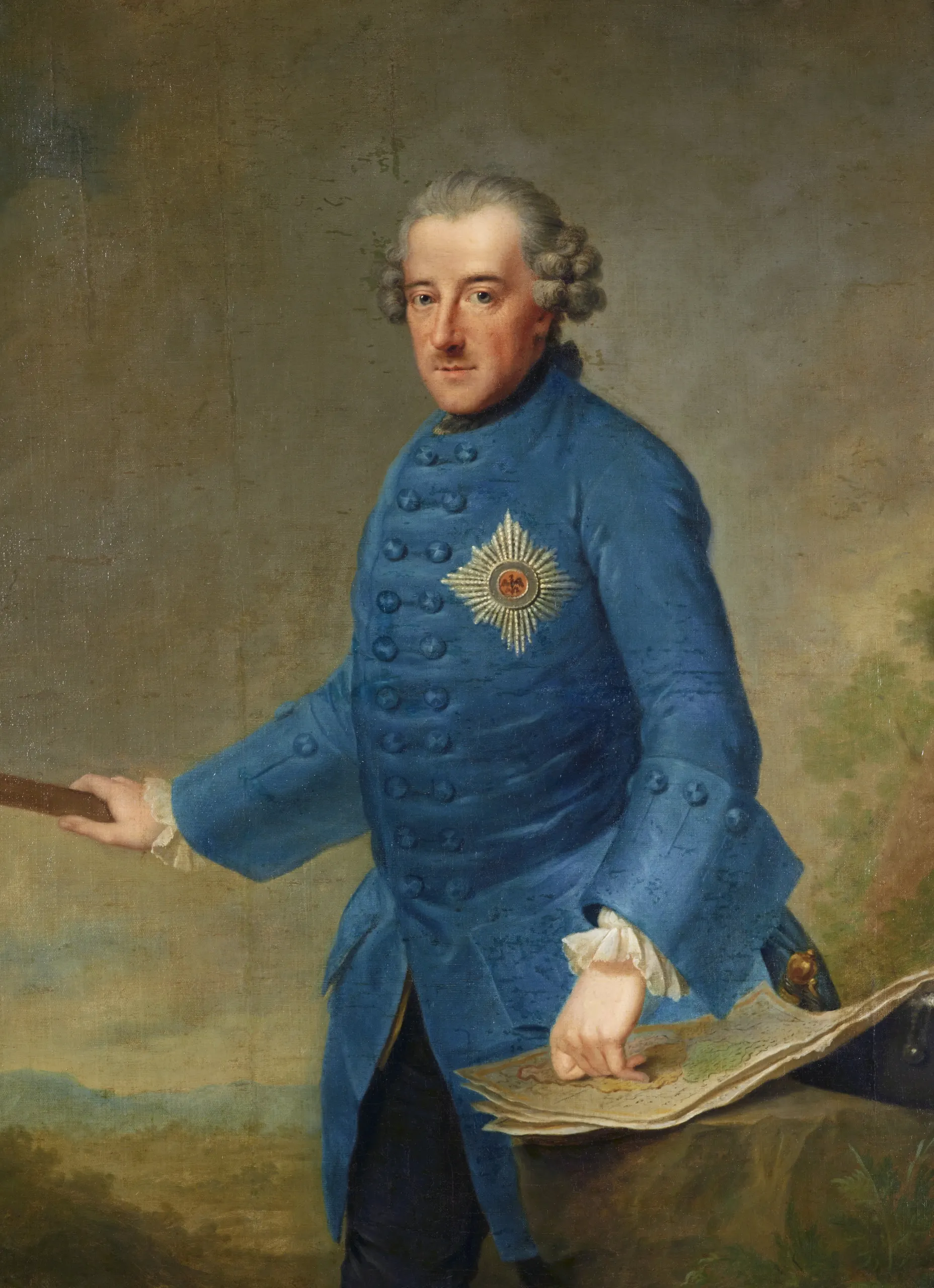
Frederick II of Prussia
 Germany
monarch•military commander•philosopher•composer
Also known as: Frederick the Great, The Old Fritz, Frederick II, Father Fritz
Birthday
January 24, 1712
Birth Sign
Sagittarius
Birthplace
Berlin, Kingdom of Prussia
Age
Died at 74
Height
5 ft 9 in (1.75 m)
About
Frederick II of Prussia, universally known as Frederick the Great (German: Friedrich der Große), stands as one of Europe's most transformative monarchs and a central figure of the Enlightenment. Born on January 24, 1712, in Berlin, he ascended to the throne in 1740 at age 28 and ruled until his death on August 17, 1786. A member of the House of Hohenzollern, he is celebrated for elevating Prussia from a regional power to a major European force through military genius, administrative reform, and cultural patronage. He was the third King in Prussia and the first to hold the title "King of Prussia" after the incorporation of Royal Prussia in 1772.
His legacy endures as the archetype of the "Enlightened Absolutist," combining absolute power with progressive ideals such as religious tolerance and meritocracy. Frederick reorganized the Prussian bureaucracy, modernized the legal system, and famously stated that every man must go to heaven in his own way. He transformed Prussia into a cultural hub, inviting Voltaire to his court and building the Sanssouci Palace in Potsdam as a refuge for philosophy and music. His reign saw significant territorial expansion, including the retention of Silesia against overwhelming odds during the Seven Years' War and the annexation of territories in the First Partition of Poland. He remains a defining figure of 18th-century history, noted for his intellectual depth, musical virtuosity, and strategic brilliance.
Early Life & Background
Frederick was born Prince Frederick William of Prussia at the Berliner Stadtschloss in Berlin as the second child of Crown Prince Frederick William and Sophia Dorothea of Hanover. His early life was defined by a profound conflict with his father, a stern militarist who despised Frederick's intellectual interests in music, philosophy, and French literature. The tension culminated in the "Kronprinzenzeit," where Frederick attempted to flee to England in 1730 with his friend Hans Hermann von Katte. The attempt failed, leading to Katte's execution in front of Frederick and Frederick's imprisonment in Küstrin fortress. This traumatic event hardened Frederick but did not extinguish his passion for the arts or governance.
Before his rise to global prominence, he had already established himself as a skilled flutist and composer, writing over 100 sonatas. He spent much of his time in the gardens of Rheinsberg, composing music and reading works by Voltaire, laying the groundwork for his future reign as a patron of the arts and sciences. Upon his accession in 1740, he immediately reversed his father's isolationist policies, opening Prussian borders to immigrants and philosophers. His early years were spent navigating the strict Prussian court culture, where he often felt stifled by the rigid expectations of his upbringing. He spoke French better than German and preferred writing in French, even issuing official decrees in the language.
Career Growth
Frederick's career began with immediate military aggression. In December 1740, just months into his reign, he invaded the wealthy Austrian province of Silesia, sparking the War of the Austrian Succession. This campaign established his reputation as a brilliant tactician. He successfully defended Silesia against Austria, France, and Sweden in the First Silesian War (1740–1742) and the Second Silesian War (1744–1745). His most defining achievement was the Seven Years' War (1756–1763), often considered the world's first "world war." Facing a coalition of Austria, France, Russia, and Saxony, Frederick nearly lost his kingdom multiple times. Through decisive victories at Rossbach and Leuthen and the "Miracle of the House of Brandenburg," he survived the odds and retained Silesia.
Beyond warfare, Frederick reorganized the Prussian bureaucracy, modernized the legal system, and promoted religious tolerance. He also transformed Prussia into a cultural hub, inviting Voltaire to his court and building the Sanssouci Palace in Potsdam as a refuge for philosophy and music. Under his leadership, Prussia expanded significantly, annexing territories in the First Partition of Poland (1772). He founded the Prussian Academy of Sciences in 1744, appointing himself president, and revived the Order of the Black Eagle as the highest order of chivalry. During the Seven Years' War, he ordered the seizure of the Meissen porcelain factory to secure luxury goods for his palaces while conflict raged elsewhere. His reign ended in 1786, leaving behind a state that was a major European power.
Career Timeline
Public Image & Style
Frederick is portrayed as the archetype of the "Enlightened Absolutist," a ruler who combined absolute power with progressive ideals. Modern media often depicts him as a complex figure: a brilliant strategist, a musical genius, a philhellene, and a controversial figure regarding his sexuality and imperial expansionism. He was known for wearing a simple blue uniform with a tricorn hat, often without a wig, reflecting his disdain for frivolity and preference for practicality. Standing approximately 5 feet 9 inches tall, he was physically imposing yet described as slender and athletic in his youth before becoming gaunt due to illness. His public persona was that of a philosopher-king who valued reason and merit over birthright, yet he remained a ruthless conqueror when it suited his strategic goals.
Fame & Fandom (iFAMOUS Rankings)
Frederick II of Prussia commands a global attention that spans centuries, maintaining a distinct presence in modern cultural memory despite his death nearly two and a half centuries ago. In the September 2026 cycle of the iFANN Global Fame Rankings, he holds specific standing among historical figures. He is currently the 95th most famous person from Germany, down from 94th last cycle. Within the specialized sphere of creative history, he ranks as the 55th most famous person in Art & Design, holding steady against contemporaries. These placements reflect a legacy that transcends simple historical record to occupy a space in contemporary recognition. While no organized fanbase with a formal name exists for an eighteenth-century monarch, his audience consists of historians, museum visitors, and general enthusiasts who engage with his life through scholarship rather than active campaigning. The absence of a dedicated fandom structure does not diminish his reach; instead, it underscores the nature of his fame as a static, authoritative force within the canon of European history.
Interesting Facts and Legends
Frederick II banned coffee in Prussia to promote domestic beer production, a unique economic strategy distinct from mere personal preference. During the Seven Years' War, he ordered the seizure of the Meissen porcelain factory to secure luxury goods for his palaces while conflict raged elsewhere. He spoke French better than German and preferred writing in French, even issuing official decrees in the language. A persistent legend claims he introduced the potato to Germany and forced its cultivation to prevent starvation, a story widely retold though historically inaccurate. Despite being apocryphal, this narrative remains so potent that tourists continue to leave raw potatoes on his grave at the New Church in Potsdam as a ritualistic tribute. Modern re-evaluations have occasionally characterized him with descriptors like "Frederick the Gay," reflecting shifting perspectives on his personal life. He composed over 100 sonatas for the flute, often playing with musicians like Quantz.
Notable Quotes
“I am the first servant of the state.”
“All religions must be tolerated... for in this country every man must go to heaven in his own way.”
“A prince should be the first soldier of his nation.”
Family & Personal Life
Frederick was the second child of Crown Prince Frederick William and Sophia Dorothea of Hanover. His relationship with his father was notoriously strained, marked by physical abuse and ideological clashes. He married Elisabeth Christine of Brunswick-Wolfenbüttel-Bevern in 1733, an arranged political union that was never consummated. They had no children. Elisabeth Christine was described as dutiful but intellectually mismatched with the king. Frederick remained celibate throughout his marriage, though historical records suggest he maintained long-term relationships with men, including his brother-in-law Leopold, Duke of Anhalt-Dessau, and later, his close confidant Adam Ludwig Orlow. He was succeeded by his nephew, Frederick William II.
Notable Connections
Relationships & Dating History
Frederick II was married once, to Elisabeth Christine of Brunswick-Wolfenbüttel-Bevern, on June 12, 1733. Their marriage was arranged by his father and was never consummated. Elisabeth Christine was described as dutiful but intellectually mismatched with the king. They had no children. Frederick remained celibate throughout his marriage, though historical records and modern scholarship suggest he maintained long-term relationships with men, including his brother-in-law Leopold, Duke of Anhalt-Dessau, and later, his close confidant Adam Ludwig Orlow. Unlike modern celebrities, Frederick's "dating history" consists of documented friendships and rumored liaisons common among 18th-century aristocracy. There were no public engagements, breakups, or divorces in the modern sense. As of the end of his life in 1786, he was widowed.
- MarriedElisabeth Christine of Brunswick-Wolfenbüttel-Bevern1733 - 1786Arranged political union; never consummated; no children.
- RumouredLeopold, Prince of Anhalt-Dessau1730 - 1740Rumored intimate relationship during Frederick's youth; some historians view this as a deep platonic bond.
- RumouredAdam Ludwig Orlow1740 - 1750Close companion and potential lover; shared a bed for periods during travels.
Death & Aftermath
Died
August 17, 1786 (aged 74)
Death Place
Potsdam, Brandenburg, Germany
Cause of Death
Intestinal obstruction and gangrene
Frederick II died on August 17, 1786, at the age of 74 within the walls of his beloved summer residence, Sanssouci Palace in Potsdam. His final days were marked by severe abdominal pain and constipation that began on August 9, leading to a rapid deterioration. Attending physicians, including Dr. Johann Georg Zimmermann, diagnosed an intestinal obstruction or gangrene resulting from chronic digestive ailments, though some contemporary accounts suggested liver failure or a ruptured appendix. Despite the physical agony, he remained conscious and composed until the end, reportedly listening to music and receiving courtiers.
The late monarch requested a modest funeral, rejecting traditional royal grandeur. On August 21, 1786, he was buried in the private crypt beneath the Orangerie colonnade at Sanssouci rather than in the royal mausoleum. His successor, his nephew Frederick William II, honored these wishes but quietly consolidated the vast estates without legal challenge. Posthumously, Frederick became the subject of immense legend, particularly the "Potato King" myth where tourists continue to leave raw potatoes on his grave as a tribute to the apocryphal story that he forced Germans to cultivate potatoes to prevent famine.
Net Worth (Estate Value)
$0
iFANN Editorial Team estimate
As a deceased historical figure, Frederick II does not have a personal net worth in the modern sense. However, the value of his estate and legacy is substantial. The Prussian state assets accumulated under his rule formed the basis of the German Empire's wealth. Today, the physical assets he owned, such as the Sanssouci Palace complex and the Potsdam palaces, are managed by the Stiftung Preußische Schlösser und Gärten Berlin-Brandenburg (Prussian Palaces and Gardens Foundation Berlin-Brandenburg). These sites generate significant revenue through tourism. Ticket sales, merchandise, and licensing of IP rights related to his life and works contribute to the foundation's annual income. Biographies, films, and documentaries continue to generate royalties. The iFANN Editorial Team estimates the current value of his estate and associated cultural assets at approximately $0, as the concept of personal net worth does not apply to historical monarchs whose assets are now state-managed heritage sites.
Awards & Accolades
View 9 records, honours and achievementsKnown For
Seven Years' War
1756 · Commander
Silesian Wars
1740 · Monarch
Sanssouci Palace
1745 · Builder
Keywords
Sources
Quick Facts
- Profession
- ruler, art collector, monarch
- Born
- January 24, 1712
- Birthplace
- Berlin
- Died
- August 17, 1786
- Death Place
- Potsdam
- Gender
- Male
- Spouse
- Elisabeth Christine of Brunswick-Wolfenbüttel-Bevern
- Birth Sign
- Sagittarius
Personal Details
- Full Name
- Prince Frederick William of Prussia
- Height
- 5 ft 9 in (1.75 m)
- Spouse
- Elisabeth Christine of Brunswick-Wolfenbüttel-Bevern
- Children
- Education
- Home tutoring by French tutors; self-study in philosophy and music
Frequently Asked Questions
Who was Frederick the Great?
Did Frederick the Great have children?
Why do people leave potatoes on Frederick the Great's grave?
What was Frederick the Great's cause of death?
Was Frederick the Great gay?
Social Media
Similar People
Join the community
fans discussing