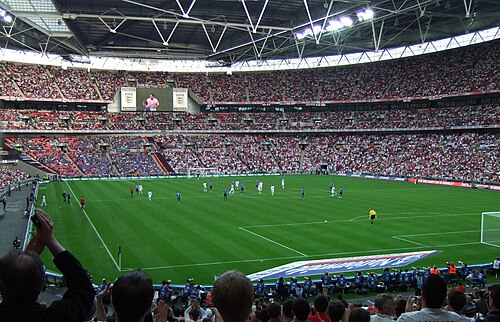
Football in England
 United Kingdom
"The birthplace of modern association football and a global sporting ecosystem."
About
England serves as the foundational ground for modern association football, transforming from medieval folk games into a codified sport that now dominates global culture. The pivotal moment arrived on October 26, 1863, when delegates from London clubs and schools convened at the Freemasons' Tavern to establish the first official rules. This gathering created The Football Association, the world's oldest national governing body, and formally separated "association football" from rugby codes. That single meeting laid the groundwork for an intricate pyramid system that continues to define how the game is played and organized today.
The structure of English football operates as a multi-layered network anchored by two primary entities: The FA and the Premier League. While The FA functions as a non-profit membership organization overseeing grassroots development, national teams, and domestic cups like the FA Cup, the Premier League acts as a commercial powerhouse managing the top tier of professional play. Together they form a self-sustaining ecosystem where promotion and relegation allow movement between tiers, creating a dynamic environment where local clubs can theoretically rise to the highest level.
Cultural significance permeates every aspect of the sport within the nation. Over 40,000 registered clubs participate across the country, making it the most popular sport by a wide margin. The industry generates billions in revenue annually through broadcasting rights, commercial partnerships, and matchday attendance. Recent years have seen a surge in investment and visibility for women's football, with the national team achieving historic success in major tournaments while the men's side navigates high-stakes international competition and tactical evolution under new management.
Mission
The overarching purpose of the English football ecosystem is to govern, develop, and promote the sport at all levels. The governing bodies aim to ensure competitive integrity, manage national representation, and foster widespread participation from youth academies to senior amateur leagues. Commercial entities focus on maximizing the financial value of the top tier while maintaining sporting standards and accessibility for fans across the globe.
History
The origins of organized football trace back to the mid-19th century when various regional codes existed in isolation. On October 26, 1863, representatives met at the Freemasons' Tavern in Great Queen Street to unify these differences. They formed The Football Association and published the first set of standardized laws, effectively birthing "association football." This event distinguished the game from rugby and provided the blueprint for international play.
Structural evolution continued rapidly with the establishment of the English Football League in 1888 by William McGregor. This innovation introduced a formal league system with 12 founding clubs, creating a model for professional competition that spread globally. The FA Cup followed shortly after in 1871, becoming the world's oldest knockout competition. These institutions created a stable framework that allowed the sport to grow from a pastime into a major industry.
The 20th century brought significant shifts, including the formation of the Premier League in 1992. Top clubs broke away from the Football League to negotiate their own television deals, resulting in a massive financial boom. The era also saw England reach its peak on the international stage with the 1966 World Cup victory at Wembley. Modern developments include the professionalization of women's football and the implementation of stricter safety regulations following the Hillsborough disaster in 1989.
Subdivisions
Premier League
Top-tier professional league comprising 20 clubs.
English Football League
Manages the Championship, League One, and League Two divisions.
National League
Fifth tier of the pyramid containing 20 clubs.
Women's Super League
Top division of women's football fully integrated into the FA structure.
Notable People
Stanley Matthews
Player · 1930s-1960s
Legendary winger known for skill and longevity, named after him in the FA's code of conduct.
Bobby Charlton
Player · 1950s-1970s
Key figure in England's 1966 World Cup victory and Manchester United legend.
Harry Kane
Player · 2011-Present
All-time leading goalscorer for the England national team.
Sarina Wiegman
Manager · 2021-Present
Led the England Women's team to UEFA Euro 2022 victory.
Alf Ramsey
Manager · 1963-1974
First manager to win the FIFA World Cup with England in 1966.
Milestones
1863
Formation of The Football Association and codification of the first rules.
1871
Inception of the FA Cup, the world's oldest national cup competition.
1888
Founding of the English Football League, the first professional league system.
1966
England wins the FIFA World Cup at Wembley Stadium.
1992
Creation of the Premier League, separating from the Football League for commercial independence.
2022
England Women win the UEFA Women's Euro 2022 on home soil.
Sources
Organization Info
- Founded
- October 26, 1863
- Headquarters
- Wembley Stadium, London (The FA); One North Wharf, Paddington, London (Premier League)
- Country
- United Kingdom
- Chief Executive Officer (Premier League) / Chairman (The FA varies)
- Richard Masters
- Type
- Other
- Birthplace of Modern Football
- Yes
- Registered Clubs
- Over 40,000
- Oldest Governing Body
- The Football Association (1863)
- Top Tier Teams
- 20 (Premier League)
- World Cup Wins
- 1 (1966)
Financials
- Revenue
- £6 billion+ (Premier League annual turnover)
- Employees
- Several hundred direct staff at headquarters; thousands employed across the wider industry
Official Website
www.englandfootball.com/
Join the community
fans discussing