 United States
“A delightful bit of fantasy, beautifully colored and animated. The flowers and trees are given human characteristics in a most engaging manner.”
Mordaunt Hall
The New York Times
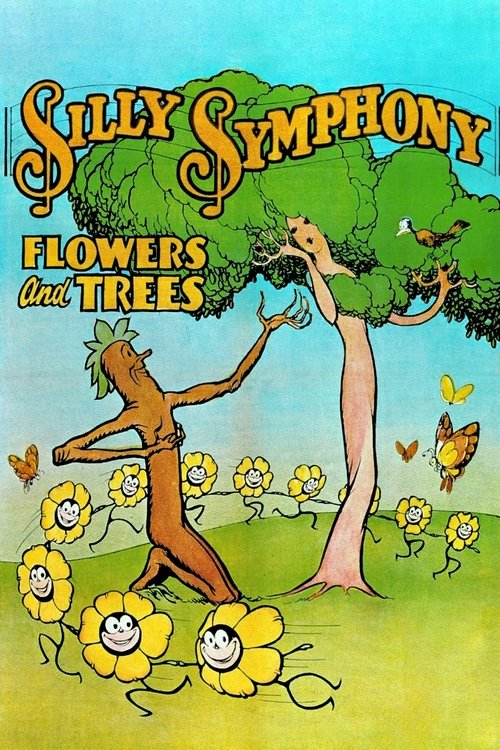
Flowers and Trees is a landmark animated short from Walt Disney Productions that made history as the first commercially released film to use three-strip Technicolor. Released on July 30, 1932, the eight-minute Silly Symphony tells a simple fable of love and jealousy set in a vibrant forest. Its groundbreaking color process, which Disney initially shot in black and white before re-animating, stunned audiences and critics alike, winning the first Academy Award for Best Animated Short.
The short features anthropomorphic trees and flowers brought to life with fluid animation and a classical score built around Schubert's Marche Militaire. While the plot is straightforward, the film's technical achievement transformed the animation industry. Disney took a financial risk by scrapping the original black-and-white version and spending $15,887 on the color redo, a gamble that paid off when the short became a critical and commercial sensation.
Voiced by Disney regulars including Pinto Colvig and Walt Disney himself, the characters are charming but secondary to the visual spectacle. The film's success convinced Disney to produce all subsequent Silly Symphonies in color and influenced rival studios to adopt the technology. Today it is preserved in the National Film Registry and remains a cornerstone of animation history.
Availability and pricing can change. Confirm on the provider's site before purchasing.
In a magical forest on a spring morning, the sun rises over a landscape of blooming flowers, mushrooms, and trees. Two anthropomorphic trees, one male and one female, emerge from their slumber and immediately notice each other. They begin a graceful courtship, swaying and intertwining their branches as the forest creatures watch with delight. Birds chirp, butterflies flutter, and smaller plants dance around them, celebrating the budding romance.
The idyllic scene is shattered by a gnarled, evil tree stump that lurks nearby. Consumed by jealousy, the stump plots to destroy the couple's happiness. It uses a spark from a rock to ignite a fire, which quickly spreads through the dry underbrush. Flames leap from tree to tree, sending the forest into panic. Birds take flight, squirrels scramble, and the flowers wilt as smoke fills the air. The male tree tries to shield his beloved, but the fire surrounds them, cutting off escape.
The evil stump cackles as the blaze grows, but the male tree refuses to give up. He signals to the clouds, and dark thunderheads begin to gather. Rain starts to fall, first in droplets, then in a downpour that douses the flames. The forest is saved, and the evil stump is washed away or destroyed. With the danger past, the surviving flora and fauna gather for a celebration. Mushrooms form a procession, flowers arrange themselves into a bridal path, and birds sing a wedding march. The two trees are joined in matrimony, their branches forming a heart shape as the forest rejoices. The short ends with the happy couple surrounded by dancing plants, a testament to love's triumph over malice.
Critical Consensus
Flowers and Trees is a historic milestone in animation, being the first commercially released film to use three-strip Technicolor. While its plot is simple, its vibrant colors and charming characters revolutionized the industry and remain delightful nearly a century later.
“A delightful bit of fantasy, beautifully colored and animated. The flowers and trees are given human characteristics in a most engaging manner.”
Mordaunt Hall
The New York Times
“The color is remarkably effective, and the animation is of the highest order. Disney has again demonstrated his mastery of the short form.”
Variety Staff
Variety
“A landmark film that proved Technicolor could be used to magical effect in animation. It remains a charming, simple story of love and jealousy.”
Leonard Maltin
The Disney Films
“A primitive but charming precursor to Disney's later features. The color is stunning even by today's standards.”
Dave Kehr
The Chicago Reader
“Watching Flowers and Trees is like seeing the birth of a new art form. The colors are so vivid they seem to leap off the screen.”
Roger Ebert
Chicago Sun-Times
Clarence Nash
Birds (voice) (uncredited)
Esther Campbell
(voice) (uncredited)
Marion Darlington
(voice) (uncredited)
Pinto Colvig
Evil Hollow Tree (voice) (uncredited)
Walt Disney
Owl Sirens (voice) (uncredited)
Director
Burt Gillett
Producer
Walt Disney
Academy Award for Best Short Subject (Cartoon) (1932)
Best Short Subject (Cartoon): Won
Academy Honorary Award (1932)
Special Plaque: Won
Join the community
fans discussing