“A delightful, low-key sci-fi adventure that prioritizes heart over spectacle, with a winning performance from young Joey Cramer.”
Roger Ebert
Chicago Sun-Times
 United States
"He was lost in space for eight years. He's just trying to get home for dinner."
User Score
960 votes
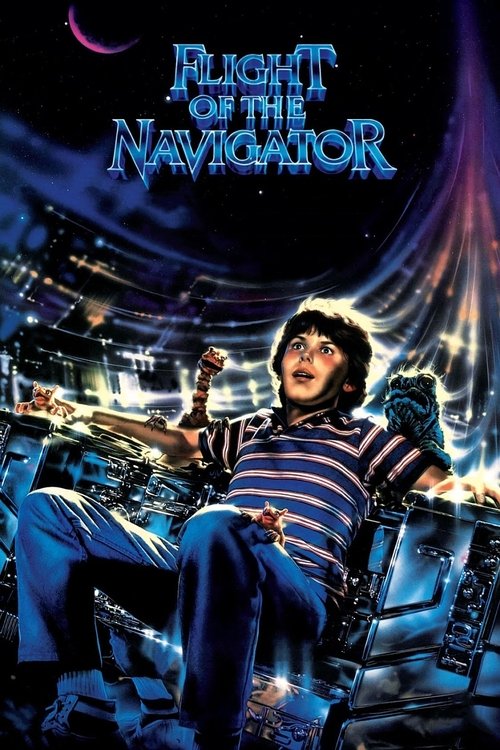
In the summer of 1978, twelve-year-old David Scott Freeman disappears into the Florida woods after chasing his younger brother. Eight years later, he stumbles out of the same forest, still twelve, with no memory of where he's been. His family has aged, his hometown has changed, and NASA is very interested in the untapped star charts buried in his brain. Directed by Randal Kleiser, fresh off Grease, this 1986 Disney-distributed adventure stars Joey Cramer as David and features an early voice performance from Paul Reubens as Max, the wisecracking alien ship computer.
What sets Flight of the Navigator apart from other mid-80s kid sci-fi is its emotional grounding. David isn't an orphan or a chosen one; he's just a regular kid with a loving family who gets caught up in an extraordinary situation. The film doesn't rush to spectacle. Instead, it lets the mystery of David's missing years sink in, showing the quiet grief of his parents and the awkwardness of his younger brother now being older than him. The special effects, including some of the earliest CGI in a feature film, hold up surprisingly well, but it's the heart that keeps viewers coming back.
Produced on a $9 million budget, the film grossed $18.5 million worldwide, a modest return that didn't stop it from becoming a beloved cult classic. It's often grouped with E.T. and Explorers, but its focus on homesickness and identity gives it a distinct flavor. For many who grew up in the 80s, it's not just a movie; it's a formative memory. The score by Alan Silvestri, hot off Back to the Future, adds a sweeping warmth that's become iconic in its own right.
Stream
Availability and pricing can change. Confirm on the provider's site before purchasing.
July 4, 1978. Fort Lauderdale is buzzing with fireworks and barbecue smoke. Twelve-year-old David Scott Freeman, a typical kid with a paper route and a crush on the girl next door, is sent to find his little brother Jeff, who's wandered into the woods. In the deep shadows of the trees, David encounters a blinding white light and a strange hum. He passes out, and when he wakes, he's still in the forest, but something feels off. The air is different, the trees seem older. He walks home to find his house still there, but his family is not the same. His mother, Helen, has gray hair and lines on her face. His father, Bill, looks worn. And his little brother Jeff is now a lanky sixteen-year-old who towers over him. The year, they tell him, is 1986. Eight years have passed, but David hasn't aged a day.
David's return makes headlines, and soon NASA comes calling. Dr. Louis Faraday, a pragmatic scientist played by Howard Hesseman, notices that when David is hooked up to an EEG, his brainwaves project images of a spacecraft and star maps. The same craft, a sleek silver saucer, crashed through a power grid and is now hidden at a NASA research facility. Faraday convinces David to come to the facility for 48 hours of tests, promising answers. At first, David is hopeful, but the tests become invasive. Scientists like Dr. Carr and the cold Dr. Jenkins treat him more like a specimen than a boy. They probe his mind, extracting star charts and coordinates, including references to a planet called Phaelon, over 500 light-years away. David feels trapped, a lab rat in a government maze.
The breakthrough comes when David sneaks into the hangar where the saucer is stored. The ship's artificial intelligence, Max, wakes up. Max is voiced with a manic, playful energy by Paul Reubens, who was credited as Paul Mall to avoid association with Pee-wee Herman. Max explains that Phaelonian scientists sent the ship to collect life samples from various planets. David was chosen as Earth's specimen. When the Phaelonians learned that humans use only a fraction of their brain capacity, they filled the rest with star charts for their research. The ship's crash into power lines corrupted its memory, and now David's brain holds the only complete copies of the navigation data. Max needs David's help to get home.
David seizes the chance to escape NASA and boards the ship. Max, a chatterbox with a childlike curiosity, becomes an unlikely friend. Together, they fly out of the hangar, dodging military jets and leaving a stunned Dr. Faraday behind. As they soar into space, David is awestruck by the view of Earth from orbit. Max explains the physics of faster-than-light travel in simple terms: the ship bends space, and time slows down for the traveler. That's why David didn't age. For him, the abduction felt like minutes; for Earth, it was eight years.
Max offers David the ultimate adventure: to travel to Phaelon and see the galaxy. It's tempting, a dream come true for any kid. But David's thoughts keep drifting back to his family, to his mother's tears and his father's tired eyes. He realizes that if he stays in 1986, he'll never be a kid again. His parents have already mourned him; his brother has grown up without him. The only way to reclaim his life is to go back to 1978, to the moment he disappeared, and undo it all. Max is reluctant to lose his only friend, but he understands. The ship's navigation data is still incomplete, but David's brain holds the key. They set a course for the exact time and place of the abduction, hoping they can thread the needle of the space-time continuum.
Flight of the Navigator (1986) - HD Trailer
Flight Of The Navigator
Critical Consensus
A charming and underrated family sci-fi adventure that blends genuine emotion with a sense of wonder. Joey Cramer's earnest performance and the witty AI Max make it a nostalgic favorite, even if the plot occasionally feels thin.
“A delightful, low-key sci-fi adventure that prioritizes heart over spectacle, with a winning performance from young Joey Cramer.”
Roger Ebert
Chicago Sun-Times
“Flight of the Navigator is a rare kids' film that treats its young protagonist with respect, letting the wonder and the fear coexist.”
Janet Maslin
The New York Times
“The special effects may be dated, but the movie's charm is timeless. Max is one of the most memorable movie AIs ever.”
Kim Newman
Empire
Joey Cramer
David Scott Freeman
Paul Reubens
Max (voice)
Veronica Cartwright
Helen Freeman
Cliff DeYoung
Bill Freeman
Sarah Jessica Parker
Carolyn McAdams
Matt Adler
Jeff (16 years)
Howard Hesseman
Dr. Louis Faraday
Robert Small
Troy
Jonathan Sanger
Dr. Carr
Richard Liberty
Mr. Howard
Raymond Forchion
Detective Banks
Cynthia Caquelin
Woman Officer
Director
Randal Kleiser
Writers
Mark H. Baker, Michael Burton, Matt MacManus
Composer
Alan Silvestri
Cinematographer
James Glennon
Producers
David Joseph, Dimitri Villard, Robert Wald
Join the community
fans discussing